
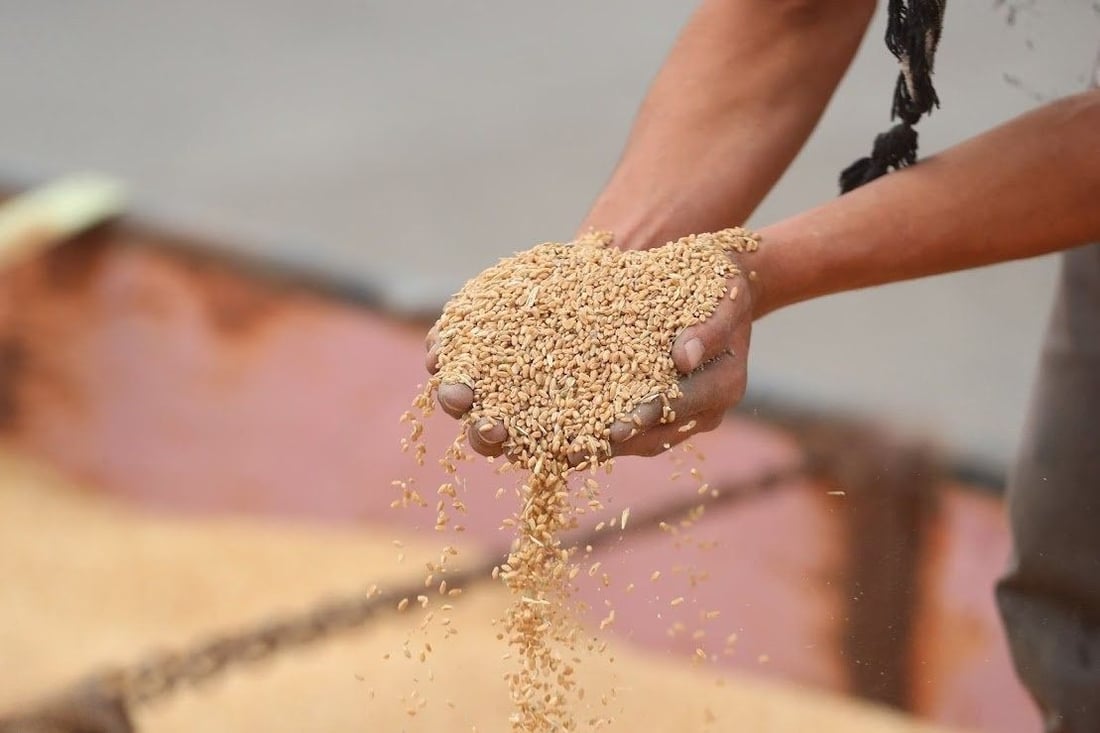
A worker handles wheat grains during collection at a storage site in Iraq, as the country’s wheat marketing season continues with over 2 million tons received so far.
According to ministry
Iraq ends wheat season with over 5.1 million tons, maintains self-sufficiency for third year
BAGHDAD — Iraq’s Ministry of Agriculture on Tuesday announced the close of the 2025 wheat marketing season, reporting total production of more than 5.1 million tons and marking the country’s third consecutive year of wheat self-sufficiency.
At a ceremony at the ministry’s headquarters in Baghdad’s Karrada district, Agriculture Minister Abbas Jabr al-Maliki credited coordination among government institutions for overcoming persistent climate and water challenges.
“We have had three successful agricultural seasons during which the ministry achieved self-sufficiency, even recording surpluses in wheat production,” al-Maliki said.
Wheat is one of Iraq’s most heavily subsidized crops. The federal government sets purchase prices above global market rates and buys large quantities directly from farmers each year to bolster domestic production and reduce import dependency.
According to al-Maliki, Iraq produced 5 million tons of wheat in 2023, followed by 6.3 million tons in 2024 and 4.7 million tons in 2025. Including contributions from the Kurdistan Region, the total this year surpassed 5.1 million tons.
Al-Maliki thanked ministry staff, provincial agriculture directorates, and other government agencies, including the Ministry of Water Resources and the National Security Service, for their roles in supporting the sector.
The minister acknowledged Iraq’s ongoing water crisis, calling current drought conditions the most difficult the country has faced in decades. “That’s why we shifted focus to desert lands,” he said, referencing a 1931 benchmark mentioned by the water resources minister as the beginning of Iraq’s water woes.
To address irrigation challenges, al-Maliki said the ministry had allocated 250 billion dinars (roughly $178 million) for irrigation technology projects, including the reactivation of a $30 million Austrian loan that had been frozen since 2020. An additional 100 million dinars (approximately $71,000) was designated for emergency support.
The ministry also spent more than $4 million on pivot irrigation systems and introduced incentives to encourage modern irrigation methods: 250,000 dinars ($178) per ton for wheat grown with sprinklers and 200,000 dinars ($143) per ton for wheat irrigated by rivers.
“This success is the result of collective work by the ministry and its team,” al-Maliki said. “We maintained price stability despite the global food crisis, proving the value of relying on domestic production and our ability to maintain a strategic reserve for any emergency.”