
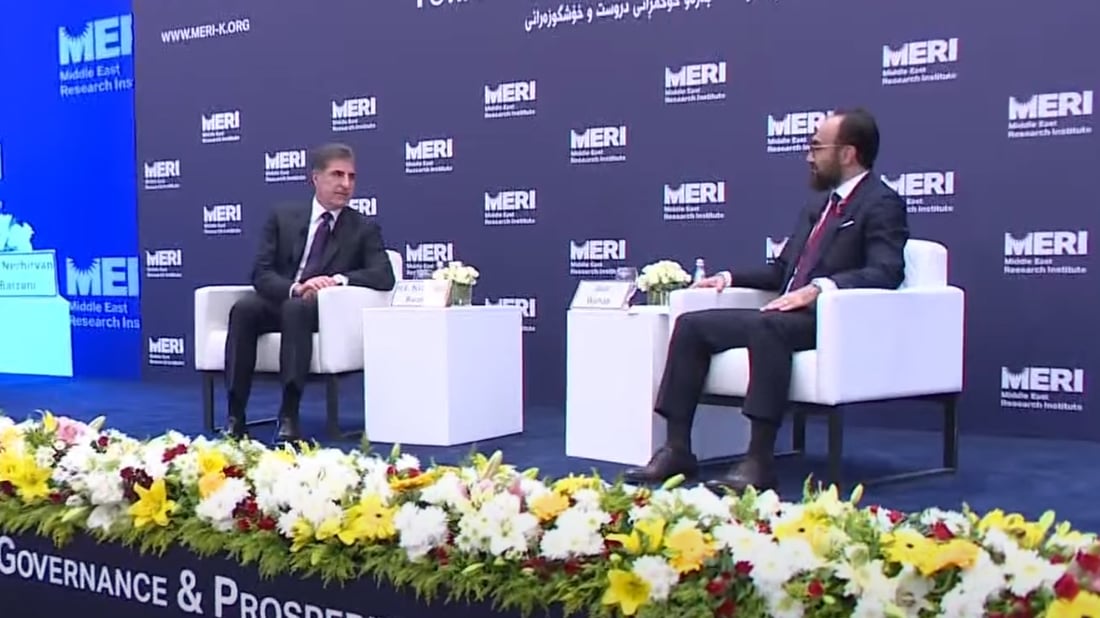
MERI Forum 2024
Kurdistan Region President Nechirvan Barzani discusses elections, government formation, relations with Baghdad
ERBIL — In the final session of the MERI Forum 2024 on Wednesday, President of the Kurdistan Region of Iraq, Nechirvan Barzani, engaged in a broad discussion with the American University of Iraq in Sulaimani President Bilal Wahab. Under the theme “The Kurdistan Region of Iraq in a Turbulent Neighborhood: Visions & Directions,” the session delved into political and regional issues, the recent Kurdistan elections, government formation, and the ongoing relations between Baghdad and Erbil.
President Barzani highlighted the significance of the recent parliamentary elections, stating, “The elections were vital for the Kurdistan region, as they restored legitimacy to government institutions.” Originally scheduled for 2022, the elections were delayed due to political disagreements. “Delays to the election were very bad for the Kurdistan Region,” he noted. He acknowledged the Iraqi High Independent Commission’s role, saying, “I would like to specifically thank the Iraqi High Independent Commission, which ran the elections professionally.”
Reflecting on the election atmosphere, the president noted increased enthusiasm among party supporters, especially within the Kurdistan Democratic Party and Patriotic Union of Kurdistan. “In Erbil, the two main parties in the Kurdistan Region conducted campaign rallies simultaneously without any problems,” he said, alluding to the final day of campaigning. He praised the turnout, reported at 72%, as a testament to Kurdish commitment to democracy. “This participation is a clear indication that the Kurdish people are conscious and believe in democracy, voting for the party they trust,” he added.
In response to some allegations of fraud, especially from Halwest and Komal parties, he affirmed, “The recent elections were the most fair ever conducted in the region.” Despite these disputes, he emphasized cooperation, saying, “The election is over; we need to cooperate. What is ahead of us is far greater than what is behind us.”
“Parties are not enemies, we are political revials,” he added.
President Barzani underscored the need for prompt government formation, warning that delays would disappoint the people. “All political forces in the Kurdistan Region are facing a big test. The people have given them their trust; they should stay loyal to this trust,” he urged. He reiterated that a coalition government remains essential, remarking, “Kurdistan won’t become two administrations again,” referencing the period after the civil war decades ago when the region was divided between the KDP and PUK.
When asked if it’s possible to form a government without the KDP or PUK, Barzani replied simply, “No.”
He highlighted his responsibility as president to support government formation, saying, “I have responsibility as the president of the Kurdistan Region, and will try many efforts to form the government.”
Turning to Erbil-Baghdad relations, President Barzani emphasized the need to strengthen internal unity to improve engagement with Baghdad. “It is time to find a suitable model for how to deal with Baghdad. But we must first fix our internal issues, forming a strong government,” he said. He noted that “Baghdad claims we are even in confederalism, but we think that Baghdad is not a proper federal system,” and affirmed that Kurdistan’s strategy focuses on resolving issues based on the constitution. While acknowledging that both sides have made mistakes, Barzani indicated that recent meetings in Baghdad aimed to address some of these longstanding issues.
On the stalled oil exports, he stated, “We don’t see oil as a political topic but rather a commercial one. After the halt of Kurdistan Region oil exports, Iraq has lost more than 15 billion dollars. Iraq is the biggest loser in this issue.”
Discussing regional conflicts, the president underscored the importance of neutrality. “What is important to the Kurdistan Region in cooperation with Iraq is to avoid being dragged into this regional war and conflict,” he noted. “Iraq must keep itself away from regional conflicts. Iraq is still in a transition period.” He emphasized that political parties across Iraq must support Prime Minister Al-Sudani in maintaining this stance, stating, “While it must be the responsibility of the prime minister, all political parties and forces in the country must help the prime minister in this regard.”
Commenting on the future of the U.S.-led coalition forces, Barzani acknowledged their significant role in supporting Iraq but emphasized the need for clarity on the coalition’s future. “The U.S.-led coalition provided great help to Iraq. They were invited by the Iraqi state. After 12 years, it is normal for Iraq to reevaluate, to determine where we are headed.” He added that “more clarity regarding the future of international coalition forces” would be beneficial as Iraq approaches the scheduled coalition drawdown in December 2025. While acknowledging ISIS’s enduring presence, Barzani stressed the importance of continued global assistance, saying, “In the Kurdistan Region, we think that ISIS is not over. It still poses a threat.”
Turning to the Kurdish peace process in Turkey, Barzani expressed optimism, stating, “If we realistically look at the matter, since this government came to power in Turkey, significant steps have been taken.” He mentioned his recent visit to Turkey and engagement with Turkish President Erdoğan, underscoring his support for renewed peace efforts. “We in the Kurdistan Region will be very pleased if the peace talks are to begin and reach a conclusion,” he said. Recent discussions on the Kurdish issue in Turkey have included remarks by Devlet Bahçeli, leader of Turkey’s Nationalist Movement Party and Erdoğan ally, proposing that Abdullah Öcalan, the imprisoned PKK leader, be allowed to address parliament if he agrees to dissolve the PKK. This proposal marks a shift for Bahçeli, who has traditionally opposed negotiations.