
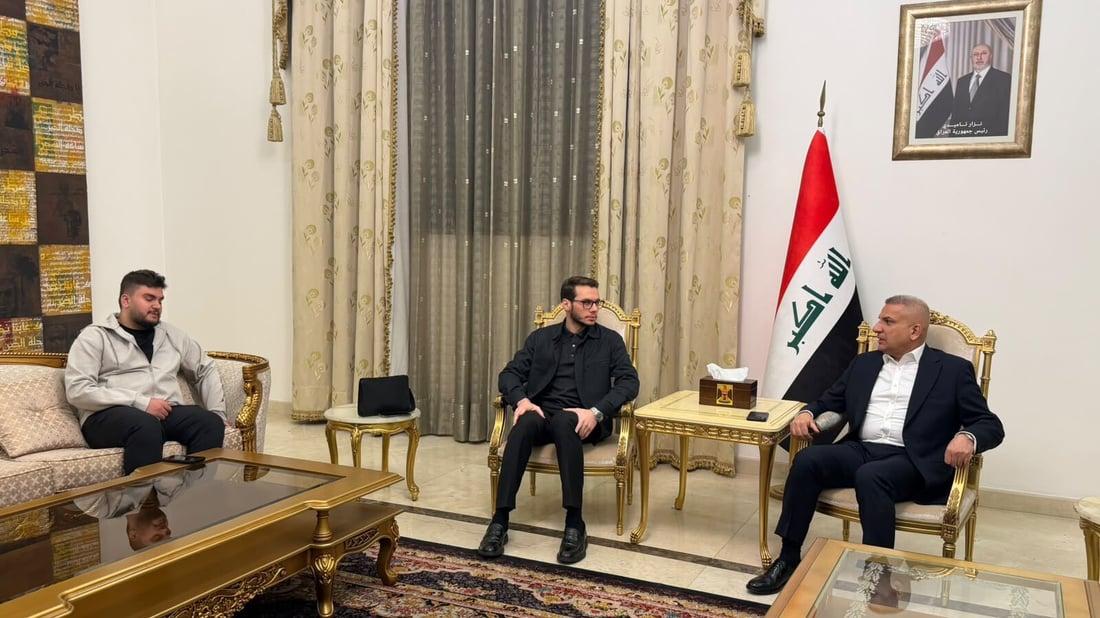
Alwani's son Talha arrives in Beirut to match DNA samples with his father's body
Iraq’s president presses Lebanon for urgent probe into Alwani killing
BAGHDAD — Iraqi President Nizar Amedi pressed Lebanese Prime Minister Nawaf Salam on Wednesday for an urgent investigation to identify the killers of former Iraqi lawmaker Ahmed al-Alwani, whose body was found in a Beirut apartment on Tuesday.
Amedi raised the killing when he met Salam at his residence in Antalya, Turkey, where both were attending the UN climate conference, COP31, the presidency said in a statement.
On what the statement called Alwani’s assassination, Amedi “stressed the importance of quickly uncovering the circumstances of the incident and conducting an urgent investigation to identify the perpetrators and ensure they do not escape accountability.”
Salam expressed appreciation for Iraq’s support for Lebanon, the statement said. It did not report a reply from him on the case.
Alwani’s son, Talha al-Alwani, arrived in Beirut on Wednesday afternoon to give DNA samples so the body can be formally identified, Iraq’s ambassador to Lebanon, Mohammed Reda al-Husseini, said in a post on X on Thursday.
Talha al-Alwani came “to have DNA samples taken from him at the Lebanese Internal Security Forces Directorate, Information Branch, to complete the procedures for matching the DNA with the body,” Husseini said. He traveled with Alwani’s brother-in-law, Azhar al-Alwani, and another companion, the ambassador said.
Husseini said Wednesday that a viewing had identified the body, but Lebanon’s top prosecutor ordered a DNA test because the body had decomposed. Salam also condemned the killing that day.
The ambassador said he offered his condolences to the son and explained what the embassy was doing to complete the procedures and bring the body to Baghdad “as quickly as possible.”
“There is continuous coordination and great cooperation between the embassy and the Lebanese judicial and security authorities regarding the body, as well as the intensive investigations under way to uncover the perpetrators and establish the circumstances of the incident,” Husseini said.
Lebanon’s interior minister, Ahmed al-Hajjar, told LBCI on Wednesday that the Internal Security Forces’ Information Branch was investigating the killing in close coordination with the judiciary.
Parliament Speaker Haibat al-Halbousi also called Wednesday for the investigations to be completed, with Iraqi and Lebanese authorities working together. Alwani had died “in mysterious circumstances, which calls for uncovering the circumstances of the incident and reaching the truth,” Halbousi said in a statement.
The Sovereignty Alliance, a Sunni bloc, condemned “in the strongest terms” what it called Alwani’s assassination, in a statement from its chairman, Sarmad al-Khanjar. It urged the Iraqi government to follow up on the investigations and hold those involved accountable.
The statement said Alwani’s courage in speaking up for his community had “made him a target of many parties that do not wish Iraq and Iraqis well.”
Hours later, Sovereignty Alliance leader Khamis al-Khanjar called the killing “a new political assassination” and blamed “militias wreaking havoc in Iraq.” He urged the government to work directly with Lebanese authorities on a transparent investigation that includes representatives of the Iraqi state and Alwani’s family, with the results made public and those involved sent to court.
Alwani had been formally invited to Chatham House’s annual Iraq Initiative conference in London on Wednesday, the director of his media office, Bashar al-Dulaimi, told the Saudi newspaper Okaz. Dulaimi said Tom Barrack, the U.S. special presidential envoy to Iraq and Syria, was due to attend.
Dulaimi said Alwani told him he had to make a trip but did not say where or why, and asked him to postpone all his official appointments. The office had been arranging meetings with foreign parties for a reform project Alwani was working on, Dulaimi said.
Their last contact was a WhatsApp message at 9:05 p.m. on Nov. 5, Dulaimi said. In it, Alwani asked for the news, said he had reached his destination without naming it and said he wanted to rest. After that, none of his four phone lines or social media accounts responded, and the office learned of his death from the media.
The media office’s timeline, released Wednesday morning, described the 9:05 p.m. contact as a call of two minutes and 30 seconds in which Alwani said he had arrived in Beirut and was moving from the airport to his residence.
Dulaimi ruled out a criminal or personal motive. He accused unnamed international parties of planning the killing to derail Alwani’s reform project, which he said targeted Iranian influence and Iran-linked armed groups. He offered no evidence for the accusation.
Alwani flew to Beirut from Erbil on Nov. 5. His media office has said people seen in surveillance footage left the apartment 14 minutes after his flight landed.
Alwani, a Sunni former MP from Anbar, played a prominent role in the 2012-2013 Anbar protests against the government of Nouri al-Maliki, then prime minister. He was sentenced to death in 2014 and freed in 2025 under Iraq’s General Amnesty Law.