
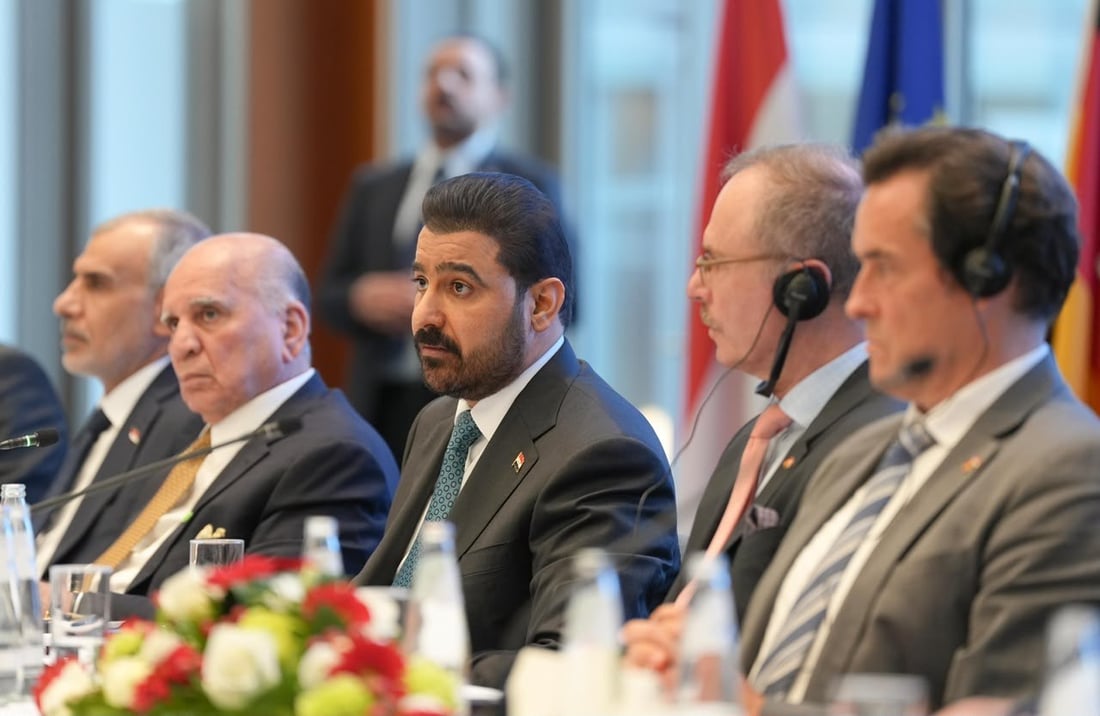
Iraqi Prime Minister Ali Al-Zaidi attends the German-Iraqi Business Dialogue Forum in Berlin.
Zaidi says Iraq will not stay hostage to one corridor, floats pipeline idea in Berlin
BERLIN — Iraq will route crude to Europe through Syria and Turkey rather than depend on a single export corridor, Prime Minister Ali al-Zaidi said in Berlin, where he also raised the idea of a pipeline linking Iraq to Germany.
“We are working to export crude oil to Europe via Syria and Turkey, and we are seeking to diversify export outlets,” he said at a joint news conference with Chancellor Friedrich Merz. “We will not remain hostage to a single corridor.” He said he had discussed buying and supplying Iraqi crude reaching the Mediterranean with President Emmanuel Macron in Paris on Monday and had raised the same file with Merz, and that Iraq was looking at supplying both Europe and the United States. The single corridor is the Strait of Hormuz, through which almost all Iraqi crude passed until shipping there was disrupted in March, cutting exports from nearly 100 million barrels in February to 18.6 million the following month.
The pipeline was put as a proposal rather than a plan. Zaidi floated the idea of building a line connecting Iraq to Germany, saying such a route could provide more secure and stable supplies. He gave no route, cost or timeline. What Iraq is actually building on are the two Mediterranean options: a one-year agreement signed with Ankara in August covering shipments through Ceyhan with a minimum of 750,000 barrels a day, and a memorandum with Damascus on a pipeline to Baniyas on the Syrian coast.
On the relationship itself he was warm. “The relationship between Iraq and Germany is strong and founded on mutual respect, and work is the language of the future,” he said. “Germany is a trusted and faithful partner, and we want to build economic bridges between the two countries. Iraq has resources and manpower in abundance, and we need the technology, expertise and equipment that we will buy from Germany.” Berlin is the second stop on his first European tour since taking office in May, after Paris, where six memorandums were signed covering defence, energy, civil aviation, development financing and research.
He said Iraq was committed to a centrist policy, away from aggressive ones, and that Baghdad and Berlin shared an interest in defusing the war between Iran and the United States, which he said had hit Iraq and the world through the halt in oil exports and its effect on global markets. Iraq has spent the conflict trying to avoid being drawn in, closing its airspace repeatedly and protesting attacks launched from its territory at neighbouring states, most recently the drone strike on a Saudi oil pipeline last Friday.
Asked about weapons, he said arms would be in the hands of the state and that the decision of war and peace was the state’s alone. His government has made that its central security policy, tied to Sept. 30, when the U.S.-led coalition mission ends, though officials have since said the date marks the start of talks with armed factions rather than a deadline for handing weapons over.
On foreign Islamic State prisoners, Zaidi said the matter was out of the government’s hands. “The file of foreign prisoners belonging to the terrorist ISIS concerns the judiciary, and the government has no authority over it,” he said, asking the countries that supported Iraq during the war against the group to strengthen economic partnership and contribute to reconstruction. Iraq took in 5,704 suspected members from northeastern Syria in January and finished questioning them this month, and the Justice Ministry approached 61 countries in August about repatriating nearly 6,000 foreign prisoners to serve their sentences at home.
Merz said Iran must end the closure of the Strait of Hormuz and expressed concern about the situation in the Red Sea. “Many of our companies in Iraq are doing pioneering work,” he said, adding that the Iraqi government had taken important steps against corruption. Iraq has convicted a run of senior officials this month, including a deputy oil minister and the head of a state electricity distribution company, in a campaign that began with the arrest of a former deputy oil minister in May.
Iraq exported an average of about 3.4 million barrels a day before the war, most of it through Hormuz, with China and India its largest buyers. Since the disruption it has moved crude by tanker truck through Syria and through the pipeline to Ceyhan, routes that carry only a fraction of its former seaborne trade. Zaidi wants to raise production to between 9 and 10 million barrels a day.