
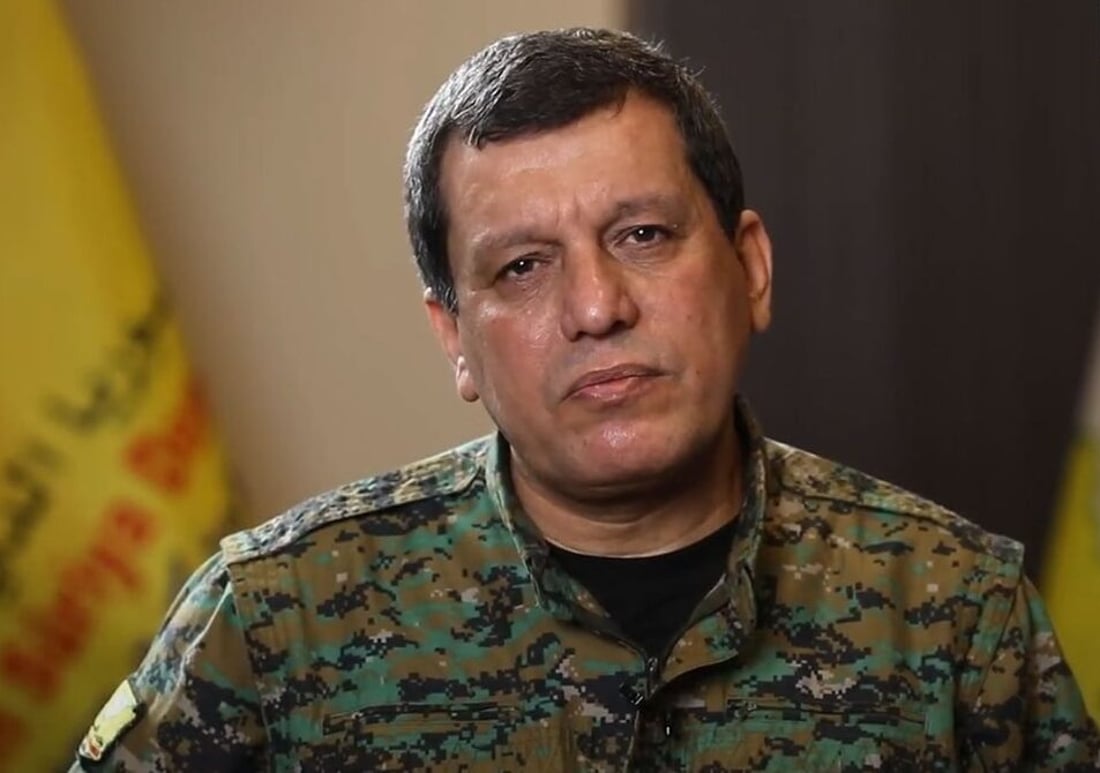
Syrian Democratic Forces commander Mazloum Abdi
Opinion
Thank you, General
In our part of the world, picking up a gun is far easier than putting one down. A gun brings power, followers and a seat at the negotiating table. And the longer a war lasts, the more reasons a warrior finds for keeping it alive.
Mazloum Abdi did the opposite. He stood in the People’s Palace in Damascus and, “with full responsibility,” declared the mission of the Syrian Democratic Forces complete: the force he had led for more than a decade would dissolve as an independent military and fold into the institutions of the Syrian state.
That was not surrender. It was courage.
Starting battles and running them is not the hardest decision of a commander’s life. The hard decision comes when a general recognizes the moment the war itself becomes a danger to the cause he took up arms for.
This is where the warlord and the warrior diverge. For the warlord, the war must survive so that he can. For the warrior, the gun is a means, not a homeland.
The general had more than one road open to him. He could have gone looking for a new patron once the American position shifted, or thrown himself into another regional axis, or wrapped himself in slogans and turned the Kurdish areas of Syria into an open front for years to come.
It is never hard to find someone to fund a new war. The hard thing is finding someone to fund a peace.
The general chose to give peace a chance.
He did not do it from nowhere. Behind him stand thousands of fighters and martyrs, years of war against ISIS, territories his administration governed, and security and military institutions built over more than a decade. And he agreed to lay all of it on the table of a new state that has not yet been fully tested.
This is no small step, and no maneuver. It is an enormous political deposit the Kurds have placed with Damascus, and with the international community that encouraged this course.
In return, there is a commitment. President Ahmed al-Sharaa has pledged to protect Kurdish rights, to recognize the Kurds as an integral component of the Syrian people and to open the way for Kurdish-language education. The political track speaks of anchoring those rights in the constitution and absorbing the leaders and institutions of the former administration into the state.
The general has done the harder half of the test. It now passes to Damascus.
Kurdish eyes, in Syria and everywhere, are on them now. “One army, one government, one state” must not come to mean one identity, one language or one narrative for today’s Syria.
If the Kurds have agreed to let the gun become part of the state, the state must prove that the Kurds themselves will be a full part of it.
Tom Barrack called what happened a “historic development” and spoke of the old division turning into a “lasting partnership.” Good. But lasting partnerships need lasting guarantees.
They asked an armed commander to trust politics. Now they must make politics worthy of that trust.
It might have been easier for Mazloum Abdi to keep his gun. Kurdish history, the region’s experience, even the record of his own relationship with the United States all give him ample reason to doubt.
Instead he chose to risk peace. That too is a risk. It may be a greater one than war.
We do not know how history will judge the agreement. We do know what has just happened.
A commander with an independent military force of his own chose to give up its independence, and to bet on the state rather than on another round of war.
That should not be read as weakness. Warlords know how to start wars. True warriors also know how to end them.
Now it is the turn of Damascus and the world to prove that his bet on peace was not a mistake, and that what he did has earned the state’s recognition, not for the man himself but for a people exhausted by war and persecution.
Thank you, General.