
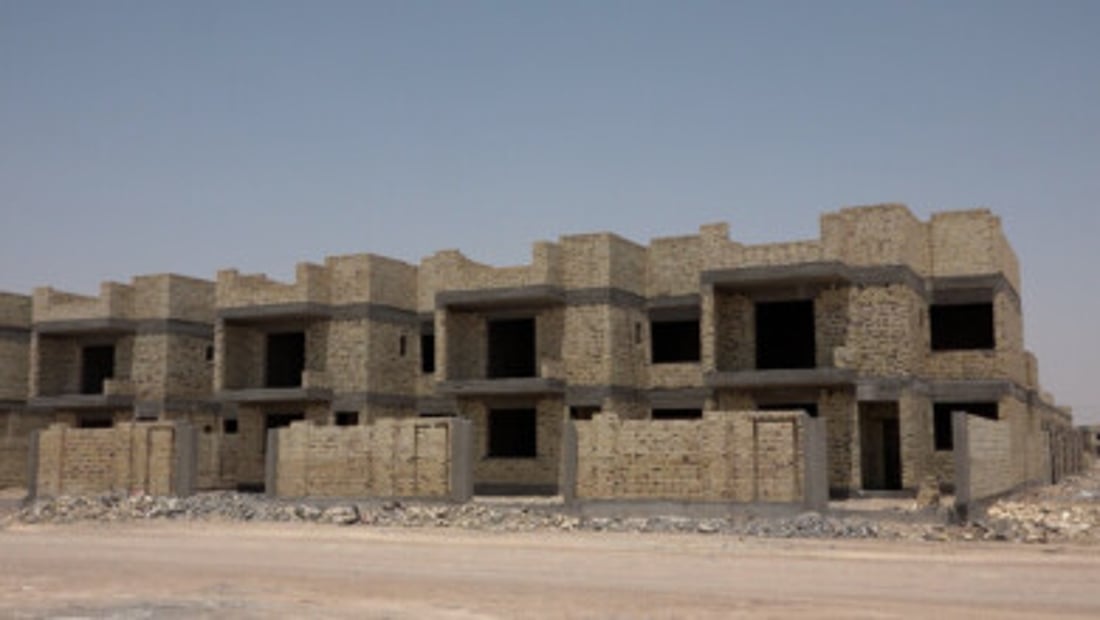
Housing demand outpaces supply in Maysan as migration drives up prices. (Photo: 964media)
Amarah
Maysan housing shortage grows as rural migration boosts demand
MAYSAN — Maysan is facing growing pressure on its housing market as rural migration, population growth and years without residential land distribution drive up property prices, while officials say government and private housing projects remain insufficient to meet demand.
Local officials told 964media that water shortages, declining agricultural activity and tribal disputes have prompted more families to move from rural areas into Amarah, the provincial capital, increasing demand for housing. At the same time, developers are expanding residential projects, including gated communities offering villas with private gardens and swimming pools.
Consulting engineer Nasser Al-Tayeb said housing prices vary widely by neighborhood. Homes in higher-end districts sell for between 2 million and 3 million Iraqi dinars ($1,324-$1,986) per square meter, while prices in middle- and lower-income neighborhoods range from 1.5 million to 2 million dinars ($993-$1,324) per square meter.
“These prices are beyond the reach of many residents, whose monthly incomes do not match housing costs,” Al-Tayeb said, adding that some families have turned to informal developments built on agricultural land because they are more affordable than homes in established neighborhoods.
Raed Shamel, mayor of Amarah district, said the housing shortage has been exacerbated by population growth, reduced agricultural activity and environmental pressures.
“The decline in agricultural activity has pushed increasing numbers of residents from districts and subdistricts toward the provincial center,” he said.
Shamel said reduced water releases, falling river levels and the drying of large parts of Iraq’s southern marshes have displaced many rural families, while Amarah’s universities, employment opportunities and public services continue to attract residents.
More than 47,000 applications for residential land allocation have been registered with Amarah Municipality, he said, underscoring demand that far exceeds the housing currently available.
The local government has completed and distributed the first phase of a 1,000-unit housing project, while construction of the second phase is more than 95% complete. A separate 500-unit development near the Lebanese Hospital is also under construction.
Shamel said those projects remain insufficient. He cited the planned Al-Izza residential development, which is expected to include more than 3,800 housing units, along with several other public and private projects at various stages of construction.
The local government is also working to allocate land for developers and designate more than 20,000 dunams (4,942 acres) within Amarah for future residential distribution while expanding the city’s municipal boundaries under a revised master plan.
Shamel said years of delays in distributing residential land have contributed to rising prices, while tribal disputes, growth in the oil sector, tourism and relative economic stability have further increased demand and land values.
“If water releases improve and the marshes recover, migration to the city center could decline in the future,” he said.
Hazem Abdul Shahid, managing director of the Al-Izza Residential Complex, said the 652-dunam (161-acre) project will include homes ranging from 200 to 400 square meters, including two-story villas with private gardens and swimming pools.
He said the development will provide electronic gates, security systems, perimeter fencing and extended electricity supply through coordination with the Ministry of Electricity, supported by generators and solar power.