
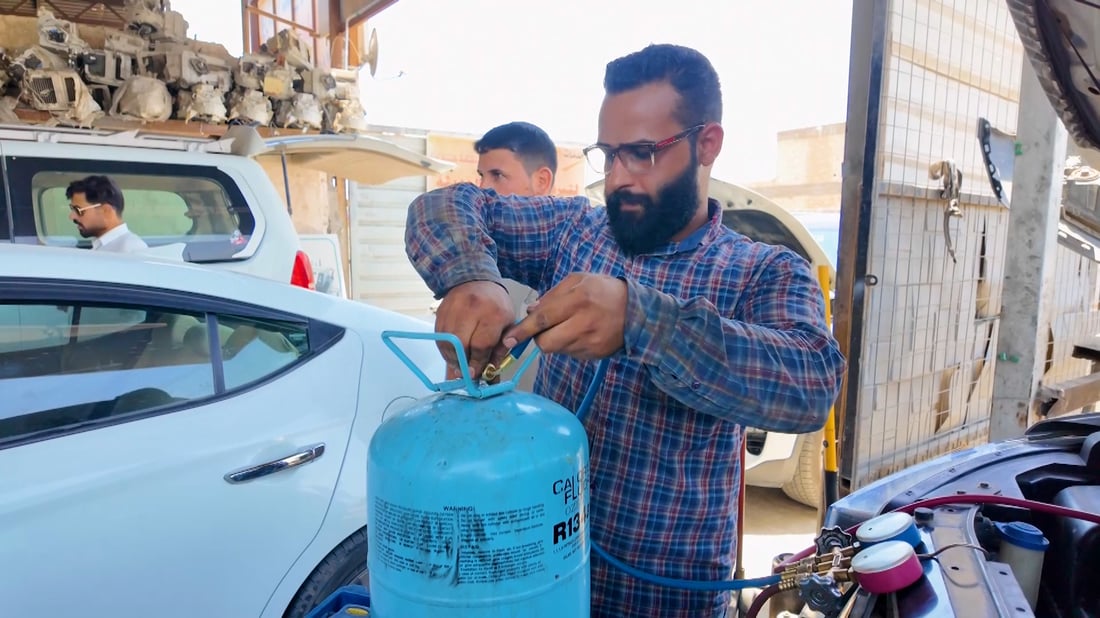
A technician refills a vehicle’s air conditioning system at a repair workshop in Najaf. Photo by 964media.
Refrigerant costs rise
Strait of Hormuz closure ripples down to vehicle AC repairs in Najaf
NAJAF — The summer heat has sent drivers in Najaf flocking to have their car air conditioning fixed, but the cost has climbed as refrigerant prices rise, with mechanics blaming the wider market disruption that has followed the closure of the Strait of Hormuz.
Hassan Falah Abdul Hussein, who runs an AC repair workshop in central Najaf, said an 11-kilogram cylinder of refrigerant that once cost about 150,000 dinars (about $98) now runs to 250,000 (about $163). That has pushed the refrigerant cost of a typical refill from roughly 7,000 dinars (about $4.50) to about 11,500 (about $7.50), before labor. A full service, including disassembly and reassembly, now costs about 50,000 dinars (about $33) a vehicle. He tied the rise to the regional conflict and the disruption to supply routes through Hormuz.
The strait, the outlet for nearly all of Iraq’s oil exports and a conduit for much of its imported goods, was briefly closed during the recent escalation between Iran, Israel and the United States. Its disruption hit Iraq hard: oil exports and revenues fell sharply, straining public finances, while the squeeze on shipping and the wider regional instability pushed up prices for a range of imported goods. Everyday items that depend on foreign supply, from refrigerant to spare parts, have grown more expensive and harder to source.
Abdul Hussein said the type of refrigerant matters as much as the price. Newer cars use R-1234yf, which local mechanics call “1200,” while 2015 models and older use R-134a, and mixing them can damage the system. “You cannot use 1200 gas in a car designed for 134 gas, or vice versa,” he said. R-134a is sold in American, South Korean and French brands, he said, with the French the most used at his shop for its balance of quality and price.
A typical car takes 400 to 600 grams of refrigerant, and most repairs can be done in an hour to 90 minutes with the right equipment, he said. He advised drivers to choose genuine compressors over cheaper aftermarket parts, saying originals last longer and run better, and noted that the flood of commercial alternatives has made it hard for many drivers to tell genuine parts from imitations.