
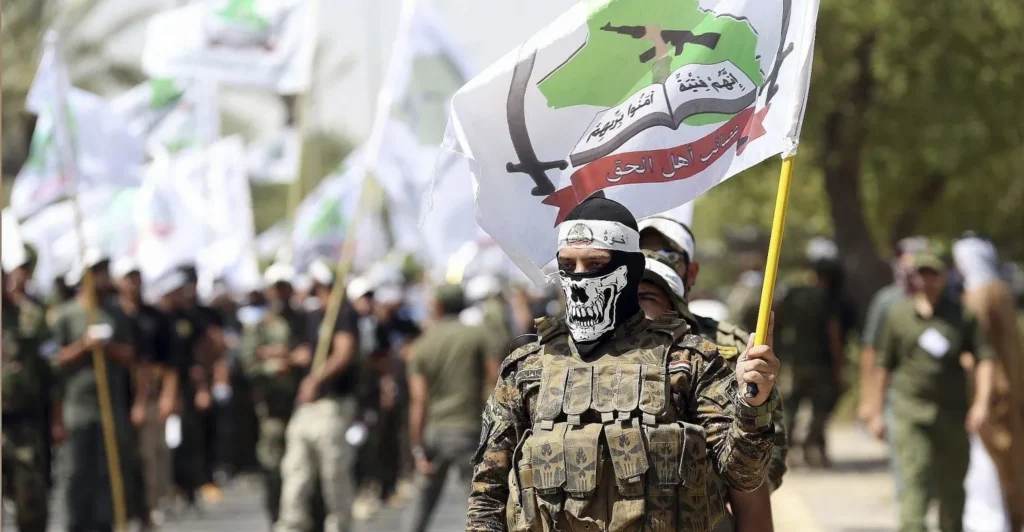
A member of Asaib Ahl al-Haq holds the group’s flag during a public march in Iraq
Asaib Ahl al-Haq weighs handing weapons to PMF
BAGHDAD — Asaib Ahl al-Haq, the Iran-aligned faction holding 28 parliamentary seats, is considering transferring weapons held outside the Popular Mobilization Forces’ official inventory into it, as Washington presses for the exclusion of politically active armed groups from the next government.
The move, if it materializes, would fall short of what Washington appears to be demanding. Asaib Ahl al-Haq is already formally part of the PMF — a force nominally under the prime minister’s authority but which operates with significant independence in practice. What is being proposed is the consolidation of weapons held outside even the PMF’s accounting system into its official inventory.
Hussein al-Sheihani, a member of the group’s political office, framed the proposal in those terms. “There is weaponry outside the inventory and accounting system of the Popular Mobilization Forces, and this weaponry must be transferred to the Popular Mobilization Forces,” he said on Al-Dijla TV.
Talib al-Baidhani, a lawmaker from the Sadiqoun bloc, said U.S. messages calling for the exclusion of factions from government predated the nomination of Prime Minister-designate Ali al-Zaidi. He said any decision on weapons would be deferred to the Coordination Framework. “If the framework agrees on handing over the weapons of the factions, we will agree to this decision and will hand over these weapons to the Popular Mobilization Forces as one of the formations of the military institution,” he said.
Reports also indicate that Kataib Imam Ali may relinquish heavy and medium weapons to the PMF — a move seen as an attempt to satisfy conditions for participation in the next cabinet rather than a fundamental restructuring of military capacity.
U.S. President Donald Trump expressed support for Zaidi through a phone call, a Truth Social post and public statements, calling for a government “free of terrorism” — a phrase widely interpreted as targeting armed factions in politics. Washington has also conveyed messages calling for the exclusion of armed groups from sovereign ministries and expressed dissatisfaction over the appointment of Adnan Faihan as deputy parliament speaker.
Baghdad has outlined four parallel tracks to address armed factions: political dialogue, security measures including containment and arrests, judicial accountability and diplomatic efforts, according to Hussein Allawi, a prime ministerial adviser. Allawi said the political approach is prioritized and that security measures alone will not produce lasting results.
Outgoing Prime Minister Mohammed Shia al-Sudani said in March that resolving the issue would become easier after September 2026, when the international coalition mission ends and foreign forces withdraw, noting that factions view foreign troops as an “occupation.”
Support for weapons consolidation under state authority has also come from within the Coordination Framework. Nouri al-Maliki told Agence France-Presse in February that U.S. pressure aligned with existing Iraqi demands. “In fact, America has not brought anything new. These are our demands. We want weapons to be in the hands of the state. We want centralized military power,” he said, adding: “Whoever leaves weapons is welcome to be part of the next government.”