
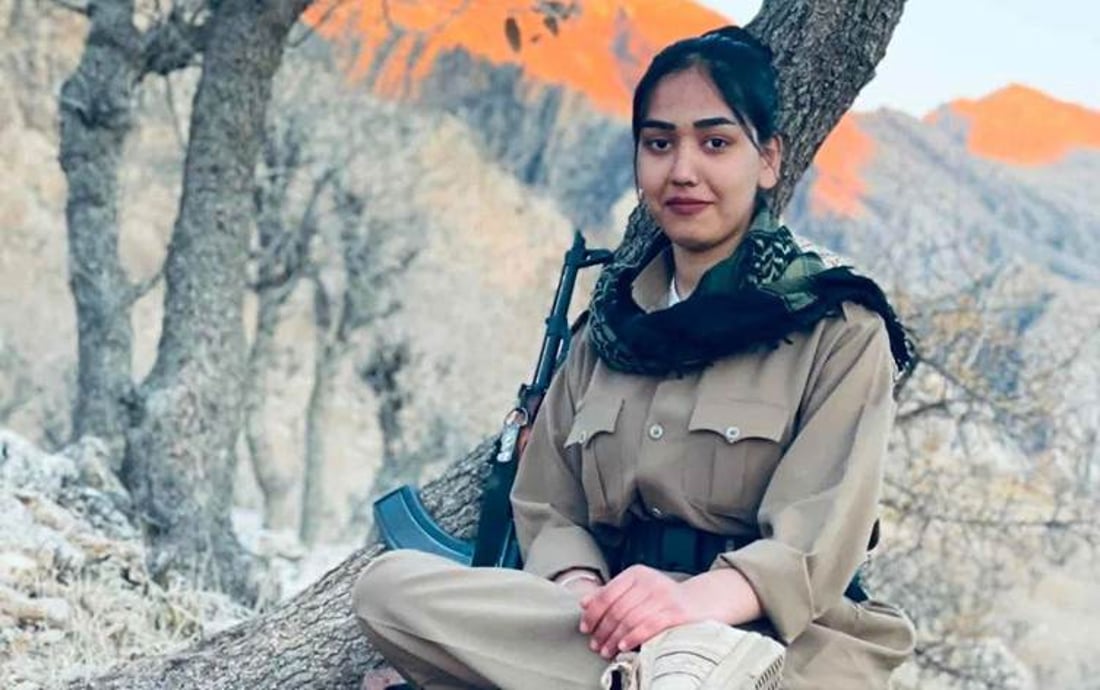
Ghazal Mawlan, a female Peshmerga fighter from Komala, who died after being wounded in a drone strike and transferred between hospitals in Sulaymaniyah, April 2026.
The night Ghazal Mawlan died
Ghazal Mawlan, a female Peshmerga fighter with Komala Shorshgery Zahmatkeshani Kurdistani Iran, died in the early hours of April 14 after being moved between several hospitals in Sulaymaniyah following a drone strike the party blamed on Iran. Her companions say private hospitals refused or delayed admitting her. The hospitals dispute the account.
Drawing on multiple well-informed sources and people close to Mawlan, 964media reconstructed what her companions describe as the sequence of events that followed.
Komala said Mawlan was wounded alongside two other fighters in a drone strike carried out near the border of Sulaymaniyah governorate. “Comrade Ghazal Mawlan Chaperabad, a Komala Peshmerga fighter, who was wounded in a drone attack by the Islamic Republic, lost her life after arriving at the hospital because of the severity of her injuries and joined the caravan of Komala and Kurdistan’s martyrs,” the party’s central committee secretariat said. The strike is part of a broader pattern of attacks on Iranian Kurdish opposition groups in the Kurdistan Region since the regional war began Feb. 28. It was one of multiple attacks on Iranian Kurdish opposition groups since the ceasefire took hold.
Mawlan was first taken at around midnight to Shorsh Hospital, a Peshmerga facility under the Ministry of Peshmerga. After initial treatment, her companions were told the injury was severe, that the hospital lacked the required equipment, and that she needed to be taken to a private hospital. She was loaded into a Shorsh ambulance with a doctor aboard — who would remain with her for the rest of the night — and taken toward Asia Hospital, a few hundred meters away. Two people called ahead to explain the case: one from Komala, one from Shorsh Hospital staff. Asia, according to that account, declined, telling them it “could not receive that kind of case.”
Asia denies this. At a joint press conference with other hospitals, spokesperson Halgurd Jalal said the hospital had “never been contacted” to receive the wounded fighter, that there had been “no contact even with the nursing staff and medical teams,” and that it rejected “all rumors.” When 964media put to Jalal that Mawlan’s companions had twice insisted — once from Komala, once from Shorsh — on being turned away, he declined to comment further.
The ambulance moved on to Bakhshin Hospital, also nearby. Sources close to Mawlan said she was taken to the fifth floor, where her companions asked that she be admitted to intensive care. Staff, according to those sources, said they could not receive her because “it was a police case” and could not admit her “without the consent of the security side.”
Bakhshin’s director, Rebwar Hassan, gave a detailed public account that differs significantly. Mawlan entered the hospital at 7:53 a.m. and was met at the entrance by staff, who accompanied her and “brought oxygen and other things” as they took her to the fifth floor toward intensive care. The problem, Hassan said, was procedural: “the intensive care employee, without police papers, without procedures, without a doctor’s approval, cannot receive this patient.” Staff asked whether legal procedures had been completed, whether there was a police report and whether there was a medical report, and were told there was none.
The hospital was not waiting passively, Hassan said. He was personally on the phone with security officials seeking approval. “During that time, as you know, to obtain approval by phone takes several calls and communication,” he said, describing the timeframe as natural given the circumstances. Security officials eventually told the hospital, “It is fine, help her and treat her.” By then, however, Mawlan’s companions “were in a hurry and had taken her to another hospital” and “did not wait for our response.” She had been at Bakhshin from 7:53 until 8:14. Once approval came through, the hospital called to say it would receive her — “but they had gone to another hospital and did not return.”
“This patient was not delayed with us,” Hassan said. Surveillance cameras had recorded the episode and the footage could be released, he added. “Unfortunately, after a very short period we heard the news of her death, and we were all saddened by it.”
From Bakhshin, the companions called another private facility nearby. A hospital employee, according to people close to Mawlan, asked: “Is the wounded case from Surdash?” Mawlan had been wounded at the Surdash camp in Dukan district, a joint base for Komala and Komala Zahmatkeshani Kurdistani Iran. When they answered yes, the call was cut off.
They next called Faruq Hospital, a short distance away. A person close to Mawlan who was with her that night said the hospital called back about five minutes later and said, “Bring the case.” By the time they arrived, she had died. “When we reached Faruq Hospital, Ghazal had died because of the severity of her injuries and nothing could be done for her,” the source said.
The case has prompted a statement from more than 150 thinkers, artists and civil society activists in the Kurdistan Region, who said Mawlan had faced “a very clear injustice” and called the hospitals’ response “unjustified,” amounting to “a departure from medical ethics and conduct and a violation of the legal medical oath.” They held hospital administrations responsible, and urged prosecutors in Sulaymaniyah to open an investigative file, pursue legal follow-up, identify any negligent party and inform the public. The statement also condemned attacks on Kurdish targets “under the pretext of war” as unjustified.
Sulaymaniyah’s forensic medical authority later concluded that Mawlan’s wounds were fatal regardless of where she had been treated. “The martyred girl had three severe and lethal wounds,” forensic medicine specialist Dr. Bakhtiyar Rashid told 964media, adding that “even if she had been taken anywhere in the world, she would have lost her life” and that treatment “might only have changed the timing a little.” Rashid said a written instruction from the health sector to private hospitals had caused misunderstanding due to “a small linguistic mistake,” but said the Health Ministry does not instruct hospitals to refuse such cases because “a person’s life is more important than all procedures and laws.”
Mawlan had initially been set to be buried at Zrgwez cemetery, where some Komala fighters are laid to rest. After word spread that the site had been struck by Iranian bombardment earlier the same day, her companions changed the location and held a smaller ceremony, attended by a number of her friends and some public figures and journalists from Sulaymaniyah. “Zrgwez cemetery, where several of our martyrs had previously been buried, became a target of missiles by the Islamic Republic,” said Navid Mihrawar, a Komala member and companion of Mawlan. The body was transported discreetly in a regular vehicle rather than an ambulance. “In order for the transfer of the body not to be very visible, we did not request an ambulance from any institution or side. We considered it better, given the security situation, to transport the body in a regular vehicle,” Mihrawar said.