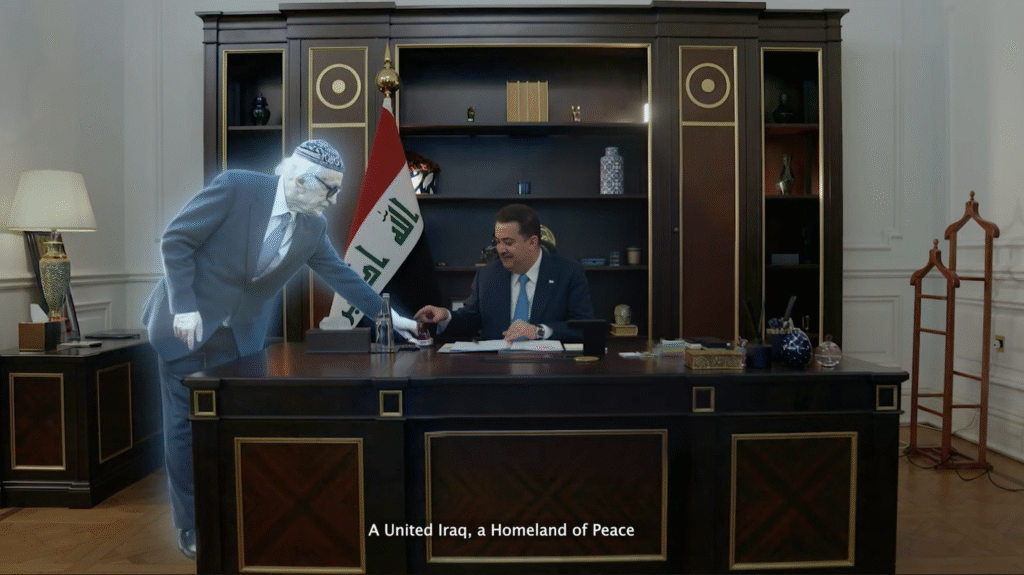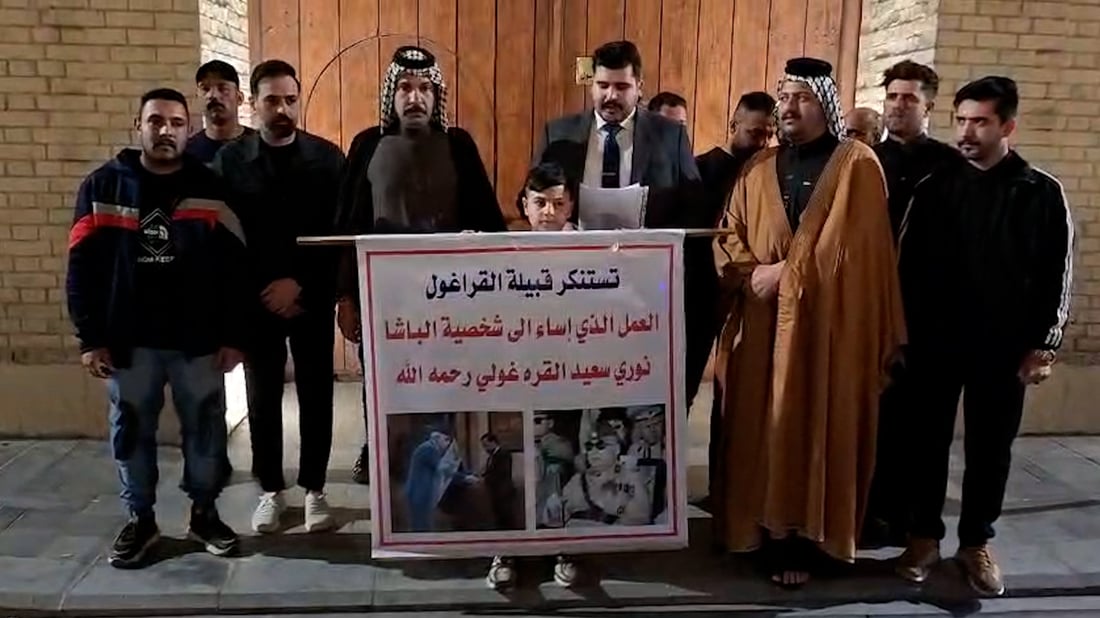
Members of the Al-Qaraghol tribe hold a statement condemning an AI-generated advertisement depicting former Prime Minister Nuri al-Said, during a gathering in Baghdad.
Qaraghol tribe demands apology over AI ad depicting Nuri al-Said serving tea to Halbousi
BAGHDAD — Reactions continued across Iraq on Monday over an AI-generated Ramadan advertisement that depicted prominent historical figures serving tea to contemporary political leaders, as the Al-Qaraghol tribe issued a strong condemnation and demanded a public apology and removal of the video.
In a statement, the tribe said it “condemns in the strongest terms” what Bana Marketing, “with the participation of MP Mohammed al-Halbousi,” had done by publishing a clip that included “a direct and deliberate insult to the late Iraqi statesman Nuri al-Said, one of the members of our tribe and one of the most prominent symbols of the modern Iraqi state.”
The tribe said the content “cannot be interpreted as a media mistake or a promotional misjudgment,” but constitutes “a rejected offense and clear disregard for Iraq’s history and its symbols.”
It demanded the clip be removed “immediately and without delay” and called for “a formal, public and explicit apology,” warning it will take “all legal and tribal measures guaranteed by the constitution and the law” if there is no response.
The controversy stems from an advertisement titled “United Iraq,” published on YouTube on Feb. 17 as a Ramadan campaign. The AI-generated video showed the late poet Mohammed Mahdi al-Jawahiri appearing as a spectral figure serving tea to Prime Minister Mohammed Shia al-Sudani in his office. It also depicted Nuri al-Said offering tea to Taqaddom party leader Halbousi.
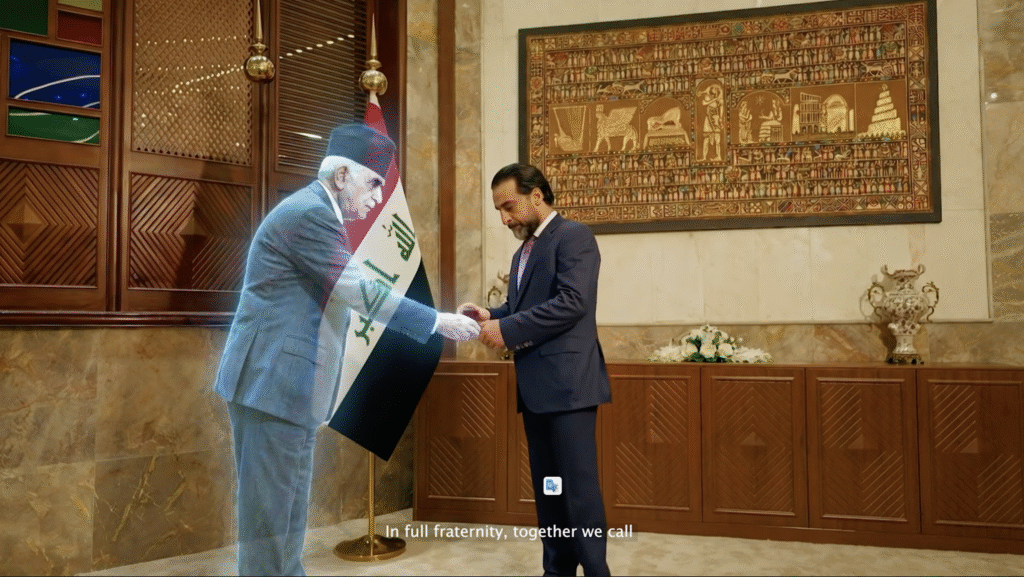
The video was presented as a message of unity, with scenes from across the country including the Erbil Citadel, Baghdad’s Al-Mutanabbi Street and the ancient city of Ur. The advertisement framed tea as a social symbol linking Iraq’s past and present.
However, the scenes showing Jawahiri and Said serving tea to contemporary political figures became the focal point of criticism. Journalists and commentators described the portrayal as disrespectful to national and cultural icons. Some warned that misuse of artificial intelligence could distort historical memory.
On Feb. 18, Sudani directed the Communications and Media Commission to conduct an urgent investigation. His media office said he “expresses his rejection of the content of the virtual video, in which he appeared with the late ‘Greatest Arab Poet’ Mohammed Mahdi al-Jawahiri in a way that contradicts the respect and appreciation he holds for the literary and national value of al-Jawahiri.”
The statement said Sudani ordered an investigation into the parties that produced, promoted or published the advertisement, citing “an insult to cultural symbols and government institutions, as well as the irresponsible use of artificial intelligence technologies.”
Bana Marketing issued a statement defending the artistic intent of the advertisement. The company said Jawahiri’s appearance “was not a literal embodiment of the historical figure,” but a symbolic representation of Iraq’s cultural spirit. It said the tea-serving scene reflected the transfer of heritage from past to present.
Producer and director Ban al-Jumaili defended the concept in an interview on Dijla TV, saying the role represented the office of prime minister rather than the individual. She described tea as a simple national symbol uniting Iraqis across backgrounds.
Jawahiri, born in 1899 in Najaf and widely known as the “Greatest Arab Poet,” is regarded as one of the most prominent figures in modern Arabic poetry. Said served multiple terms as prime minister during Iraq’s monarchy and was killed in the 1958 revolution.