
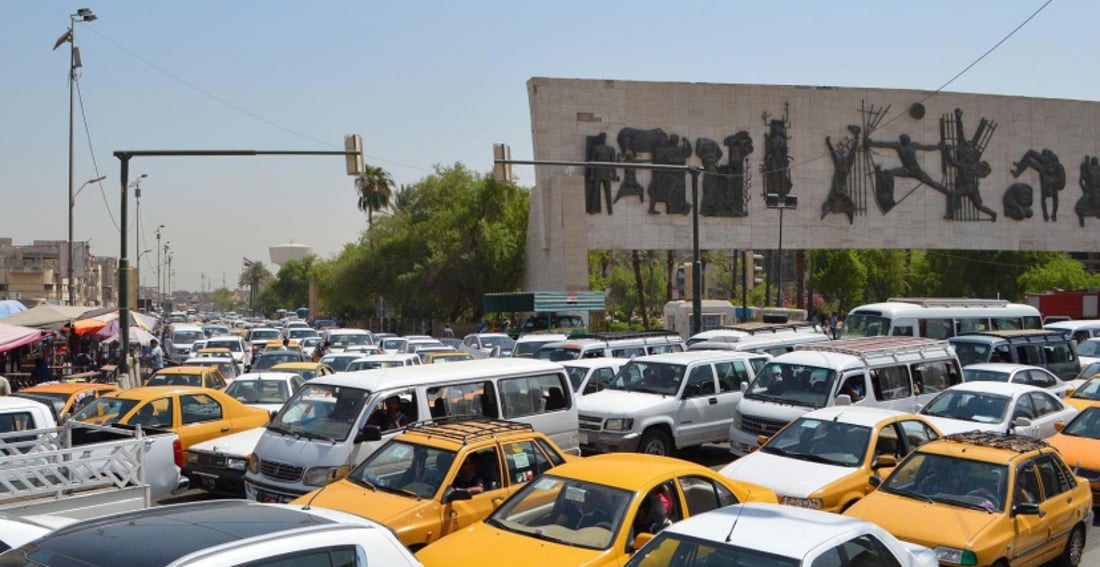
Heavy traffic congestion fills a central Baghdad roadway
Iraq plans to relocate government offices, projects to ease pressure on Baghdad
BAGHDAD — Iraq is moving toward a planning policy that would relocate some government institutions and investment projects from major cities to districts and subdistricts in an effort to reduce population density and service pressure on urban centers, the Planning Ministry said.
The plan focuses on developing medium-sized cities and district centers by strengthening infrastructure, creating jobs and establishing educational and housing projects to turn those areas into attractive hubs for residents and investment.
Mohammed al-Sayyid, director general of regional and local development at the ministry, told the official daily Al-Sabah that “the new policies will focus on developing medium-sized cities, particularly district centers, in addition to small cities that serve as subdistrict centers surrounding major cities.”
He said the approach “requires providing integrated infrastructure in small and medium-sized cities, along with creating real job opportunities for residents,” which would encourage “the gradual movement of some residents from major cities to smaller and medium-sized ones.”
Among the proposed solutions is relocating government offices from major cities to districts and subdistricts, “which would make these areas attractive for job opportunities,” al-Sayyid said. Investment projects such as private universities and large residential complexes could also be distributed outside city centers.
“Moving such projects to districts surrounding the capital Baghdad, such as Al-Mada’in, Al-Mahmoudiya or Al-Rashidiya, would greatly and effectively reduce the burden on the capital,” he said, adding it would help ease traffic congestion.
Baghdad is Iraq’s largest city, with a population estimated at more than 8.3 million in 2026. Officials say the daytime population can exceed 10 million when commuters and visitors are included, placing heavy pressure on housing, services and infrastructure.
The strain is most visible in traffic. Baghdad’s roads were designed to handle about 700,000 vehicles but now carry an estimated 2.5 million to 3 million cars, leading to daily gridlock and commutes stretching to two hours. Congestion and emissions have worsened air quality, with environmental groups warning that pollution levels pose growing health risks.
Al-Sayyid said establishing residential complexes outside major cities “will help provide housing units at suitable prices for citizens” while reducing pressure on Baghdad. The approach aims to achieve balanced development “starting from villages, through subdistricts and districts, and reaching major cities,” ensuring fair distribution of population, services and jobs.