
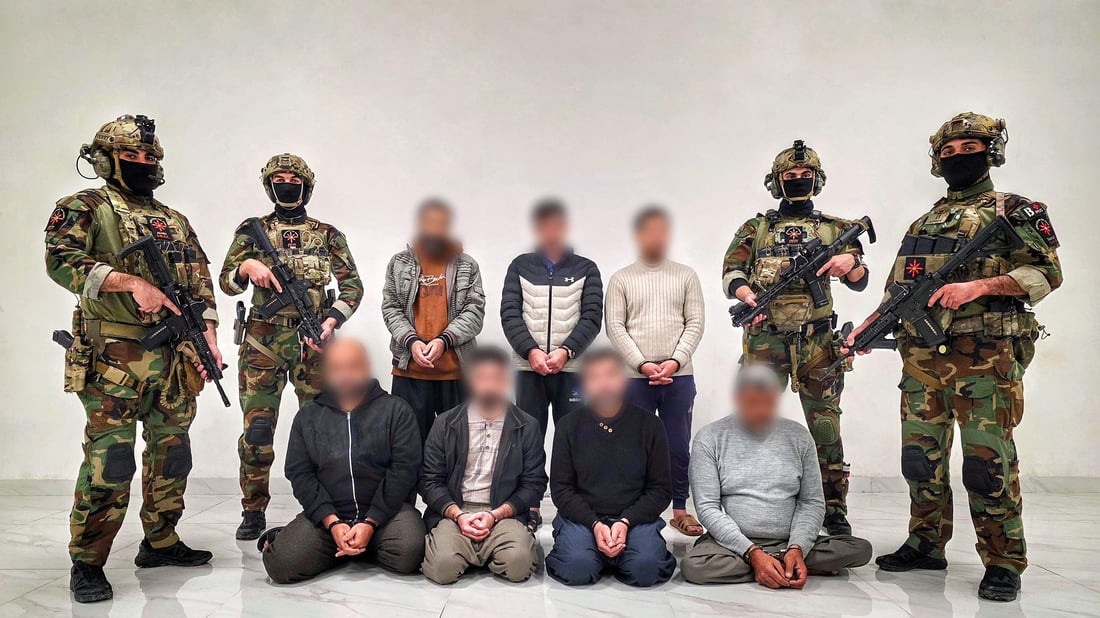
(Photo: Directorate of Kurdistan Region Security Agency)
Seven terrorism suspects arrested in Sulaymaniyah operations
SULAYMANIYAH — Sulaymaniyah’s security forces announced the arrest of seven suspects wanted by Iraqi courts on terrorism-related charges, saying they had entered the governorate areas in an attempt to hide.
In a statement on Wednesday, the Sulaymaniyah-based Directorate of Kurdistan Region Security Agency said its operations directorate, following intelligence-led tracking and information exchange with federal Iraqi security agencies, carried out several operations in January 2026.
The statement said that “in several operations during January 2026, in the Sulaymaniyah governorate, seven terrorists wanted by Iraqi courts were arrested.”
According to the directorate, the suspects “had come to the area with the aim of hiding.”
The statement added that all detainees are currently being held under Iraq’s Anti-Terrorism Law, and investigations into their cases are ongoing.
Iraqi authorities have intensified their anti-terror efforts. Iraq’s National Security Service said it arrested 16 people on terrorism charges during operations carried out in January.
Early this month, Syrian government forces and allied Islamist militias launched a coordinated offensive against Kurdish-held areas in northeastern Syria, including Rojava, triggering renewed instability and humanitarian concerns.
The fighting has intensified international concern over detention facilities and camps holding thousands of Islamic State detainees and their families. Clashes near several sites have led to reported escapes, raising fears that deteriorating security conditions could allow ISIS to regroup.
U.S. Central Command has begun transferring detainees to Iraq, with plans to relocate up to 7,000. Iraq’s First Karkh Investigative Court said Monday it has begun investigation procedures into 1,387 Islamic State members recently received from detention facilities in Syrian territory.
Iraq has faced waves of militant violence over the past two decades. After the 2003 U.S.-led invasion, armed groups including al-Qaeda in Iraq carried out bombings and assassinations. In 2014, the Islamic State group seized large areas of Iraq, including Mosul, before losing territorial control by late 2017 following a military campaign by Iraqi forces and Kurdish Peshmerga backed by a U.S.-led coalition.
Despite the collapse of the group’s self-declared caliphate, Iraqi authorities say ISIS remnants continue to operate in rural and border areas through sleeper cells and sporadic attacks.