
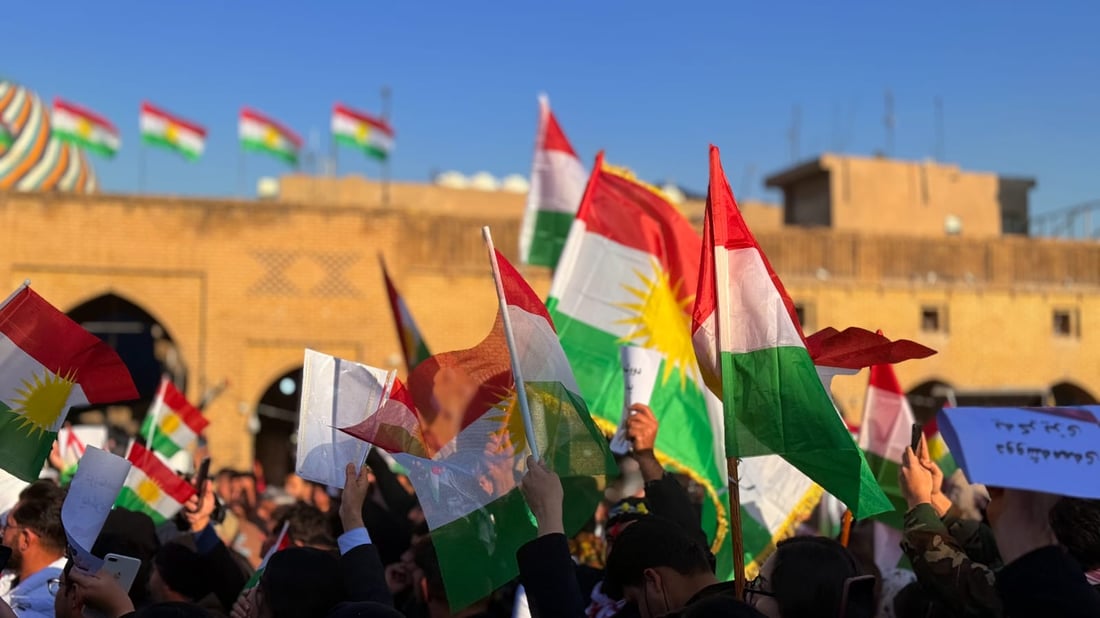
Kurdistan flags raised during a protest in Erbil in support of Rojava. (Photo: 964media)
Rallies enter second week
‘Attacks on Rojava are attacks on us all’ say Erbil demonstrators
ERBIL — Residents in Erbil have been protesting daily for over a week in support of Kurds in Rojava, vowing to continue until the Syrian regime forces and allied Islamist militias halt their assaults on the Kurds.
Hiwa Said Salim, a local activist, told 964media on Tuesday, “We will continue to protest, support, and assist Rojava as long as it needs us.” He said the protests offer both moral backing and practical solidarity to those under attack in northeastern Syria.
Referencing remarks by the Kurdish-led Syrian Democratic Forces commander Mazloum Abdi, Salim said, “This support lifts morale for Rojava and its fighters.”
He added that the demonstrations also help draw international attention and diplomatic pressure in favor of Kurds in the region.
Each day, protesters gather in front of Erbil’s historic citadel, raising the Kurdistan flag and chanting slogans including “Rojava will not fall.”
Nishtiman Kamal, another activist, told 964media that women’s participation has been especially impactful. “Women’s involvement in all forms of activism, particularly political ones, has a strong influence,” she said.
She also highlighted increased hostility and hate speech from pro-Syrian regime and Arab media targeting Kurds, especially Kurdish female fighters.
“These demonstrations show our resilience and solidarity,” she said. “The attacks on Western Kurdistan (Rojava) are attacks on us all.”
As of late January 2026, the conflict in northeastern Syria continues with a fragile ceasefire holding after clashes between Syrian regime forces and the Kurdish‑led Syrian Democratic Forces.
Government forces and allied Islamist militias launched an offensive earlier this month that captured large areas once under SDF control, including territory in Raqqa, Deir ez‑Zor, and Aleppo governorates, leading to widespread displacement and disruption of civilian life.
Kurdish civilians in Rojava, especially in Kobani city, face humanitarian challenges including shortages of electricity, water, food and displacement.
Rights organizations and local reports have documented abuses and violations targeting civilians based on their Kurdish identity. In a recent report, Community Peacemaker Teams said six members of a single Kurdish family were killed and six others injured by Syrian government forces because they were Kurdish.
In a statement, CPT said the family was traveling in a Kia truck near the village of Abu Khashab when they were stopped by an armed group affiliated with the Syrian government. The group asked where the family was from and, after they replied “Raqqa,” the commander asked, “Are you Kurds or Arabs?” the statement said. The family responded, “We are Kurds, but we are not affiliated with any party or military force.” The commander then said, “Fine, now I will end all of you!”