
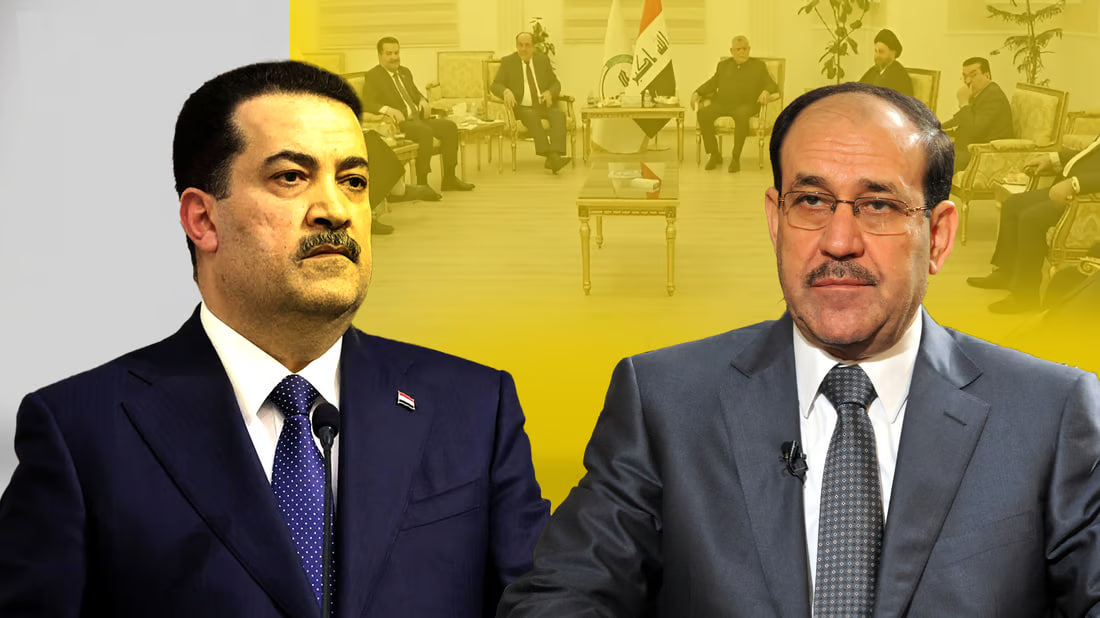
Mohammed Shia al-Sudani (left) and Nouri al-Maliki appear in a composite image against the backdrop of a meeting of Shia Coordination Framework leaders in Baghdad
Framework bargaining deepens
Sudani said to weigh ending bid for second term as Maliki pushes for return
BAGHDAD — Reports circulating late Saturday suggested Prime Minister Mohammed Shia al-Sudani had agreed to step aside in favor of former Prime Minister Nouri al-Maliki as the Shiite Coordination Framework weighs its nominee for the next government.
Sudani’s camp has not publicly confirmed an end to his bid and the framework has not named a candidate.
Multiple political figures contacted by 964media said Sudani’s standing weakened in the days and weeks following the election, as rival Shiite factions moved to consolidate support around alternative candidates. With the exception of Qusay Mahbuba, a member of Sudani’s Reconstruction and Development Coalition, no senior figure from the prime minister’s team has publicly confirmed that Sudani has relinquished his bid for a second term.
Mahbuba wrote late Saturday that “the Construction and Development Coalition and the State of Law Coalition are ending the ambitions of opportunists and climbers and ending the political deadlock within the Coordination Framework.” He added, “From this principle came Sayyid Sudani’s concession to Sayyid Maliki so that he would be the framework’s candidate to form the government.”
According to information obtained by 964media, Sudani’s reported decision to end his bid, which he has not officially acknowledged, emerged in the context of internal negotiations after his candidacy failed to secure broad backing within the Coordination Framework. Sources said discussions included whether Maliki could overcome objections tied to his previous tenure.
Those talks, sources close to the negotiations said, also turned on whether Maliki could secure what was described as “non-objection” from the Shiite religious authority in Najaf, represented by Grand Ayatollah Ali al-Sistani. Sistani effectively ended Maliki’s bid for a third term in 2014 when he called on political forces to choose a “new” prime minister. It remains unclear whether that stance constitutes a permanent veto, as Maliki’s critics argue, or a position tied to circumstances that have since changed, as his supporters contend.
Maliki previously served as prime minister from 2006 to 2014. He secured a second term after the 2010 election but stepped down in 2014 under intense domestic and international pressure after the collapse of army defenses and the fall of Mosul to the Islamic State group.
The office of Grand Ayatollah Ali al-Sistani in Najaf has publicly reiterated that the religious authority will not interfere in choosing the country’s next prime minister. The statement, issued through Ali al-Sistani’s son, Mohammed Reza, came after Shiite Coordination Framework leaders reportedly asked whether they could submit potential candidates for Sistani’s approval. The office questioned why repeated attempts were being made to involve Sistani, citing his long-standing position of non-interference.
In the Nov. 11, 2025, parliamentary election, Sudani’s Reconstruction and Development Coalition finished first with 46 seats, followed by Maliki’s State of Law Coalition with 29. Despite the commanding lead on polling day, Sudani did not secure dominance inside the Shiite Coordination Framework, which later declared itself the largest bloc in parliament, giving it the constitutional right to nominate the candidate for prime minister.
A senior official from Sudani’s team, who requested anonymity, acknowledged that Sudani had discussed stepping aside after failing to secure consensus, but rejected conclusions portraying the outcome as settled. “I don’t know why some believe that Sayyid Maliki is only steps away from the palace,” the official said.
The official pointed to the Coordination Framework’s most recent statement, saying, “The framework’s statement is clear – there is no consensus, not even a preliminary agreement, on nominating Sayyid Maliki.”
Based on sources inside Sudani’s camp and other political sources, any understanding regarding Sudani’s exit depended on full framework agreement, a condition that has not been met. The framework’s statement issued Saturday did not name any candidate.
Discussions remain open over what would follow if Maliki fails to overcome these obstacles, and whether Sudani could reenter the race. Political analyst Haider al-Barzanji, who is close to the government, said that “Sudani’s nomination has ended in all cases,” while another adviser said the door could reopen for Sudani only if Maliki’s candidacy collapses under internal opposition.
Sources familiar with the past three days of negotiations said Maliki’s candidacy triggered objections from several influential actors, including the Najaf religious authority, Hikma Movement leader Ammar al-Hakim, Asaib Ahl al-Haq leader Qais al-Khazali and Sadrist leader Muqtada al-Sadr. Those figures, the sources said, have not signaled acceptance of returning the premiership to the Islamic Dawa Party.
Speculation that Maliki’s nomination could be part of a political maneuver intensified after congratulatory messages began circulating, including one from his relative Hussein Ahmed al-Maliki, known as Abu Rahab, and another from Sports Minister Ahmed al-Mubarraq.
On Saturday, the Coordination Framework said it held its 258th regular meeting at the office of Mohsen al-Mandalawi to continue discussions on forming the next government and naming a prime minister. The statement said the meeting featured “positive atmospheres and responsible discussions” that resulted in “important developments and advanced indicators in line with political stability and the country’s supreme interest,” without naming a candidate.
Meanwhile, Hussein Ahmed al-Maliki, the State of Law Coalition’s representative in Karbala governorate, congratulated Maliki on what he described as his nomination, saying he possessed “political and administrative experience and the ability to manage crises.”
In a separate televised interview, Ali Mazhar al-Kaabi of the State Support Bloc, the political wing of Kataib Sayyid al-Shuhada, recalled that Abu Alaa al-Walaei was “the first to write Sudani’s name on the board” during earlier Coordination Framework meetings. He said, “Maliki and Sudani are candidates on the first list, but there are close understandings to reach a solution to form the next government.”
Sources cited by Al-Ahd television, affiliated with Asaib Ahl al-Haq, also reported that Sudani had withdrawn from seeking a second term in favor of Maliki, shortly after reports by I-News that the framework had nominated Maliki. Those reports contrasted with earlier expectations from several political figures who said both Sudani and Maliki were likely to be sidelined, with competition narrowing to Intelligence Service head Hamid al-Shatri and State of Law figure Bassem al-Badri.