
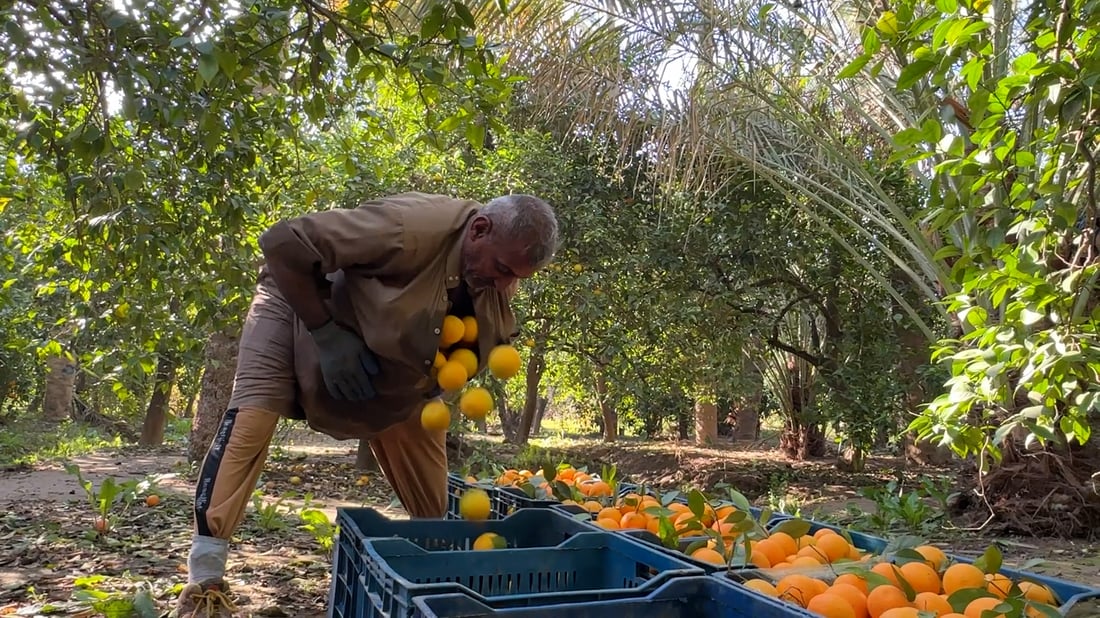
A farmer harvests oranges in an orchard in Al-Zuhairat village near Abu Saida, Diyala governorate, using a traditional method of carrying fruit in his dishdasha as the citrus picking season reaches its peak. (Photo: 964media)
Farmers Defy Rankings
Orange harvest begins in Diyala as officials estimate 44,000-ton season
DIYALA — Orange harvesting has begun across Diyala Governorate, with local agricultural officials estimating production at about 44,000 tons this season, a modest increase compared with previous years.
Munir Khalil, head of the forestry division at Diyala’s Agriculture Directorate, said the figures reflect stable yields as farmers enter the peak harvest period. In 2021, orange production in the governorate stood at about 42,000 tons.
964media documented harvesting activity in Al-Zuhairat village near Abu Saida subdistrict in Al-Muqdadiya, where farmers were seen using a familiar seasonal method to speed up collection. Wearing wide dishdashas, workers filled the garments with oranges before transferring the fruit to crates, a practice that has become a hallmark of the local harvest.
Diyala has long been known as Iraq’s “city of oranges,” with citrus orchards lining the banks of the Kharisan River, whose fresh water has historically supported large-scale fruit production. In recent years, however, Salah al-Din governorate has surpassed Diyala’s output, producing about 50,000 tons annually, while Baghdad remains among the country’s leading orange producers.
Orange trees in Iraq typically begin bearing fruit within three years, can live for up to 50 years, and may produce as much as 200 kilograms per tree.
Some orchard owners dispute claims that Diyala has slipped to second place. Murtadha Samir, who owns an orchard in Al-Zuhairat, said seasonal conditions this year favored strong yields.
“The rainfall at the beginning of this season was beneficial for the fruit,” he said. “I reject the official statistics that say Diyala is second. Diyala can only be first in orange production.”
According to Ministry of Agriculture data from 2021, Iraq produced 157,690 tons of oranges nationwide. International agricultural statistics rank Iraq third among Arab countries in orange production, after Egypt and Morocco. At the same time, Iraq is the fourth-largest Arab importer of oranges, with annual imports exceeding $50 million.
Diyala’s orchards grow several varieties, including navel oranges, blood oranges and local types known for their distinctive flavor, alongside other citrus crops such as sour and sweet lime, citron, bitter orange and multiple mandarin varieties.
Samir said even small orchards in the area can yield large volumes. “The quality of Diyala oranges is linked to irrigation from the fresh waters of the Khrisan River, which arrive clear from lakes and springs,” he said.
In the fields, farmers Walahn Aboud and Ali Jasim take turns harvesting fruit. Orchard owners sometimes request oranges to be picked with leaves attached and at other times without, depending on market demand.