
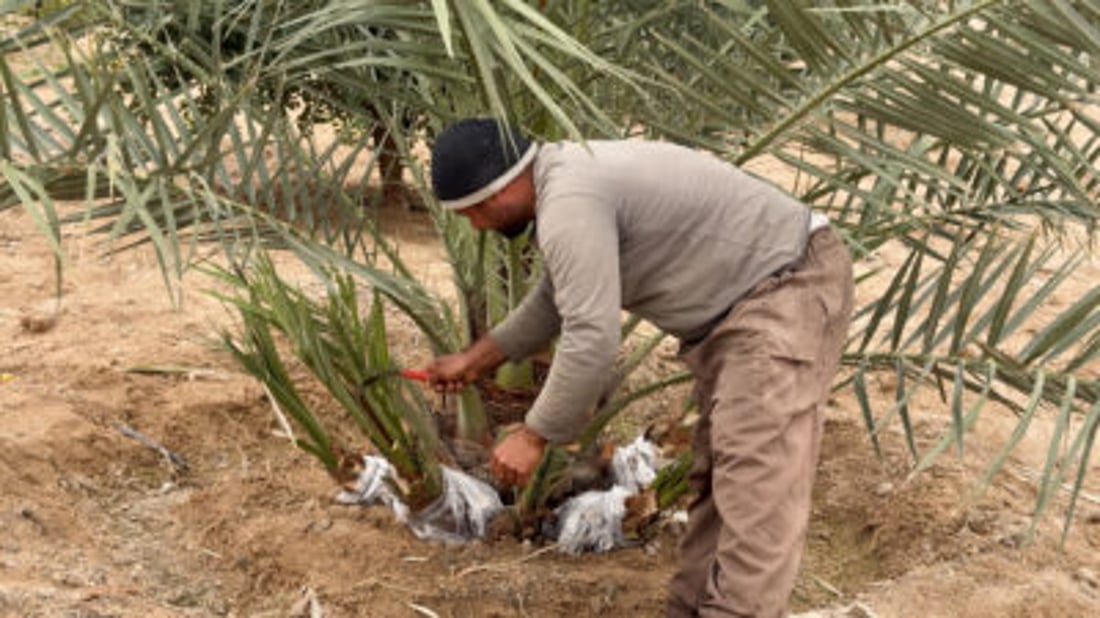
Interest grows in the Sukkari Al-Qassim variety in Basra for its high yield. (Photo: 964media)
Basra
Farmers in Zubair expand cultivation of Sukkari dates amid market demand
BASRA — Farmers in Basra are increasingly cultivating the Saudi-origin “Sukkari Al-Qassim” date palm, which has shown promising results in the Zubair district since its introduction in 2019.
Farmer Ali Abdul Zahra, who oversees this variety, said he expects the tree to thrive and spread further in Iraq in the coming years.
The Sukkari palm originates from Qassim, north of Riyadh, an area known for its dry climate. Abdul Zahra said the tree’s success in Zubair is due in part to similar weather conditions, allowing the palm to adapt with minimal care.
Farmers cited several factors contributing to the palm’s appeal: it yields up to 200 kg annually, begins fruiting within five years, and produces soft, high-quality dates with a conical shape and no outer skin, similar to other commercial varieties such as Medjool.
The tree also produces up to 15 offshoots, has a thick-trunked appearance similar to Iraq’s Barhi variety, and does not require special conditions for storage. These traits make it suitable for export, especially as prices for Sukkari dates can reach $10 per kilogram in Arab markets and beyond.
Abdul Zahra said market saturation and changing consumer preferences are also driving interest in new varieties. “There’s a kind of boredom with the dominant types like Barhi, Halawi, Khastawi, and Zahdi,” he said.
According to Abdul Zahra, about 300 Sukkari palms are now planted in Zubair.
The palm’s spread in Iraq has been supported by tissue culture propagation, replacing the traditional method of growing new trees from offshoots.
The Sukkari variety’s introduction comes amid renewed cooperation between Iraq and Saudi Arabia. Though a bilateral coordination council was established in 2017 to support joint agricultural efforts. The council has recently resumed its role, and in November Saudi experts had arrived in Iraq to assist with palm cultivation.