
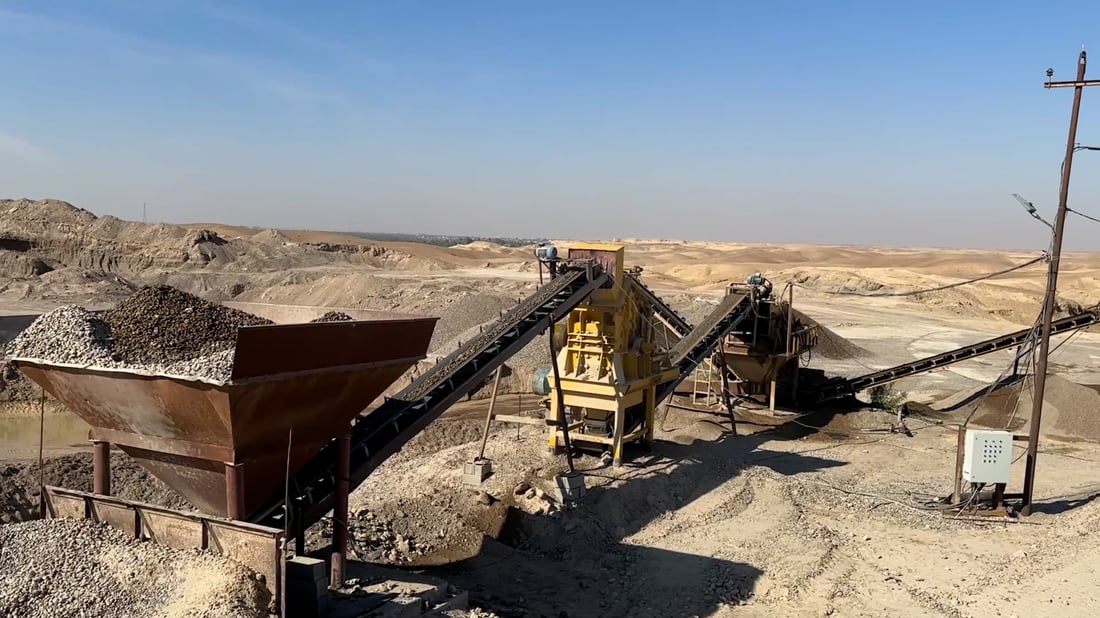
Crushing and screening equipment processes stone at the Aqeeq gravel and crusher plant in the Suwaib area east of Hit, where raw material is sorted into gravel, aggregate and sand for construction use across several Iraqi governorates. Photo by 964media.
From quarry to concrete
Anbar quarry near Hit supplies gravel for projects across Iraq
ANBAR — East of Hit, hard stone deposits in the Suwaib area are feeding construction sites across central and southern Iraq, with a local plant producing washed and graded materials used in concrete, asphalt and block production.
At the Aqeeq gravel and crusher plant, stone is excavated from the quarry, washed and separated by size through a multi-stage process. Large stones, known locally as “jalmoud,” are used for foundation bedding in soft soil areas, while standard gravel is supplied for concrete. Smaller aggregate and sand are shipped to block and asphalt factories, workers said.
Plant manager Ahmed Najah said the facility relies on Egyptian technical expertise to operate and maintain its machinery, including a maintenance team led by technician Ali Fadhloun. Najah said production can reach up to 15 trailer loads per hour.
“The first stage is stripping the soil and extracting the good layer and separating it from bad soil or loose gravel,” said excavator operator Mohammed Hassan. “The usable soil is transported to the plant.”
He added, “From the top layer we know whether the soil is good or not. Its quality shows in its appearance and whether it is free of impurities. The excavator reveals this from the first scoop, and we also know the depth of the layer underneath.”
Driver Marwan Fadhil said his role follows extraction. “I am responsible for the second stage, which is transporting the mixed material from the quarry to the plant using the dump truck,” he said.
Inside the plant, industrial screens sort material by size. “In the third stage, the materials go up to the screen to be classified into gravel, small aggregate used in block production, large stone and sand,” said plant operator Mustafa Hashem. “The mesh used prevents any stones larger than the required jalmoud size from passing through.”
Fadhloun said oversized stone is processed again. “The jalmoud produced by the plant is handled in other stages, starting with transport by loader, then feeding it into the hopper, onto the conveyor belt, then to the crusher and the screen to be separated into gravel, small aggregate and sand,” he said.
“My work is technical maintenance for crushers and plants,” he said. “The plant owner contacted me and helped me move from Egypt to work here in crusher maintenance, because crushers need hard work and precise operation. The hammers are very expensive, and the cost of a single one can reach $2,000.”
Fadhloun said each material has a specific use. “Large gravel is used in pouring and concrete because it is strong. Small aggregate is used in block factories and asphalt, and sand is also used in block production and asphalt plants because it is free of impurities,” he said.
Customers say quality is a key factor. “I came from Ramadi to this plant to buy gravel,” said Ahmed Khaled Awad. “We have plants in Ramadi, but their production contains a percentage of impurities and sand, which causes cracks in concrete pours. The gravel here is subject to laboratory testing.”
Najah said demand comes from across the region, including Ramadi, Baghdad and several southern governorates. He said the plant produces both natural and crushed gravel, depending on project needs.
“Each project owner orders the type they need,” he said.
Najah said the quarry’s location near the Euphrates helps keep production clean.
“The quality of the soil and the quarry’s proximity to the Euphrates River gave us a major advantage over other plants that rely on well water,” he said. “We wash the materials with river water, which makes our production clean and superior in laboratory results.”
Najah said output ranges “between 10 and 15 trailer loads per hour, equivalent to 50 to 60 trailer loads per day,” with distribution covering Hit, Ramadi, Baghdad and parts of southern Iraq.