
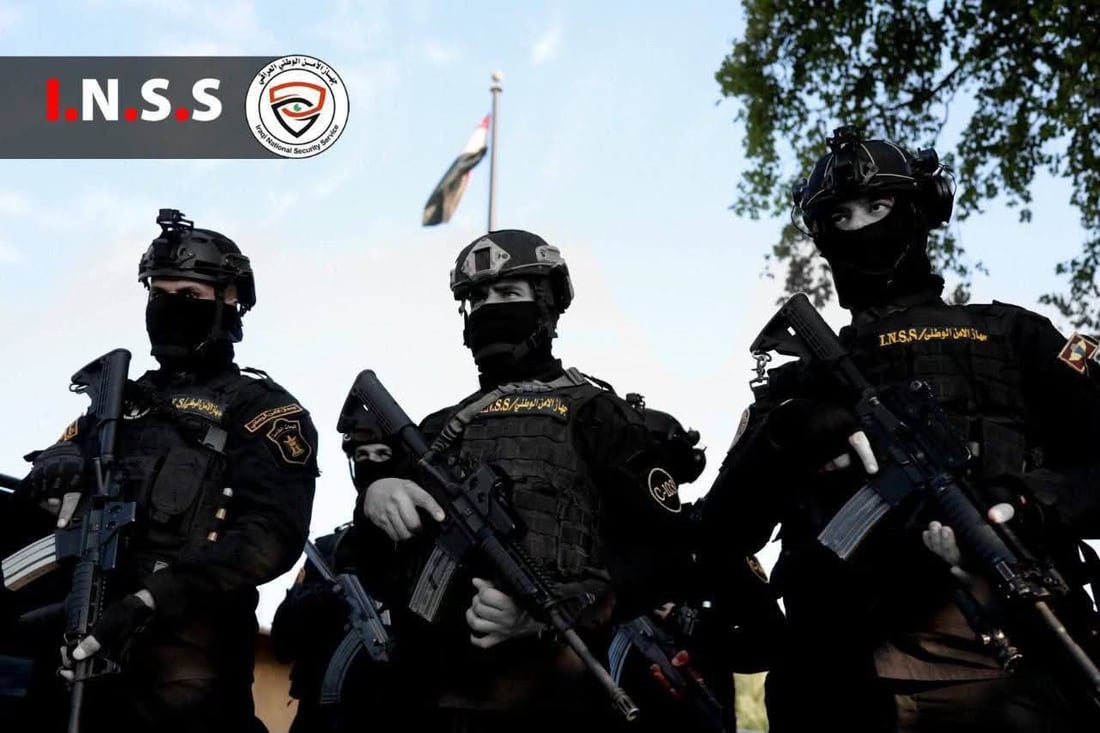
Members of Iraq’s National Security Service. (Photo: Official Facebook page of INSS)
Alleged ISIS explosives expert caught after years in hiding
BAGHDAD — The National Security Service on Tuesday announced the arrest of an alleged explosives expert affiliated with Islamic State group upon his return to Iraq from a neighboring country, following more than 10 months of surveillance.
In a statement, the agency described the operation as an “intelligence-led effort” that resulted in the capture of “one of the most dangerous leaders of ISIS.” The suspect, known by the alias “Abu Aliaa,” was reportedly involved in militant activity since 2004, beginning with al-Qaeda in Baghdad.
The statement added, “He specialized in preparing explosive devices and led a five-member unit responsible for carrying out attacks.” Investigators found that he had delivered over 100 explosive devices and was directly involved in operations targeting various areas in the capital.
According to the agency, “He was responsible for linking explosive devices to mobile phones and had advanced expertise in executing double explosions—an approach designed to target rescue teams and security forces responding to initial blasts.”
During military operations to reclaim territory, the suspect moved to Salah Al-Din and Kirkuk, changed his alias to “Abu Mustafa,” and became head of communications, overseeing the encryption and deployment of communication systems, the agency said.
Following the collapse of ISIS in Iraq, the suspect fled the country and remained in hiding for years. “Thanks to sustained intelligence efforts, the National Security Service was able to track and arrest him,” the statement read.
ISIS, sometimes called the Islamic State of Iraq and Syria, began as an armed faction in Iraq and in June 2014 declared a “caliphate” after seizing large areas in Iraq, including Mosul, and parts of Syria. The group lost most of the territory it once held by November 2017 following military campaigns by Iraqi forces and international partners.
Although it no longer controls territory, ISIS remnants continue to operate as an underground insurgency, using small cells, roadside bombs and hit-and-run attacks in remote areas such as parts of Anbar, Diyala, Salah al-Din and Kirkuk.