
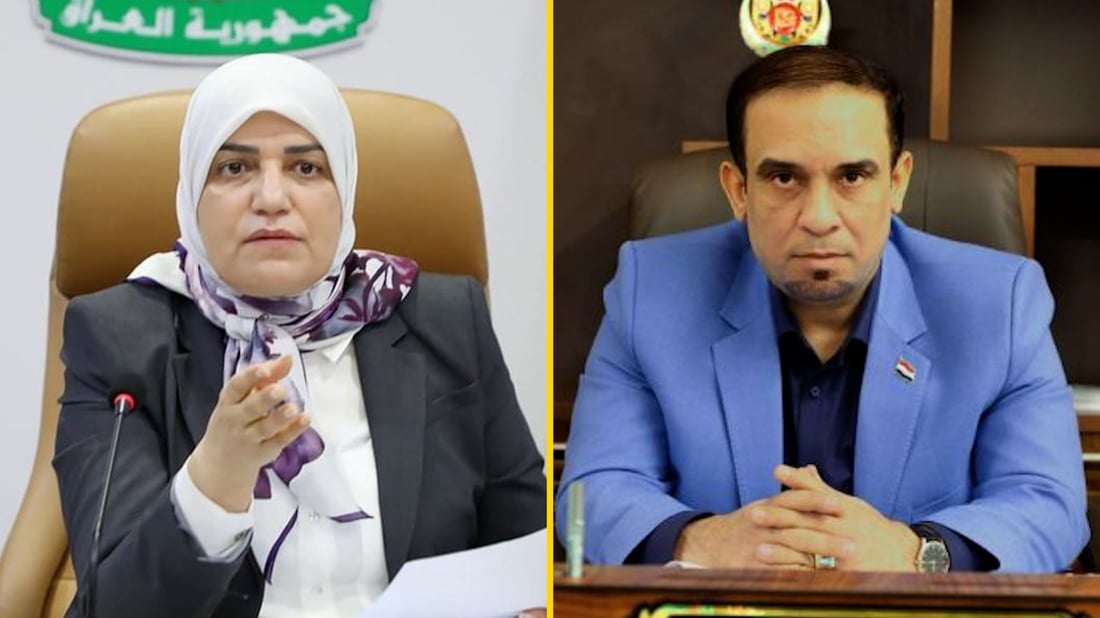
Finance Minister Taif Sami (left) and Basra Contractors Union head Hussein Fadel (right) appear separately in recent photos as tensions rise over unpaid dues and calls for a public debate on the fate of contractors’ funds.
Basra contractors chief challenges finance minister over unpaid dues
BASRA – The head of the Basra Contractors Union escalated a growing dispute with Iraq’s Finance Ministry on Saturday, accusing Minister Taif Sami of denying “obvious facts” about unpaid project dues and challenging her to a televised debate over what he described as missing funds.
In a statement, union chief Hussein Fadel said contractors in Basra and other governorates are facing the “seizure” of their financial entitlements and claimed that the money has been diverted to unknown destinations. He said the public and oversight bodies, including parliament, “do not know where hundreds of trillions” were spent.
Fadel accused the minister of avoiding direct talks with contractors and said he stands firmly behind Ali Fakher al-Sanafi, president of the Iraqi and Arab Contractors Union, warning against “targeting or pressuring him.” He described al-Sanafi as “the conscience of the wronged contractor.”
The Basra branch said it “holds the outgoing prime minister and the finance minister fully responsible for any targeting or constraint” directed at al-Sanafi. It said branches across all governorates back the national union’s leadership and reject “pressure and confusion” from the ministry, arguing that companies fulfilled government contracts but have not received their dues, while some foreign firms have been paid.
The union said it was “astonished” by the ministry’s latest statement responding to al-Sanafi, accusing it of trying to “deny obvious facts” and “dance on the wounds of local companies.” It said entitlements remain frozen and that local firms are suffering losses because of decisions taken by the minister, adding that contractors have repeatedly sought, and been denied, a meeting with her.
Fadel called on Sami to appear with him in an open televised debate to explain the status of contractors’ dues and what he characterized as large public funds whose use remains unclear even to lawmakers. He said the Basra union’s media unit has collected interviews with members of parliament “who say they do not know” how the government spent the money.
The dispute follows a sharp exchange between the national contractors union and the Finance Ministry. On Friday, the ministry rejected remarks al-Sanafi made in a televised interview and said the minister “did not receive any female member of parliament to negotiate debts,” countering his claim that an MP had been sent to tell contractors “there is no money” and that projects should be halted.
The ministry said it had provided the union’s representative with Cabinet Decisions 435 and 721 of 2025, which together allocated 2 trillion dinars (about 1.42 billion dollars), along with tables covering 25 percent of contractors’ dues. It said it financed 1,371,451,904,190 dinars (about 973 million dollars) for ministries and 1 trillion dinars (about 709 million dollars) for governorates, and that remaining delays were tied to procedures by the Planning Ministry. It added that all actions took place “with the knowledge and approval” of the union’s representative.
In his interview on INEWS, al-Sanafi said the government paid “only 30% of the dues for bottleneck-relief projects” and claimed the minister had refused to meet contractors “for two months.” He said companies working on bridges were “the most harmed,” with many receiving “20 to 25% at best.”
Contractors’ unions across several governorates have threatened to escalate. In Diyala, the local union said it “holds the finance minister fully responsible for any insult or harm that may befall Mr. Ali Fakher al-Sanafi,” after the ministry pushed back on his comments.
In Dhi Qar, deputy union head Hussam Aqil al-Sakkar al-Saeedi said more than 30,000 families tied to the sector have lost their income because payments have stalled. Contractor unions in Baghdad and Basra have also staged protests, with Basra leaders warning that continued delays risk “near-total paralysis” in key service projects.