
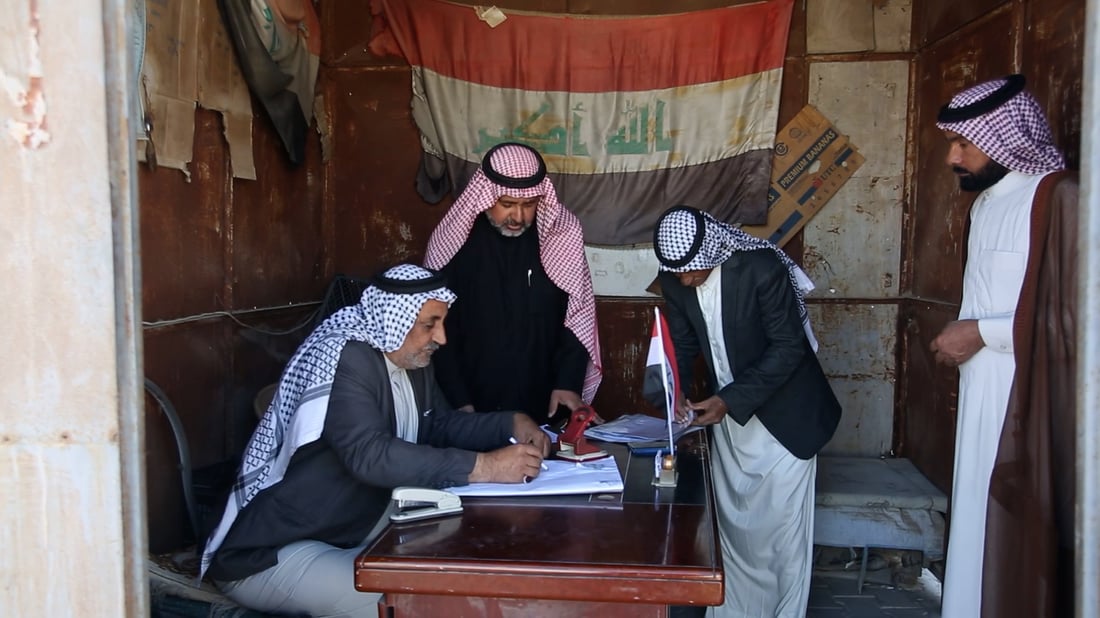
Mukhtars in Samawah work from a makeshift office made of sheet metal, handling documents and assisting residents with daily administrative needs. The group says many rely on such temporary spaces due to the absence of official facilities. Photo by 964media.
Iraq’s mukhtars warn of burnout as unpaid allowances strain century-old role
SAMAWAH — Community leaders and legal experts in Samawah say thousands of mukhtars across Iraq are working under growing financial and administrative pressure, with some considering resignation as promised allowances remain unpaid. They describe themselves as the state’s “first door,” the point of contact between residents and government agencies, yet many operate without offices and rely on caravans or sheet-metal shelters.
The mukhtar system dates back to Ottoman administrative reforms in 1831, when the empire restructured local governance. Historical records show mukhtars were tasked with relaying government orders, collecting revenues, delivering summonses and reporting injuries and deaths — duties that shaped the modern position.
Attorney Haider Al-Awadi said the role remains indispensable. “There is a need for this function as it forms a link between the citizen and the government,” he said. He added that mukhtars know every family in their neighborhood and are more accessible than security institutions. “I do not believe there is an alternative to the mukhtar,” he said.
Muhsen Ibrahim, the representative of mukhtars in Samawah, said they provide information to security and service agencies but face marginalization because they are not formally recognized as government employees. “Law No. 13 of 2011 has not been implemented,” he said, noting that mukhtars are entitled to a monthly payment of 250,000 dinars and an equipped office — benefits they say remain largely unavailable. Muthanna has 175 mukhtars, and nationwide estimates range between 17,000 and 20,000.
Ibrahim said local efforts are underway to open a dedicated office for mukhtars to improve coordination with communities and government departments.
In Karama subdistrict, mukhtar Kazem Lodi described a demanding job with limited compensation. “What can we do with this in these hard times?” he said of the 250,000-dinar monthly allowance. He added that an additional 100,000 dinars recently directed by Prime Minister Mohammed Shia Al-Sudani has not been disbursed. Some mukhtars, he said, are considering stepping down because of financial strain.
Lodi said the responsibilities extend far beyond paperwork. Mukhtars verify documents for job applications, assist residents with procedures, and accompany security forces during nighttime arrest operations. “We sit here from early morning to help citizens, and at night we receive security units at home,” he said.
Mukhtar Khalid Mahal Awad described the same pressures, saying much of the work is effectively “24 hours” and involves coordinating with courts, police and intelligence services. He said mukhtars have yet to receive land plots or service-year credits promised under the law. Their current workspace, he said, is a sheet-metal shelter purchased at their own expense. “We ask the government to build a new facility to protect documents from the rain and summer heat,” he said.