
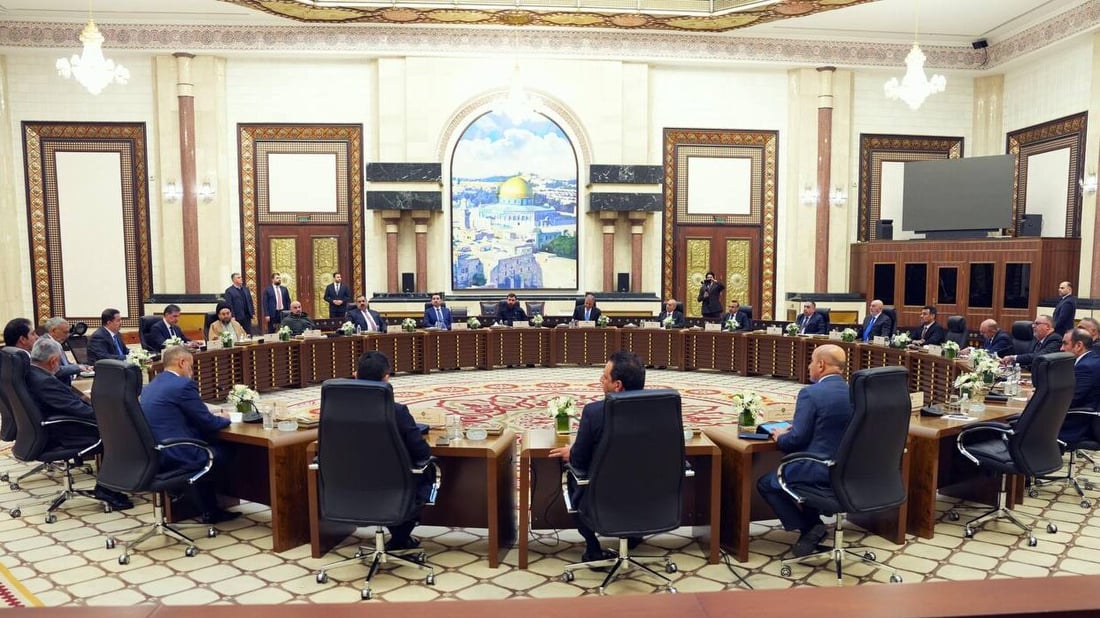
FILIES: Leaders of the ruling Coordination Framework during a regular meeting at the office of State of Law Coalition head Nouri al-Maliki in Baghdad.
Post-election bargaining
Analysts expect lengthy talks to form Iraq’s largest bloc
BAGHDAD — Political analysts say Iraq is likely to face extended negotiations before a largest bloc emerges to nominate the next prime minister, warning that divisions among major parties will slow efforts to form the new government.
Kifah Mahmoud, speaking to the state-owned Al-Sabah newspaper, said “reaching the largest bloc will not be quick due to differences among the main political forces,” describing its formation as the product of “complex understandings.” He said a repeat of the attempted 2021 tripartite alliance between the Sadrist Movement, the Kurdistan Democratic Party, and the Taqadum Party is unlikely, though he noted that “the door remains open to flexible cooperation formulas” in the coming weeks.
Ali Habib, another analyst, said the current political landscape is marked by “a relative balance between components, which provides room for dialogue and understanding.” He added that the size of alliances will determine which side can form the next government, emphasizing that “political customs in place since 2003 still play an important role in maintaining political balance.”
Ammar al-Azzawi, head of the Yarmouk Center for Strategic Studies, said parties this year appear more inclined “to avoid internal conflicts and to be open to joint solutions,” adding that political norms continue to shape “more calm and clearer negotiations.”
Political analyst Mohammed Zangana said “the competition for positions began as soon as the counting and sorting ended,” pointing to the distribution of the three presidencies as a central question for parties. He said talks over the next prime minister will be “the most complex,” and expected negotiations to continue “for weeks or possibly months” before a consensus is reached.
Iraq’s Independent High Electoral Commission released preliminary results from the Nov. 11 parliamentary elections on Wednesday night. According to 964media projections, Prime Minister Mohammed Shia al-Sudani’s Reconstruction and Development Coalition leads with 46 expected seats, followed by Mohammed al-Halbousi’s Taqadum Party and Nouri al-Maliki’s State of Law Coalition with 29 seats each.
The Kurdistan Democratic Party is projected to win 28 seats after receiving nearly 1.1 million votes nationwide. Qais al-Khazali’s Al-Sadiqoun Movement is expected to take 27 seats. Other blocs include Ammar al-Hakim’s National State Forces Alliance with 19 seats, Hadi al-Amiri’s Badr Organization with 18, Bafel Talabani’s Patriotic Union of Kurdistan with 18, and Muthanna al-Samarrai’s Azm Alliance with 15.