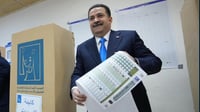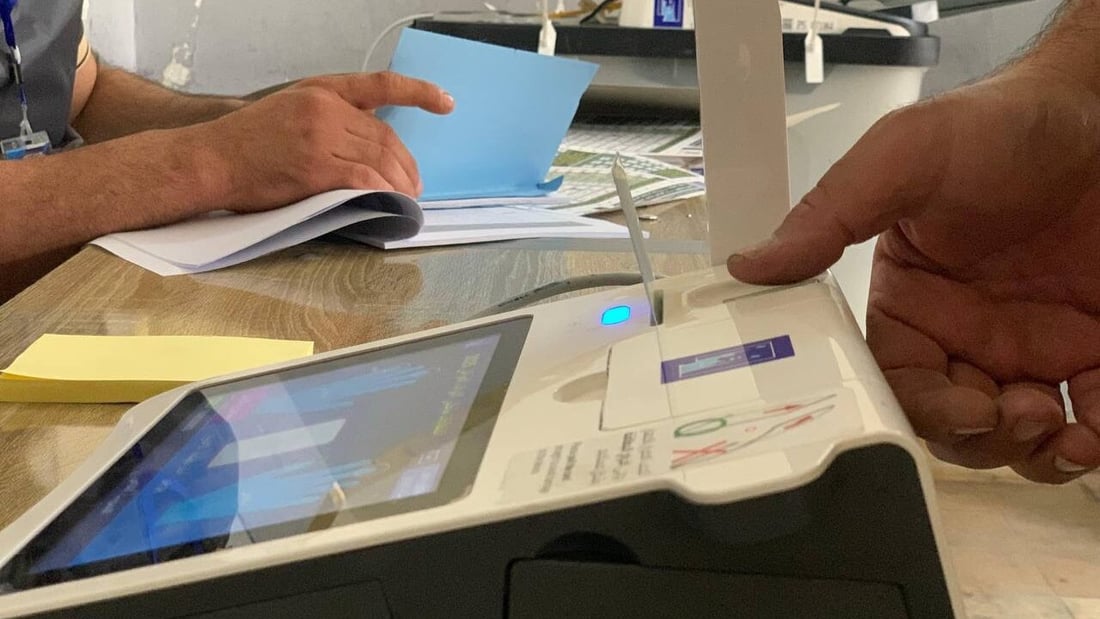
An election worker assists a voter using an electronic verification device at a polling station during Iraq’s 2025 parliamentary elections on Tuesday.
Monitor
What Iraq’s political leaders are saying as they cast their votes in parliamentary election
BAGHDAD – As Iraqis went to the polls Tuesday morning for the 2025 parliamentary elections, several political leaders welcomed the smooth start to voting and urged wide participation, framing the day as a test for Iraq’s next four years.
Voting began at 7 a.m. across all 19 governorates under tight security, following Sunday’s special vote where turnout reached 82.52% among security forces and displaced persons. The Independent High Electoral Commission said more than 20 million voters were eligible to cast ballots to choose the next Council of Representatives.
Iraqi Prime Minister Mohammed Shia Al-Sudani
Prime Minister Mohammed Shia Al-Sudani cast his ballot in Baghdad, describing the process as calm and organized.
“The 2025 parliamentary elections are taking place in a secure and stable atmosphere,” he said at a press conference. “We fulfilled our commitment in the government program to hold elections, and we ensured the presence of international observers in the parliamentary vote.”
Al-Sudani said the government placed particular emphasis on a peaceful transition of power. “The government paid great attention to the peaceful transfer of power, and holding elections on time confirms this principle,” he said. He added that “the citizen chooses responsibly and consciously who represents them in parliament.”
Kurdistan Region President Nechirvan Barzani
In the Kurdistan Region, President Nechirvan Barzani voted at a polling station inside the Rotana Hotel in Erbil. “This election is one of the most important in Iraq,” he told reporters.
Barzani urged citizens of the Kurdistan Region “to feel their responsibility today and head to the ballot boxes,” expressing hope that “these elections will mark the beginning of a new phase for Iraq.”
He added, “The Kurdistan Region must be strong in Baghdad,” and said, “We do not reject dialogue with anyone.”
Kurdistan Regional Government Prime Minister Masrour Barzani
Kurdistan Regional Government Prime Minister Masrour Barzani voted in the Pirman area of Erbil and described the moment as decisive for Iraq’s future.
“It is the people’s decision day,” he said. “I hope citizens can vote freely and peacefully according to their wishes, and that they elect patriotic and loyal representatives to defend their rights and constitutional entitlements.”
He called the election “an important one,” expressing hope that “people will decide today, away from all pressure, because today’s decision will determine the path and governance style for the next four years.”
Barzani added, “We hope the commission handles the entire process with integrity until the end,” and concluded, “I wish success to everyone and hope all citizens vote today.”
Nouri Al-Maliki, State of Law Coalition leader
State of Law Coalition leader Nouri Al-Maliki said he was pleased that the elections were held as planned and portrayed their completion as a victory over attempts to derail the process.
“We succeeded in completing the elections, and this is the first step in the path of the political process,” he said. “There were attempts to disrupt the elections, but we prevailed and congratulate the Iraqi people and political forces for insisting on holding them without delay.”
Al-Maliki said high turnout is expected and urged citizens “to send a message to those betting on the failure of the elections.”
He described election day as “a day of joy,” and added, “We came early to call on all Iraqis to head to the polls because it is a great day for us. We hope all political forces and communities take part to fight corruption.”
Qais Al-Khazali, secretary-general of Asaib Ahl al-Haq
Qais Al-Khazali, secretary-general of Asaib Ahl al-Haq, focused on the integrity of the process and the role of political forces in keeping it free from outside pressure.
“There will be no tampering in the elections or interference in forming the government after the vote,” he told the Iraqi News Agency. “The political forces, especially the Coordination Framework, are acting responsibly and will not accept any external interference.”
Al-Khazali said he hoped these elections would see the highest participation yet.
“This is the day on which Iraq’s future for the next four years is built,” he said. “Iraq is no longer a young democracy. We are building a better future.”
He praised the security forces’ early voting as “a message for all Iraqis to follow the same path of participation,” and said turnout would be “wider than in previous elections and a message to the region and the world that democracy in Iraq is established and the Iraqi people are hopeful.”
Khamis Al-Khanjar, head of the Sovereignty Alliance
Khamis Al-Khanjar, head of the Sovereignty Alliance, framed the day as both a celebration and an opportunity for political renewal.
“We congratulate the Iraqi people on this electoral celebration and urge all Iraqis to participate widely because these elections determine Iraq’s destiny for the coming period,” he told the Iraqi News Agency.
He said the elections mark “a strong launch toward change” and expressed hope for a quick path to government formation, saying he wanted “a smooth process leading to quick understandings among all political sides to form the next parliament.”
Ammar Al-Hakim, leader of the Al-Hikma Movement
Ammar Al-Hakim, leader of the Al-Hikma Movement, linked Tuesday’s vote to Iraq’s first post-2003 elections and argued it could set the course for long-term stability.
“Just as the 2005 elections established democracy, this vote lays the foundation for sustainable stability for the next twenty years,” he said. “Participation and good choices will put Iraq on the right path. Voting takes only minutes, but its results last for four years.”
He said there was “a political will among all leaders to move quickly in forming the government,” and described Iraq as recovering politically.
“Among the signs of recovery are the understanding with the international coalition to end its mission in Iraq, the conclusion of UNAMI’s work by the end of this year, and the determination to form the new government swiftly,” he said.