
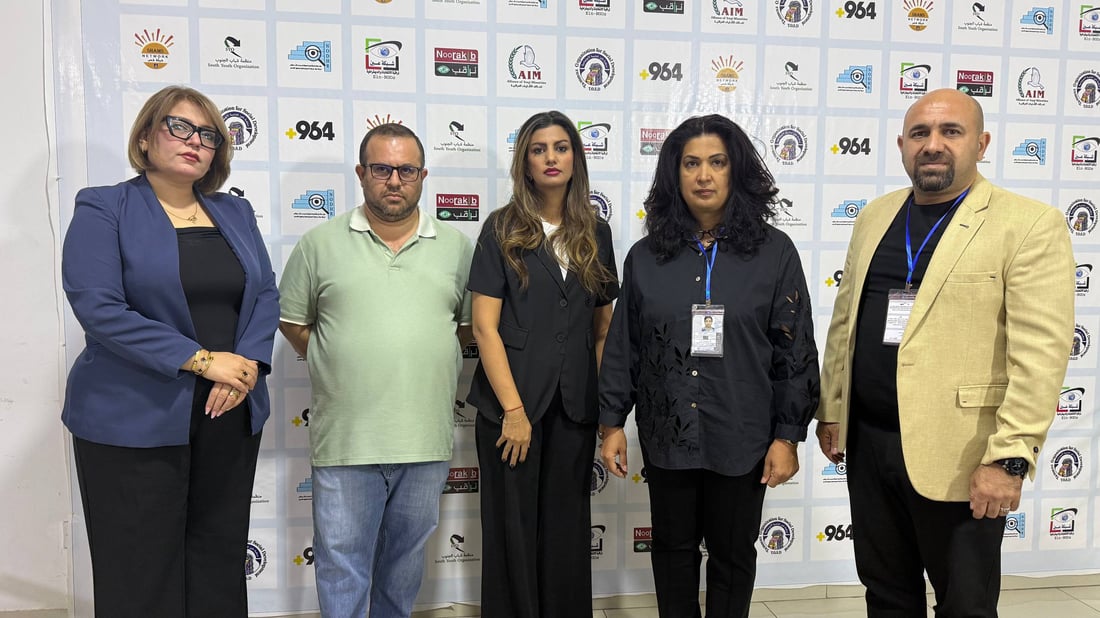
Members of Iraq’s Coalition of National Networks and Organizations for Election Monitoring present their first report on the 2025 parliamentary elections in Baghdad on Monday.
Election monitoring coalition reports over 3,200 violations during Iraq’s special vote
BAGHDAD — Iraq’s Coalition of National Networks and Organizations for Election Monitoring said Monday it recorded 3,273 incidents and violations during Sunday’s special voting day for the 2025 parliamentary elections, covering all 18 governorates. The findings were detailed in the coalition’s first comprehensive report evaluating the process.
The coalition said the irregularities involved organizational, technical, and security-related issues, along with infringements on voter rights and political interference. The report was based on 8,347 electronic monitoring forms compiled by thousands of trained observers who tracked each stage of the process — from opening and voting to closing, counting, and manual verification.
“The monitoring operation sought not only to document violations but to promote accountability, improve performance, and ensure that voter rights are respected in a fair and secure environment,” the report said.
According to the coalition, technical problems accounted for 35% of violations, including device malfunctions, failures in electronic transmission, and issues printing result slips. Delayed openings and procedural disruptions represented 25%, security-related incidents 20%, procedural breaches 15%, and logistical issues 5%.
Among the reported problems were delayed openings, missing staff in Diyala and Najaf, and breakdowns in electronic verification systems. The coalition also cited voting without official identification in Baghdad and Nineveh, group voting, and the use of mobile phones inside polling centers in Muthanna and Baghdad.
Differences between manual and electronic results were observed in some governorates, particularly Erbil and Babil. The report also documented interference by security forces in Baghdad and Anbar, pressure from party representatives in Nineveh and Sulaymaniyah, and 28 cases of threats and harassment. Restrictions on the movement of monitors and political agents were reported in several areas.
The coalition said 86 cases involved political agents being denied entry to polling stations, 89 involved monitors barred during the opening phase, and 23 cases involved voters being turned away.
“The variation in performance between governorates reflects differences in training and readiness levels,” the report said. “Some polling stations showed high compliance with procedures, while others faced serious irregularities.”
The coalition said the findings highlight “structural challenges that still hinder Iraq’s electoral process,” urging the Independent High Electoral Commission and other authorities to implement “comprehensive corrective measures” to improve oversight, strengthen administration, and safeguard the neutrality of security forces.
According to the Independent High Electoral Commission, Sunday’s special vote saw 82.52% turnout, with 1,084,289 security personnel and 20,527 displaced voters participating. The general vote is scheduled for Tuesday, November 11, with 7,768 candidates competing for seats in Iraq’s Council of Representatives.