
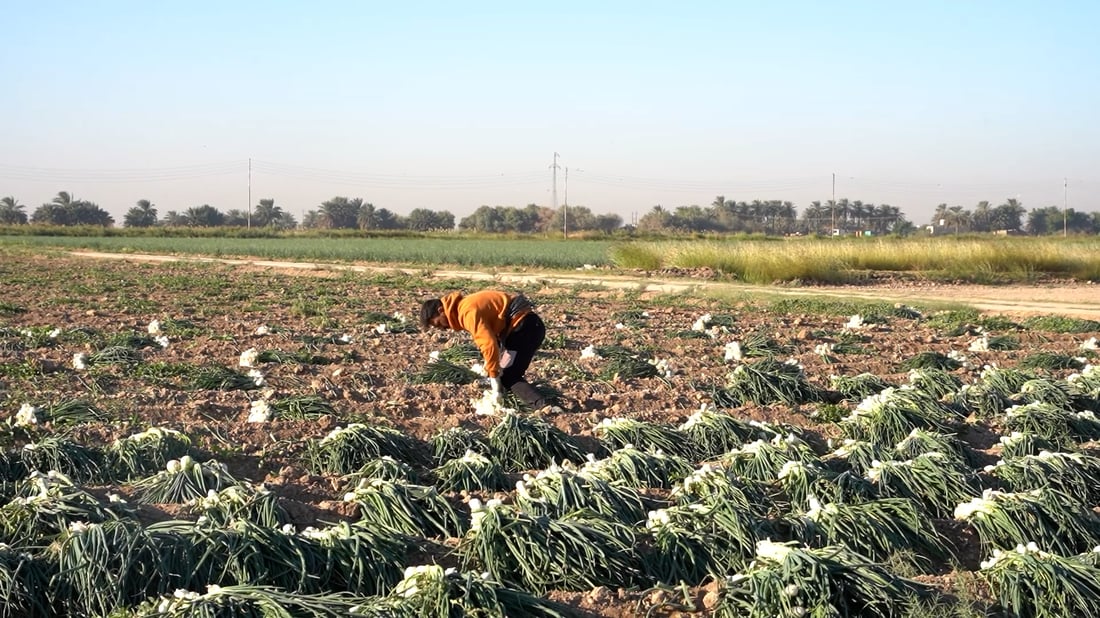
A farmer harvests green onions in Dahara, between Kut and Al-Nu’maniya, during Iraq’s peak onion season. Farmers say prices have fallen below 250 dinars ($0.18) per kilogram due to heavy imports. Photo by 964media.
Wasit farmers struggle with low onion prices and water shortages
KUT — Iraq produces nearly 33,000 tons of green onions each year, with one-third coming from Najaf, followed by Baghdad and Wasit governorates. The harvest season begins in early November, when farmers prepare crops for sale across the country. In the Dahara area between Kut and Al-Nu’maniya, farmer Karim Al-Barkawi, 53, said prices have dropped to less than 250 dinars ($0.18) per kilogram, slowing sales despite strong yields.
Al-Barkawi, who supports 13 families through farming, said the season begins with plowing, digging irrigation channels, and planting seedlings in August. “During the growing period, irrigation water is not available in sufficient quantities, and this is a big problem in green onion farming,” he said.
He added that green onions from central and southern Iraq differ from those grown in Kurdistan, Nineveh, Salah al-Din, Iran, and the Levant. “Our onions are thicker and rounder, while those from the north and outside Iraq are slimmer and softer,” he said. “We believe this is due to the soil salinity and fertility in our areas, which affects both size and taste — and helps the crop grow and ripen with less fertilizer.”
“Despite the quality of our onions, we face difficulties in marketing,” Al-Barkawi said. “We send our produce to Basra, Nasiriyah, and Amarah, but it takes two days to sell a two-ton truckload. We sell the kilo for 200 to 250 dinars ($0.14–$0.18), which is very low because of heavy imports. Farming becomes a losing business since one dunam costs four to five million dinars ($2,857–$3,571) to reach production.”
Mohammed Hamad, director of planning and follow-up at Wasit Agriculture, told 964media that differences in onion size and shape depend on several factors. “It mainly depends on the type of seedlings, the method of hybridization and selection preferred by farmers, planting practices such as spacing, density, fertilization level, and harvest duration,” he said.
Hamad added that “onions in our areas are thick and full, which means they have received sufficient nutrition and nitrogen and had enough time to mature.” He said Wasit Agriculture monitors production through weekly reports, with current output reaching about five tons per day and rising rapidly.