
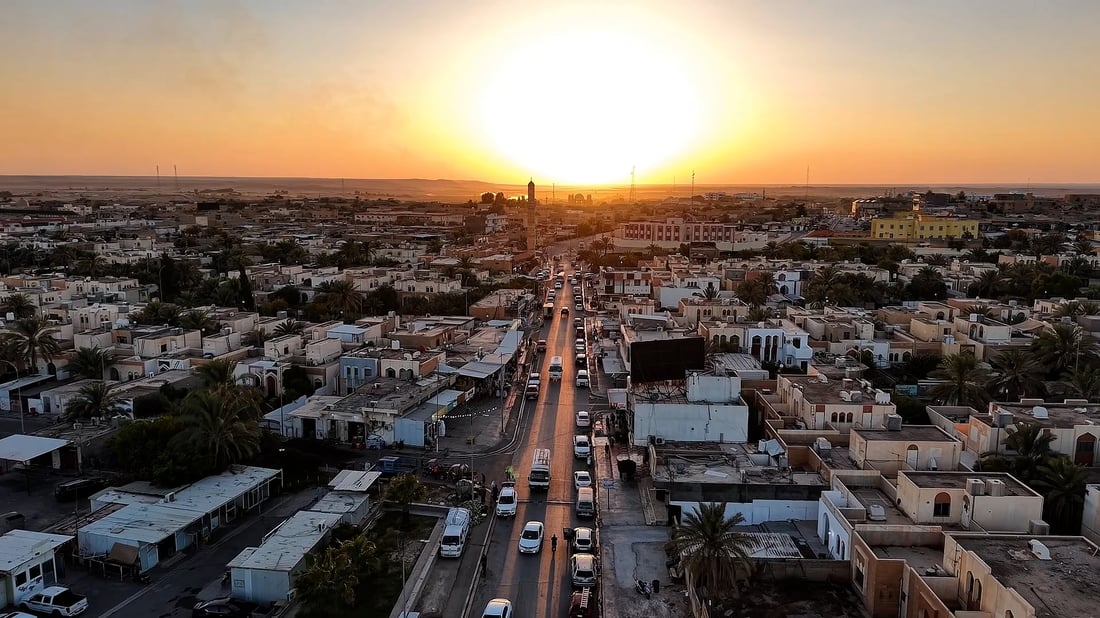
A view of Rawah in Anbar governorate at sunset, showing the city’s streets, houses, mosques, and palm trees along the Euphrates River. Photo by 964media.
Anbar
Rawah market sees downturn as women turn to delivery services
ANBAR – Traders in Rawah say their city’s market is losing its former vitality as many women, once the main customers, now order goods from Baghdad, Erbil, and Ramadi via delivery services. Shopkeepers describe the marketplace as increasingly resembling a weekly bazaar, with business picking up only during weekends and holidays.
Rawah, a quiet Euphrates city of about 20,000 residents, is divided into Old Rawah and New Rawah. Its market in New Rawah was once a cornerstone of local life, but merchants told 964media that shopping habits are shifting rapidly.
“For Rawah district, it is like other districts, but the population density is not large,” said Nadhim Al-Rawi, a fabric and furnishings seller with 25 years of experience. “Rawah has a medium-sized market and business is seasonal. For example, at the beginning of the winter season the sale of fabrics and all materials becomes active. Delivery services affected the market a lot. Before that, the market was better than it is now.”
Al-Rawi said his business depends largely on female shoppers. “During school days, activity is weak, because our biggest reliance is on families, especially women. We specialize in fabric trading, and we bring goods from Shorja market in Baghdad, and sometimes from Erbil, Mosul or Zakho if needed.”
Household goods vendor Saeed Hussein recalled when Rawah was a commercial center for nomadic tribes. “In the past, Rawah was a main destination for Bedouins, and the market was very active. Now, activity depends mainly on the district’s residents. Usually six days of the week pass with weak activity, while only one day sees noticeable movement,” he said.
He noted that the market now sees spikes only around the back-to-school season or major holidays. “At present the market focuses mainly on foodstuffs and vegetables,” Hussein added.
Grocer Hamdi Khalil, who has worked in the trade since the 1960s, described the town’s evolution. “The old market in the seventies consisted of two or three shops with some vegetable stalls. Cars were few, and farmers brought vegetables by tractor or on animals’ backs. Now Rawah has expanded and there are about thirty shops or more scattered across old and new Rawah, near the gas station and in Al-Qadisiyah neighborhood.”
He said the town is now known for its potato trade, though cotton and sesame were once its hallmark crops. “I have worked in vegetables since the beginning of the old market, from the sixties until today,” he said, naming earlier traders who specialized in rice, fabrics, oil, and soft drinks.
Cosmetics seller Youssef Abdulhamid said sales now closely follow the salary cycle. “The market clearly depends on holidays. When the school term starts, activity decreases, while during holidays it is strong. On religious occasions, it increases further. Most Rawah residents rely on salaries, so activity is strong at the beginning of the month, then gradually decreases by the middle and almost disappears at the end,” he said.