
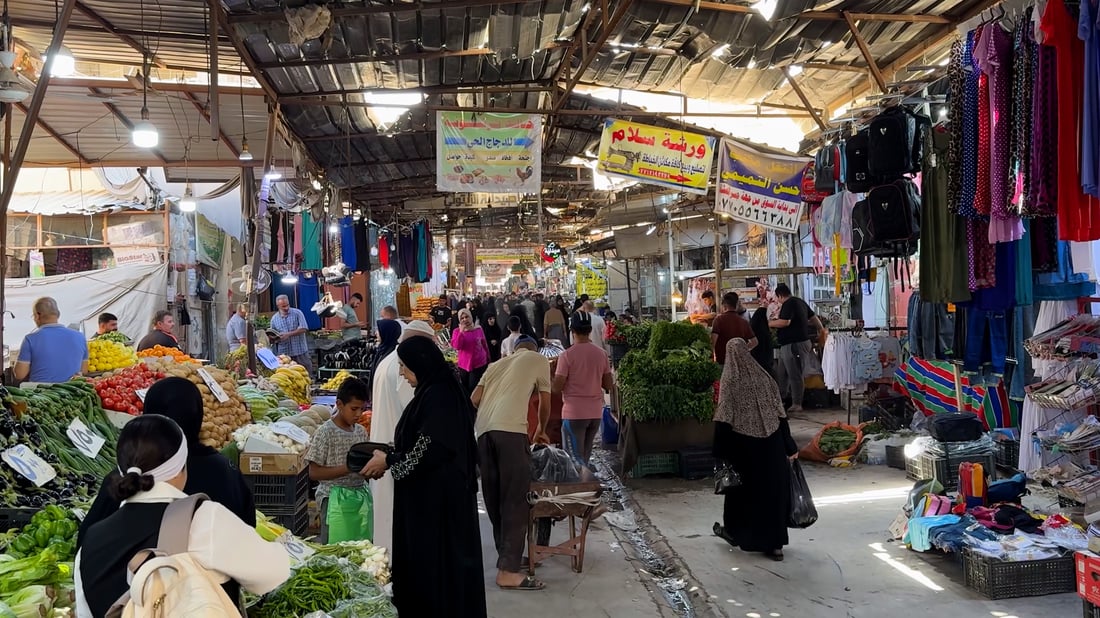
A scene inside Al-Mafraq Market in Baquba, Diyala. (Photo: 964media)
Baquba
With over 2,000 shops, Al-Mafraq Market serves as one of Diyala’s largest trading hubs
DIYALA — At a crossroads linking northern Baquba with Khan Bani Saad and the old road to Baghdad, stands Al-Mafraq Market, one of the largest commercial hubs in Diyala governorate. Once called Souq Al-Mukhtar after its founder, local mukhtar Khalil Al-Salih, the market today is home to more than 2,000 shops and stalls, employing between 3,000 and 4,000 people.
“It is called Al-Mafraq Market because it is located at a junction between northern Baquba, the Quds intersection on the new road, and the old Baghdad road,” said Saddam Sattar, a shop owner, in an interview with 964media. “When the market was established, it was named Souq al-Mukhtar after Khalil Al-Salih, may he rest in peace, who was the area’s mukhtar (local leader).”
Founded between 1965 and 1967, the market expanded rapidly in the 1970s and 1980s. It now stretches from the Fursan intersection to Al-Husseiniya Street, drawing shoppers from across Diyala, including Al-Khalis, Al-Muqdadiya, Khan Bani Saad, and Old Baquba.
“Al-Mafraq is an old, popular market and includes all professions from doctors and laboratories to grocers, butchers, and restaurants,” said Bassem Hashim, a real estate agent. He estimated daily financial turnover at 30 to 40 million dinars ($21,240 to $28,320), with goods sourced from Turkey, Erbil, Sulaymaniyah, Duhok, Baghdad, and imports from Iran, Saudi Arabia, and India. Turkish products remain the most in demand, alongside local Iraqi goods.
The market’s affordability is one of its defining features. “Its low prices make it an important support for poorer classes while also providing jobs,” Hashim said, noting that thousands rely on it for their livelihoods.
Despite its size and importance, the market faces challenges. Many shop owners extend displays into the street, obstructing movement. “What the market needs is administrative organization,” Hashim said. “Owners must be made aware not to exploit the street for displaying goods.”
Economic expert Haitham Raed told 964media that Al-Mafraq’s high level of financial activity highlights both opportunity and weakness. “The market reflects a complex economic reality,” he said. “It shows the fragility of living conditions in some surrounding areas that rely heavily on the market despite difficulties accessing it.”
Raed added that the market’s role underscores the need for more investment and job opportunities in Diyala. “This confirms the urgent need to create an investment environment in the governorate and provide opportunities for its people,” he said.