
Monitor
Iraq’s President Rashid calls for closure of Syria’s Al-Hol camp at New York conference
NEWSROOM — President Abdul Latif Jamal Rashid called for joint international action to close Syria’s Al-Hol camp during a high-level conference in New York on Friday.
“This conference, hosted by the Government of Iraq, is a direct appeal to the international community to address these camps, which are no longer a regional concern but a global security issue,” Rashid said, according to a statement from his media office.
Al-Hol camp, in northeast Syria, holds more than 50,000 people—mostly women and children, including thousands of Iraqis—detained or displaced as the Islamic State group lost its last territory in 2019. The Syrian Democratic Forces, who oversee the camp, have urged countries to repatriate their citizens, but large numbers, varied backgrounds, and logistical hurdles have complicated the process.
The president outlined Iraq’s approach to repatriating citizens from Al-Hol and surrounding camps, reporting the return of 18,830 individuals through a coordinated process involving psychological support, education, and reintegration programs alongside security measures.
He added, “We stand today at the threshold of a new phase that requires continued work and shared responsibility to bring this era and its consequences to an end.”
Statement from President Rashid’s media office:
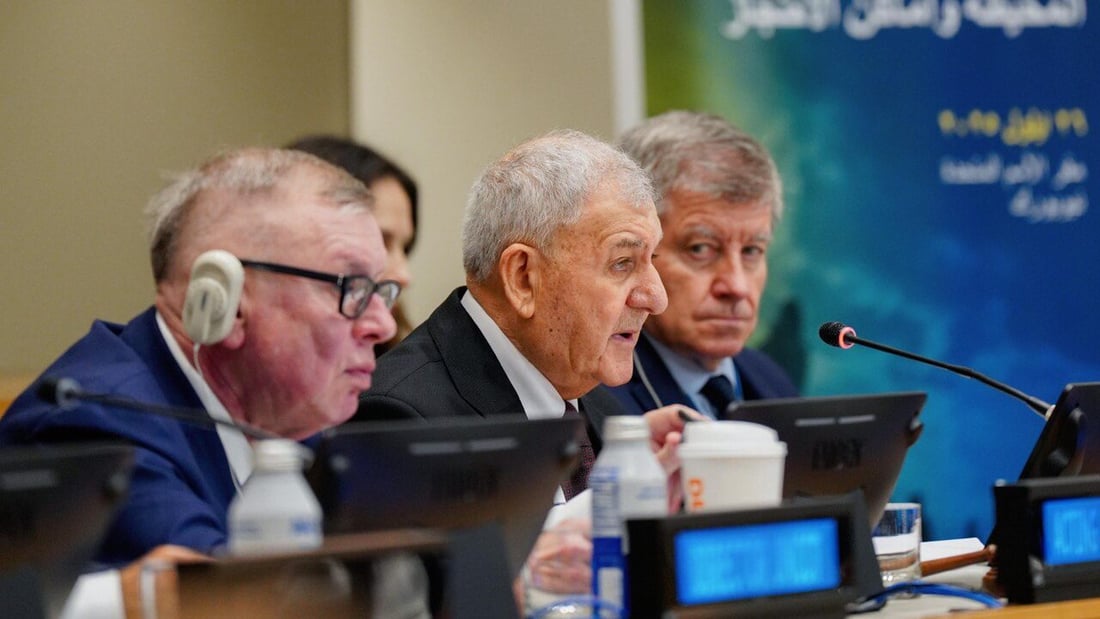
President of the Republic Dr. Abdul Latif Jamal Rashid participated on Friday in the international conference on the repatriation of individuals from Al-Hol camp, surrounding camps, and detention centers. The conference was held in New York under Iraq’s sponsorship and in coordination with the United Nations Office of Counter-Terrorism.
During the event, President Rashid delivered a speech highlighting Iraq’s efforts to resolve the issue of internally displaced persons and assist them in returning to normal life following the reconstruction of their towns and residential areas.
The president stated that despite facing serious challenges, Iraq has been among the leading countries in repatriating its citizens from Al-Hol camp, having returned 18,830 individuals through a comprehensive process that incorporated security, humanitarian, and legal dimensions. This process included psychological support, education, reintegration programs, and the implementation of security measures to ensure community stability.
President Rashid described Iraq’s experience in handling the returnees from Al-Hol as a practical model that could be adopted and built upon by other countries.
He concluded his address by reaffirming Iraq’s commitment to working with regional and international partners to achieve the common goal of closing Al-Hol camp, protecting future generations from extremism and terrorism, and transforming this humanitarian crisis into a success story of international solidarity and collective action.
The conference was also attended by Deputy Prime Minister and Foreign Minister Fuad Hussein, Kurdistan Region Deputy Prime Minister Qubad Talabani, Minister of Migration and Displacement Evan Faeq Jabro, National Security Adviser Qasim Al-Araji, and Chief Judge of the Nineveh Court of Appeals Hamid Hussein.
Full text of President Abdul Latif Jamal Rashid’s speech:
“Mr. Secretary-General of the United Nations,
Your Excellencies,
Ladies and gentlemen, members of the delegations — peace be upon you.It is my honor to welcome you all on behalf of the Republic of Iraq to this high-level international conference, hosted by the Government of Iraq, to address one of the most pressing humanitarian and security issues in our world today: the situation at Al-Hol camp. We are here to discuss the conditions in the surrounding camps and prisons in northeastern Syria, and the urgent need to repatriate all families and detainees to their countries of origin and bring an end to this difficult chapter.
This conference has been organized in coordination with the United Nations Office of Counter-Terrorism. I would like to express my gratitude for the role of the United Nations and our supporting partners, as well as all participating countries, for addressing the threats posed by the continued existence of these camps and prisons and the dangerous environments within them.
Iraq’s decision to host this conference is a direct appeal to the international community to address these camps, which are no longer a regional concern but a global security issue.
The Republic of Iraq has taken a courageous step in beginning the repatriation of its citizens from these camps through a comprehensive approach addressing security, humanitarian, and legal aspects.
This process has been carried out in coordination with Iraq’s security and service institutions, which facilitated the transfer, rehabilitation, and reintegration of returnees into their original communities.
Efforts are ongoing under a national participatory plan, in cooperation with relevant government institutions and international organizations, to provide psychological and social support, ensure access to essential services, and promote community reintegration. This is being implemented through four technical working groups comprising international organizations and government agencies, to ensure a dignified and secure future for the returnees.
Ladies and gentlemen,
We stand today at the threshold of a new phase that requires continued work and shared responsibility to bring this era and its consequences to an end. There are currently around 10,000 terrorists from 60 countries in Al-Hol camp. While more than 34 countries have repatriated their citizens, others have not yet taken similar action.Despite major challenges in recent years, Iraq has managed to repatriate thousands of its nationals, including:
The return of 4,915 families, totaling 18,830 individuals, from Al-Hol camp to Hope Center.
The return of 3,407 families, totaling 12,557 individuals, from Hope Center to their home areas.
The transfer of 3,206 Iraqi detainees previously held in SDF-run prisons.
From this platform, the Republic of Iraq affirms its advanced experience in managing the returnee file from Al-Hol through a pioneering approach that includes integrated programs for psychological support, education, reintegration, and the implementation of security measures to ensure community stability.