
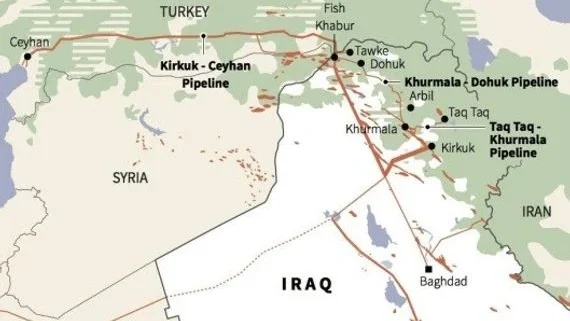
Map showing key oil infrastructure in northern Iraq and southern Turkey
'A great achievement'
Kurdistan Region crude exports finally resume via pipeline after suspension lasting 30 months
BAGHDAD — Oil exports from Iraq’s Kurdistan Region resumed Saturday via the Iraq–Turkey pipeline, ending an 30-month suspension that deprived both Baghdad and Erbil of billions of dollars in revenue and strained relations between the two governments.
The restart follows a Sept. 25 agreement between the federal government and the Kurdistan Regional Government, which leaders in both capitals hailed as a breakthrough after years of disputes over control of crude oil. Exports had been halted since March 25, 2023, when Turkey closed the pipeline after the International Chamber of Commerce in Paris ruled Ankara had violated a 1973 transit agreement by allowing the KRG to independently export oil.
The 918-day shutdown forced companies operating in the Kurdistan Region to scale back or suspend production and worsened financial pressures for both Baghdad and the KRG. Oil Minister Hayan Abdul Ghani said Saturday that flows had resumed, with crude now moving toward the receiving point at Faysh Khabur on the Turkish border.
“On [September] 25th the tripartite agreement was signed between the Iraqi Oil Ministry, the Ministry of Natural Resources, and the companies operating in the producing fields to deliver 180,000 to 190,000 barrels per day to the Oil Ministry, with 50,000 barrels reserved for operating internal refineries,” Abdul Ghani told the state news agency INA.
He said crude is now being pumped “along the Iraq–Turkey pipeline toward Ceyhan port,” and that storage tanks at the port had begun receiving shipments. “After the required quantity for export is gathered, tankers agreed upon will be loaded, and thus the dream many have awaited—receiving oil from the region and exporting it through the Oil Ministry represented by the Iraqi marketing company—has been realized,” he said.
Abdul Ghani added that 180,000 to 190,000 barrels are now being exported per day and that for each barrel, $16 will be paid under the first amendment to the federal budget law, with the oil price currently at $65. “All companies signed this agreement, therefore it became binding on all foreign companies that signed,” he said.
Kurdistan Region Prime Minister Masrour Barzani praised the agreement, calling it “a great achievement.” Speaking Saturday at the opening of the annual Niqia Academy conference in Erbil, he said, “After a two- to three-year stoppage, oil exports from the Kurdistan Region to foreign markets have resumed. This agreement with the federal government is a great achievement for all the people of Iraq, especially the people of the Kurdistan Region.”
Barzani expressed hope the deal would mark a turning point in relations between the two governments. “I hope this agreement will be a reason for economic progress and service to all citizens,” he said. He also thanked those who supported the negotiations, with particular appreciation for the United States. “We thank the U.S. government, especially the ambassador in Baghdad and the consul general in Erbil, who provided great support to reach this outcome,” he said.
Baz Karim, the CEO of Kar Group, said in a post on X: “We welcome the resumption of oil exports through the KPC pipeline to the Port of Ceyhan, with marketing by SOMO on global markets. This step is clear evidence that constructive coordination between the federal government and the Kurdistan Regional Government benefits our country and our people.”
The federal State Oil Marketing Organization, or SOMO, welcomed the resumption, saying it would strengthen Iraq’s export capacity. “Iraq can export larger quantities of oil after the return of the Ceyhan pipeline,” said Mohammed Adnan al-Najjar, SOMO’s representative to OPEC. He added that while OPEC sets production ceilings, it does not control exports, which include both foreign shipments and domestic consumption. “Iraq is currently exporting 3.4 million barrels per day out of a total of 4 million,” he said.
Al-Najjar said it is the right of OPEC members to request higher quotas when their production capacity increases, but those demands must be weighed against global market conditions. “When increasing the quota, several factors must be considered, such as whether the global market can absorb additional quantities or whether it will lead to a surplus and thus a drop in prices, in addition to Iraq’s export capacity,” he said. He added that Iraq’s ceiling had already been raised in recent months after the restoration of previously cut volumes and that new projects, especially in Basra, could add up to 1 million barrels per day in the future.
Prime Minister Mohammed Shia al-Sudani also celebrated the agreement in a statement released Sept. 25, calling it a historic step in resolving Iraq’s long-standing oil disputes. “We reached today a historic agreement under which the federal Oil Ministry will receive crude oil produced from the fields located in the Kurdistan Region and export it through the Iraq–Turkey pipeline,” he said in a post on X. He called it a long-awaited milestone that “ensures the fair distribution of wealth, diversifies export outlets, encourages investment, and is an achievement we have awaited for 18 years.”
The Oil Ministry said the agreement is grounded in the Iraqi constitution, the federal budget law, and Federal Supreme Court rulings. It covers all crude produced in the Kurdistan Region, except volumes needed for internal consumption. The ministry said the deal followed “months of continuous discussions launched from a shared national vision to enhance Iraq’s role as a key player in the global energy market.”
The KRG’s Ministry of Natural Resources confirmed exports would proceed under the deal with Baghdad and international companies, following assurances on payments that had long been a sticking point for operators in the region.