
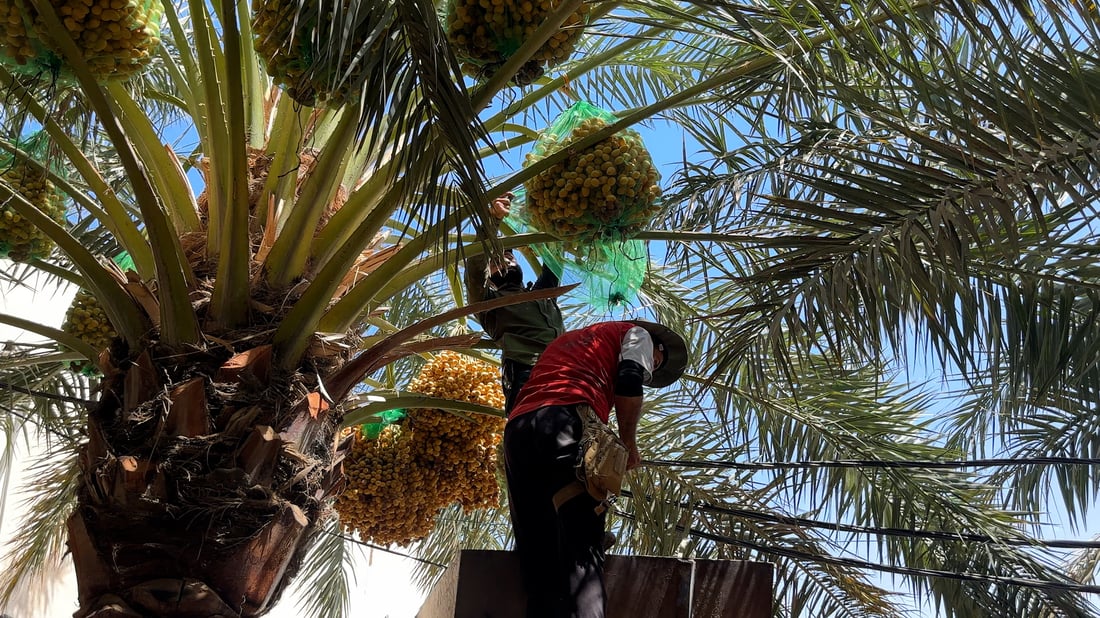
Farm workers climb palm trees to harvest ripe dates using nets to collect large clusters in Diyala governorate, Iraq. (Photo by 964media)
Diyala date harvest expected to nearly double in 2025
DIYALA — Diyala governorate is on track to nearly double its date production this year, reaching an expected 170,000 tons compared with 88,000 tons in 2021, according to local agriculture officials.
Mohammed al-Mandalawi, media officer at the Diyala Agriculture Department, told 964media, “Date production in the governorate reached 150,000 tons last year, and it is expected to exceed 170,000 tons this year, thanks to the expansion of palm numbers and intensified agricultural control campaigns.”
In the orchards of al-Harouniya east of Muqdadiyah, Prince Farms has become a testing ground for both commercial investment and specialized cultivation. Its owner, Abu Jaafar al-Rubaie, told 964media, “We are working on multiplying the Medjool variety, which has proven its high economic value, where the price per kilo ranges between 15,000 and 17,000 dinars ($10.6–$12), meaning one ton may exceed 17 million dinars ($11,972). As for Barhi, its prices range between 2,500 and 3,000 dinars ($1.7–$2.1).”
Al-Rubaie said the farm relies on drip irrigation and wells up to 70 meters deep, as well as fish ponds that improve soil fertility. He noted that a single Barhi palm can yield more than 250 kilograms, while Medjool palms have reached 150 kilograms each.
He added that Prince Farms imports tissue-cultured seedlings of international standards and provides a research environment for students and academics. “Investment in palm cultivation is profitable,” he said. “A palm tree that sells for 200,000 dinars ($141) can, after six years, produce seedlings worth up to 25 million dinars ($17,605). I recommend planting Medjool in Diyala, the Middle Euphrates, and the south, while Barhi is more suitable for other areas. We currently export part of our production to the Kurdistan Region.”
Farm worker Abdulrahman Ali described the daily harvest routine. “We start our work in the morning by setting up mats and scaffolds, then climb to pick the ripe dates and carefully sort them before moving them to cold storage. Most of our production is sent to Kurdistan and the north,” he told 964media.