
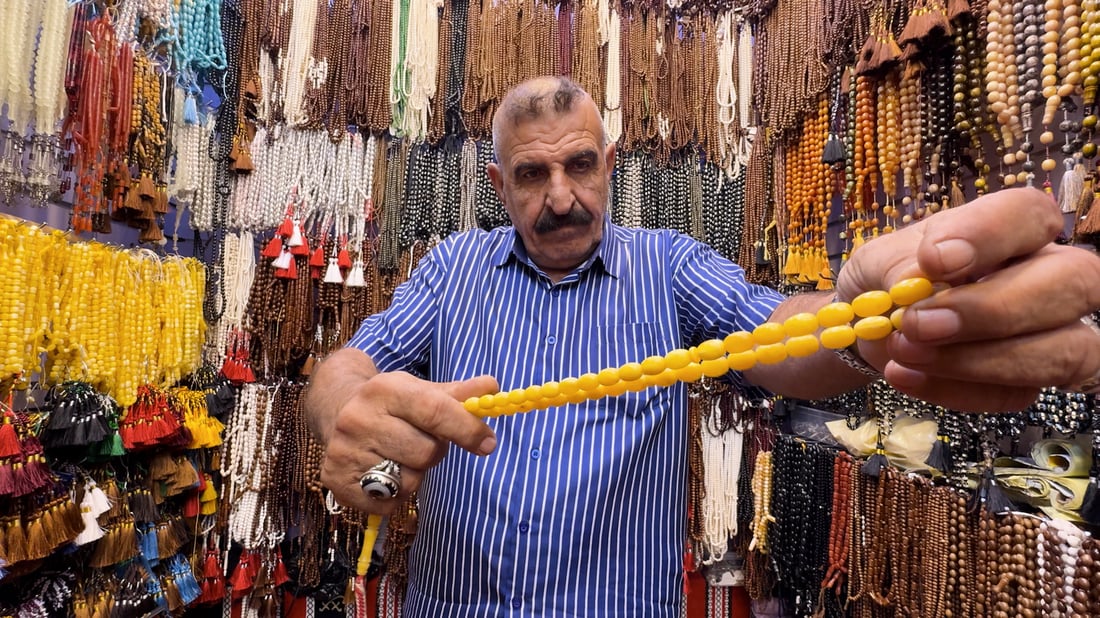
A prayer bead seller in Basra’s Ashar market displays a yellow rosary in his shop, where walls are lined with strings of beads made from different materials. (Photo: 964media)
Basra
In Ashar market, stones and prayer beads carry healing claims
BASRA — In Ashar market, traders promote stones and prayer beads they say can heal or protect, while medical experts caution the claims are rooted more in culture than science.
Vendors attribute wide-ranging powers to the stones. Some say one helps new mothers produce milk, another stops bleeding, citrine aids diabetics, and yellow sapphire regulates heartbeats. Others sell “Kabuli stones,” which they claim darken when absorbing negative energy.
Prayer bead trader Haitham Salem, who has worked near the Al-Orouba Hotel for 21 years, said his shop offers “a wide variety of rosaries, including Egyptian and Moroccan yusr, German and Kaliningrad amber, and Turkish sandalos.” He added that beads made in Najaf from ox horn, known locally as “Najafi sandalos,” are also popular.
“Amber is unanimously agreed to treat liver diseases,” Salem said. “Kabuli stones are known for pulling out negative energy, but they must be original and genuine for their effect to be stronger.”
He said age and origin determine prices. “Egyptian and Hijazi yusr beads and amber increase in value the older they are. German beads are the most expensive,” he noted, recalling his most valuable sale: a rare German amber rosary for $4,000 before Eid al-Adha.
Local tradition also keeps alive the so-called “milk bead,” a white-golden or smoky stone worn by women after childbirth. “People believe it helps with milk flow, and sometimes it is obtained by pawning a piece of gold,” Salem explained. “These practices are considered part of divine powers, as God has made a reason for everything.”
Physicians and scientists take a different view. “No stone can change the hormones responsible for producing milk,” said Dr. Haidar Kadhim Tamimi. “Milk production is a complex hormonal process controlled by prolactin and oxytocin, influenced by breastfeeding, skin contact between mother and child, psychological state, and nutrition.”
He added that belief may still influence outcomes. “Faith in the effect of the stone can provide reassurance and comfort, which indirectly improves hormone release and milk flow,” Tamimi said.
Psychiatrist Batoul Issa dismissed the idea of stones absorbing energy. “The idea that Kabuli stones absorb negative energy is not supported by evidence,” she said. “Changes in color are usually due to sweat, humidity, perfumes, cleaning materials, sunlight, or whether the stone is natural, dyed, or treated. Linking it to health is more about cultural belief than science.”
For traders like Salem, though, commerce and culture go hand in hand. “Each stone has a story,” he said. “And people value the story as much as the stone itself.”