
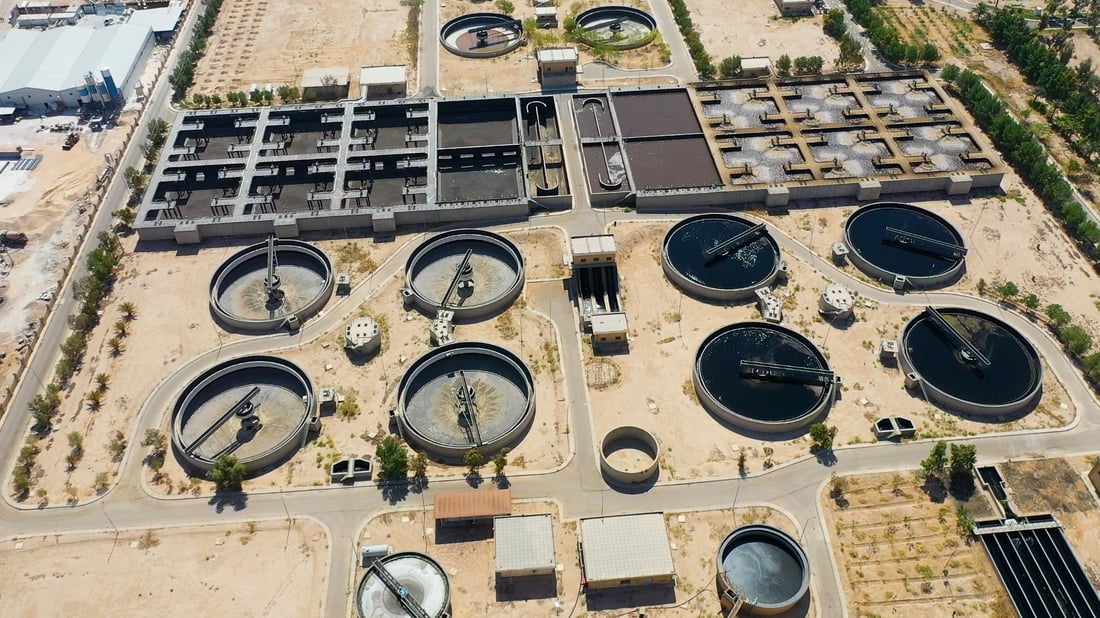
A wastewater treatment facility in Karbala, where seven plants are operating at full capacity to produce treated water and organic fertilizer for restricted agricultural use. Photo by 964media.
Retail sales launch October
Karbala wastewater plants to produce fertilizer for non-food crops
KARBALA – Wastewater treatment plants in Karbala are generating about 12,000 cubic meters of solid fertilizer each year, with officials restricting its use to non-food agriculture such as ornamental plants, forage crops, and sports turf. Retail packaging will debut Oct. 1, 2025.
“The fertilizer, or what is known as Boudret, is produced by treating wastewater sludge with gypsum or sulfuric acid to stabilize ammonia, and it is used only for ornamental trees and outdoor plants,” Baher Ghali, media director at Karbala Agriculture, told 964media. “Despite its high effectiveness, it contains heavy metals that may harm soil and microorganisms, so we warn against using it with food crops such as vegetables and fruits.”
Nursery owners use the product for decorative plants, while farmers in Khairat, Hindiya, and Husayniya apply it to clover and alfalfa. It is also spread on stadium turf and green spaces. Treated water from the plants is used in restricted irrigation, but not for vegetables meant for human consumption.
Raed Radi Aboud, head of revenues at Karbala Sewerage, said the directorate operates seven plants with three phases of treatment — physical screening, biological aeration, and chemical processing. The solid byproduct is sold at 20,000 dinars ($14) per cubic meter.
A new retail line of 4-kilogram bags priced at 2,000 dinars ($1.40) is set to launch within 30 days, pending governorate approval. Initial output will be 100 bags daily, or about 36,000 annually, with expansion depending on demand. Sales will begin at the Sewerage Directorate headquarters before reaching wider outlets.
Aboud stressed that both the fertilizer and treated water are “restricted products” unsuitable for food or feed crops. “Using them could transfer bacteria and pollutants to humans, directly or indirectly,” he said.
Hamed Obeid Abdullah, director of Karbala’s Environment Directorate, said the plants operate under environmental standards. “The solid residues undergo drying and sedimentation according to precise specifications to produce organic fertilizer that can be used safely in agriculture,” he said. “It is a good alternative to chemical fertilizers that may contain harmful components.”