
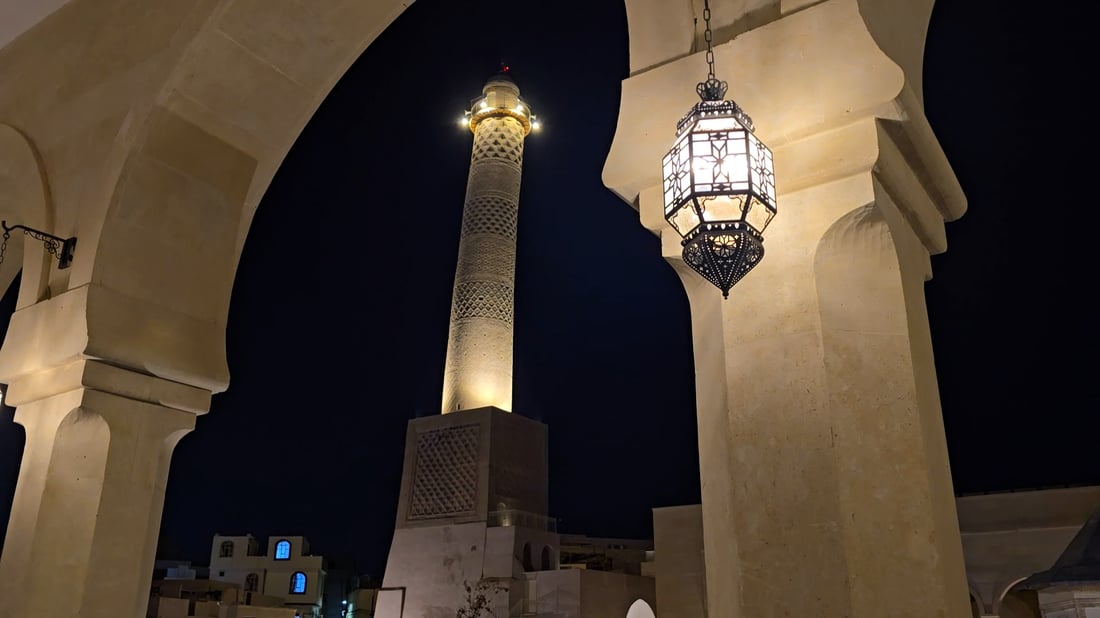
The reconstructed Al-Hadba Minaret of Mosul’s Great Al-Nuri Mosque illuminated at night following its reopening on Sept. 1, 2025. (Photo: 964media)
'Standing tall again'
Mosul’s Al-Nuri Mosque reopens for first prayers since 2017 destruction
MOSUL — The Great Mosque of Al-Nuri in Mosul opened its doors for prayer on Sept. 1 for the first time since ISIS militants blew it up in 2017, marking a major milestone in the city’s recovery.
Hundreds of residents gathered for Maghrib prayer led by Imam Dhakir Mohammed. “My feeling is full of happiness, joy, and hope, and everyone is happy for the return of this mosque in which we grew up,” Mohammed told 964media. “God has fulfilled our hope, and we see Al-Hadba standing tall again.”
The mosque will now be open daily from 10 a.m. to 10 p.m., with its first Friday prayer in 11 years expected later this week. Worshippers called the reopening emotional. “We followed the reconstruction step by step, so we always had hope that prayer would return,” said Laith Hamdi. “Three years ago, we prayed Eid al-Adha in the courtyard, but today’s prayer is indescribable.”
Another worshipper, Abdulwahid Hazem, said: “The Grand Mosque and its minaret are the spirit of Mosul, our pride and honor. I remembered 50 years of my life spent near this mosque and its beautiful alleys, praying and learning Quran and Islamic sciences inside its halls.”
Earlier in the day, Prime Minister Mohammed Shia Al-Sudani inaugurated the reconstructed mosque and its leaning Al-Hadba Minaret as part of UNESCO’s Revive the Spirit of Mosul initiative, supported by the United Arab Emirates and Iraqi institutions. “The reconstruction of Al-Nuri Mosque and its minaret will remain a milestone reminding us of the heroism of Iraqis and their defense of their land,” Al-Sudani said. He described the mosque as “a shining symbol of Islamic civilization in Iraq and a living witness to our people’s humanitarian journey.”
Al-Sudani also reopened the Dominican Clock Church, built in the 1870s, and the Syriac Catholic Al-Tahira Church, one of Mosul’s oldest and largest. He said their restoration “represents houses where people’s hearts gather without discrimination,” and called them “landmarks of Iraq’s original Christian presence in Nineveh, connected to all other communities in the governorate.”
Built nearly 900 years ago under Nur ad-Din Zengi, Al-Nuri Mosque was a spiritual and cultural hub of Mosul. Its leaning minaret, Al-Hadba, was one of the city’s most recognizable landmarks until ISIS destroyed it in June 2017 during the battle to retake the city.