
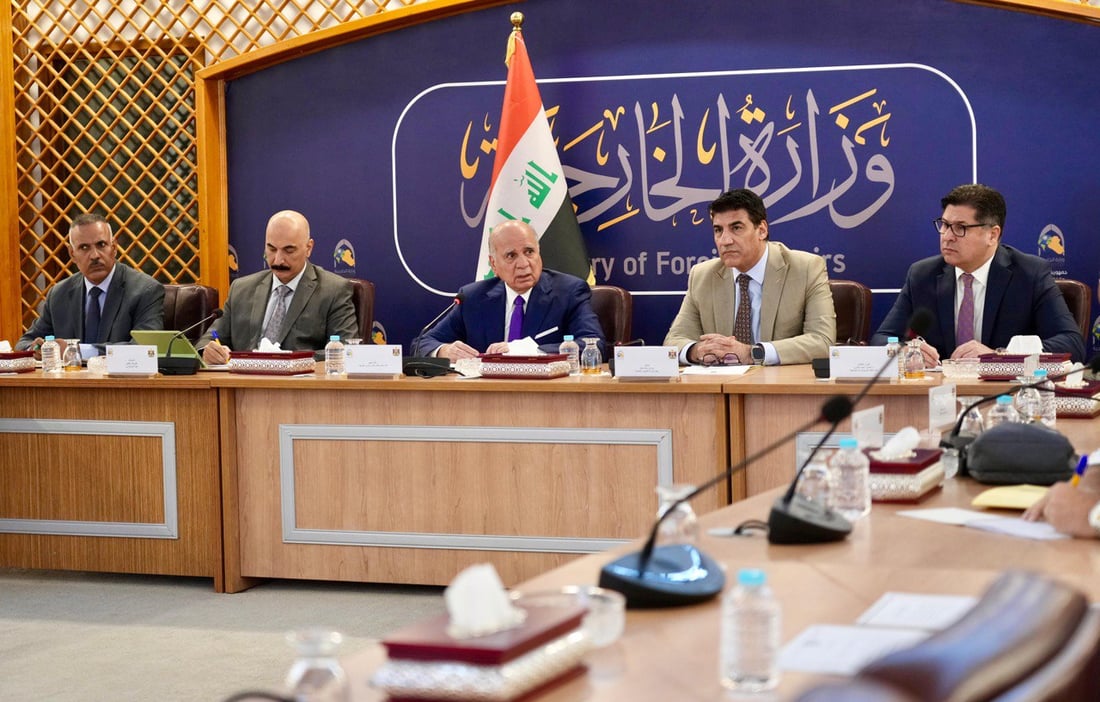
(Photo: Iraq's Foreign Affairs Ministry)
'Crisis'
Foreign minister calls for urgent strategies as Iraq faces worst water shortage in decades
BAGHDAD — Iraq’s Foreign Minister Fuad Hussein on Sunday chaired a meeting at the Foreign Affairs Ministry headquarters to discuss Iraq’s water shortage and environmental challenges, with representatives from the ministries of water resources, environment, agriculture, and other relevant departments.
Iraq is grappling with its worst water crisis in decades, with national reserves at their lowest levels in 80 years following a dry rainy season. Officials have pointed to climate change, drought, and upstream dam projects in Turkey and Iran as major contributors to the crisis.
Hussein emphasized the need for urgent and long-term strategies to safeguard the country’s water and environmental security, noting that the crisis has global dimensions.
“The water crisis in Iraq affects drinking supplies as well as agriculture and the environment sectors, and it has consequences for all aspects of life,” a statement from the Foreign Affairs Ministry read. Hussein stressed the importance of raising public awareness, reducing water waste, and using resources efficiently, adding: “The role of the media is crucial in this regard.”
He also underlined the importance of diplomacy in addressing Iraq’s water problems: “The environmental challenges are no longer a local issue but a global one that requires cooperation. The Foreign Ministry has a key role in engaging neighboring states and strengthening bilateral and regional cooperation on shared water resources.”
Iraq is among the five countries most vulnerable to climate change, according to the United Nations.
Participants presented reports on internal and external water and environmental challenges, including figures on water inflows, quality, and impacts, as well as strategies for food security and water scarcity management.
The meeting concluded with agreement on launching a “comprehensive plan” to tackle climate change, enhance coordination between national institutions, and intensify diplomatic efforts to protect Iraq’s water and environmental interests.
Minister of Water Resources Aoun Dhiab previously said Turkey uses a system of dams along the Euphrates to generate hydroelectric power and transfer water between reservoirs before releasing it downstream, a process that has cut Iraq’s share by half. He said the reduction has worsened the country’s water crisis. Iraq is continuing technical negotiations with Ankara to establish a clear framework for sharing responsibility during regional water shortages, he said.
In early August, the Parliamentary Committee on Agriculture, Water, and Marshlands stated that Iraq is considering artificial cloud seeding to confront ongoing water scarcity.