
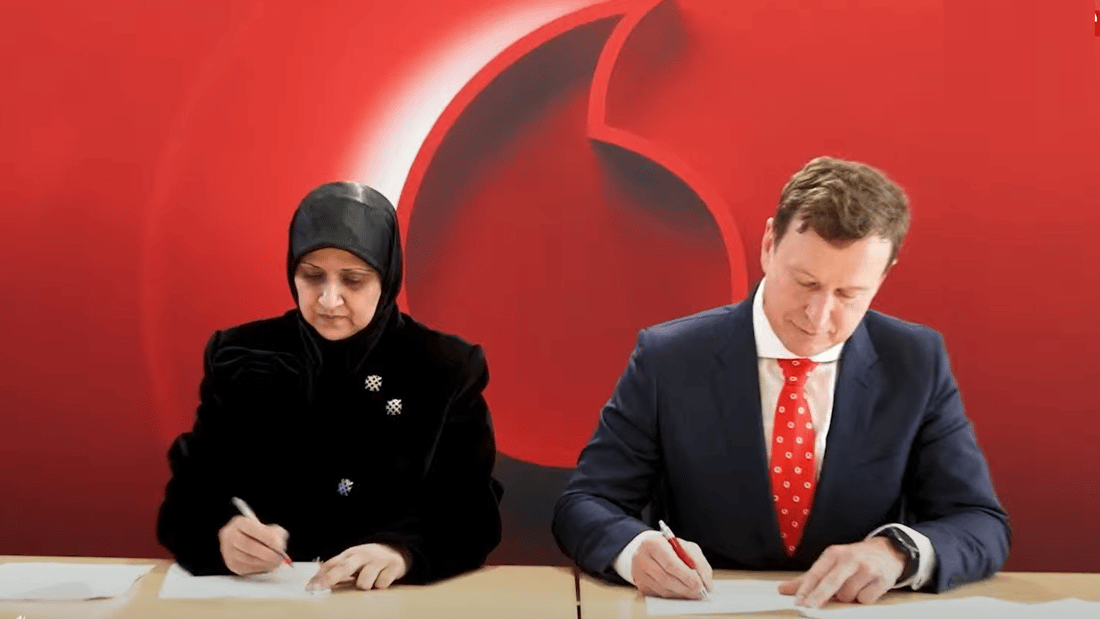
Iraq’s Communications Minister Hayam al-Yasiri and Vodafone executive Peter Dvorak sign an agreement in Baghdad in December 2024 to establish a government-owned 5G telecommunications network in Iraq.
Media Monitor
Baghdad to launch Vodafone Iraq as state telecom, 5G operator
BAGHDAD — Iraq’s Minister of Communications Hayam al-Yasiri said the government will soon establish Vodafone Iraq, a new state-backed telecom operator that will introduce 5G services and compete with private companies.
“We completed the six-month preparatory stage with Vodafone and will soon begin actual operations for the fourth license,” al-Yasiri said in an interview with Dijlah TV. She said the government operator is intended to “spark competition with the private sector to improve quality and reduce prices, especially since the government operator will introduce 5G services.”
The minister added that Vodafone Iraq will rely on unemployed Iraqi graduates to operate the network, while Vodafone will provide training. She said the national company would adopt Vodafone’s technology, operating policies, compliance standards, and branding.
The arrangement is expected to follow Vodafone’s global “partner market” model, in which the group licenses its brand, technical expertise, and commercial know-how to local operators without holding ownership stakes.
Al-Yasiri said the new operator will be “an exact copy of the parent Vodafone in terms of technology, operating policies, compliance, even furniture and visual identity.”
Prime Minister Mohammed Shia al-Sudani and the Ministry of Communications outlined the project in early 2024 as part of a push to expand fifth-generation services in Iraq. The ministry said the agreement with Vodafone covers technical expertise in network design, business development, and commercial planning, with goals of improving service quality, reducing costs, boosting state revenues, and creating jobs for young Iraqis.
Iraqi Minister of Communications Hayam al-Yasiri in an interview on Al-Dijla TV:
There are those who believe that the internet in Iraq suffers from high prices and low quality. It is important for citizens to know that the Ministry of Communications is not responsible for mobile phone companies. That is the responsibility of the Communications and Media Commission. Our responsibility is only to provide infrastructure, while fixed internet reaching homes falls under the ministry.
In some neighboring countries, the internet is expensive and does not provide good services. I am not defending the internet in Iraq, but the high cost is due to the expense of infrastructure. Iraq did not inherit anything in this field from the former regime. Now the price of one megabit of international internet that we sell to companies is only 27,000 dinars, while it used to be 150,000. We worked to reduce it until it reached this level, and I will continue lowering it until it becomes almost free.
The poor quality of the internet in Iraq is because companies rely on Wi-Fi services instead of fiber optic. Fiber provides internet that is 30 times faster. We carried out a revolution in this field and forced some companies to gradually shift to fiber optic at the expense of their profits. They made more money when they relied on Wi-Fi because capacities could be shared among several subscribers, beyond the ministry’s control. With fiber, capacities cannot be shared between subscribers, and they are controlled by the ministry.
When I took over the ministry there were about one million fiber lines, only around 100,000 of them active. Now we have 4.5 million fiber lines, with about 1.5 million active. We receive appeals and messages from citizens to expand the experience further.
In Iraq there are about 8.5 million homes. Excluding the Kurdistan Region, we need 6 million fiber lines to cover the rest of the governorates. We made a schedule with one company to gradually shift to fiber, and we follow up monthly. By next year Wi-Fi lines will be completely phased out, except in desert areas where fiber cannot reach, which are very few.
We completed the six-month preparatory stage with Vodafone and will soon begin actual operations for the fourth license. The idea of having a government operator is to spark competition with the private sector to improve quality and reduce prices, especially since the government operator will introduce 5G services. We will rely on unemployed Iraqi graduates for its operation, and Vodafone will train them to manage fifth-generation technology.
Vodafone’s method is to grant its name to local companies. There is Vodafone Turkey, Egypt, Oman, and others, and the same will happen in Iraq. Our national company will become Vodafone Iraq, an exact copy of the parent Vodafone in terms of technology, operating policies, compliance, even furniture and visual identity. Vodafone will not receive any share in the company; instead, we will pay fees for these services.
The Vodafone brand will remain with Iraq for 20 years, but the period of operation, training, and service provision will be between 7 and 10 years. Once we see that our youth are capable of running the company without issues, we will end the contract with Vodafone, but the brand will remain. At that point, they will receive lower fees in exchange for the trademark.
We will announce the establishment of the company soon. Its capital will come from the employees’ pension fund so that profits can support it, alongside the Trade Bank of Iraq and Al-Salam Company, which belongs to the ministry. All revenues will go fully to the government.
We will cover Baghdad, Karbala, Najaf, and Hilla in the first stage because they are crowded with visitors year-round, generating high profits during the periods of million-strong pilgrimages. That is the reason, and I am not being sectarian—ask my team about me. This company will not be given preferential treatment, and the ministry will remain at equal distance from all private and public operators. The company will also pay infrastructure and license fees.
The first call on Vodafone Iraq will be made in the coming weeks, certainly before the end of the current government’s term. To be transparent, that first call will mark the beginning of a trial period before the start of commercial operations within months, God willing.
Vodafone Iraq was granted exclusive rights to operate 5G services for three years. This privilege will help the company grow, just as the three operators were granted geographic exclusivity for five years when they launched in 2003—Korek in the north, Iraqna in the center, and Atheer in the south. That exclusivity helped them grow until they were ready to compete in an open market.