
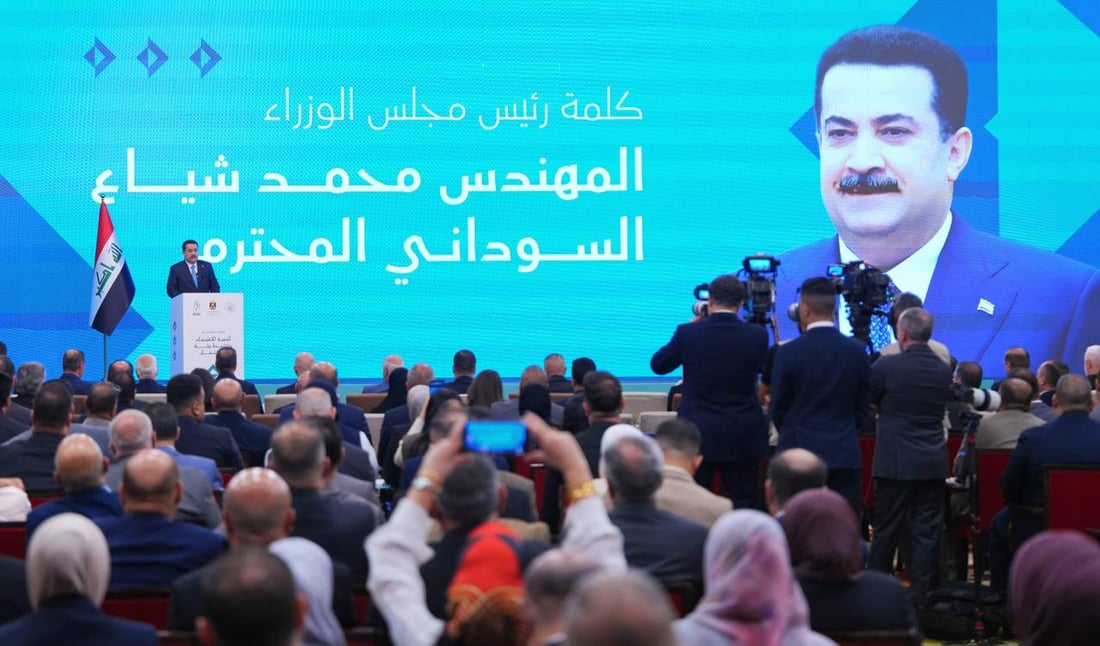
(Photo: Al-Sudani's media office)
Monitor
Al-Sudani: Iraq’s ‘greatest challenge’ is economic reform and diversification
BAGHDAD — Prime Minister Mohammed Shia Al-Sudani said the government is prioritizing “economic reform and transitioning to a diversified economy,” as he addressed the Tax Conference for Economic Development and Investment Environment Stimulation in Baghdad on Sunday.
Iraq’s economy remains heavily dependent on oil, which accounts for more than 90% of government revenue and the most of the country’s exports. Despite efforts to diversify, non-oil revenues make up only a small share of the budget, leaving the economy vulnerable to fluctuations in global oil prices.
He stressed that reform begins with “supporting the private sector by providing an attractive environment for investors and capital,” adopting international standards in business practices and tax accounting, and ensuring that tax measures are applied with “flexibility and fairness.”
Al-Sudani said Iraq is aligning with global efforts to unify tax laws in line with international standards, adding that this progress “opens wide the door for both foreign and local investors, strengthens partnerships with the private sector, and instills confidence in the Iraqi market.”
He noted that while Iraq’s annual public expenditure budget is around 150 trillion IQD, tax revenues stand at only 3 trillion, figures which he said “require review and reconsideration.”
Statement from Al-Sudani’s media office:
Prime Minister Mohammed S. Al-Sudani attended today the Tax Conference for Economic Development and Investment Environment Stimulation, held in the capital, Baghdad.
His Excellency pointed out that the government has given the utmost attention to reforming and sustaining the economic sector, noting that the gateway to this reform is supporting the private sector by providing an attractive environment for investors and capital, adopting international standards for business practices and tax accounting, and ensuring flexibility and fairness in these measures.
The Prime Minister explained that the world is now moving toward unifying tax procedures and laws in line with international standards, stressing that Iraq is making progress in this field, which opens wide the door for both foreign and local investors, strengthens partnerships with the private sector, and instills confidence in the Iraqi market.
The conference aims to highlight the 2025 Tax Reform Plan and its impact on the national economy, discuss challenges facing the current tax system and digital/monitoring solutions, strengthen public-private partnerships in tax collection, and support investors through building a transparent tax system that encourages investment.
The following are the highlights of the Prime Minister’s speech:
🔷 The greatest challenge before us is the priority of economic reform and transitioning to a diversified economy.
🔷 We have an annual public expenditure budget of around 150 trillion IQD, with tax revenues at 3 trillion, and these figures require review and reconsideration.
🔷 Reform decisions in the economic field were previously exploited as slogans amid an atmosphere of misinformation and pressure on official institutions.
🔷 We sponsored the Conference on Tax System Reform in Iraq, held in December 2023, which produced an important package of recommendations.
🔷 Cabinet Decision No. (24074 of 2024) put the tax reform packages into effect, followed by the formation of the Supreme Committee to Follow Up on Tax Reform.
🔷 Our efforts resulted in international interest from global investors regarding tax reform in Iraq.
🔷 We worked on increasing non-oil revenues, though cautiously, due to the lack of a supportive political or social environment.
🔷 We succeeded in achieving a significant leap in non-oil revenues, which rose from 7% in 2022 to 14% in 2024.
🔷 We will not allow any tax increases that create a business-hostile climate or compromise fairness in taxation.
🔷 Tax revenues increased in 2024 by 26% compared to the previous year, and by 3% in the first half of this year compared to the same period last year.
🔷 Digital transformation has enhanced tax capacity and accuracy.
🔷 The Tax Inquiry Platform ended the problem of name duplications, delays, corruption, and taxpayer distrust in the accuracy of tax procedures.
🔷 An electronic system was completed for issuing and matching tax payment receipts after tax assessments, which was previously done manually.
🔷 There is ongoing coordination with reputable global companies to achieve the highest international standards in the tax system.
🔷 The new Income Tax Bill adopted international standards while adhering to social justice goals and providing tax exemptions for low-income earners.
🔷 The new law, soon to be enacted, will be business-friendly, supportive of the green economy, and grant exemptions to startup projects.
🔷 The Supreme Committee for Tax Reform completed the policy paper on oil company taxation to resolve issues and remove obstacles hindering their operations.
🔷 Unifying tax procedures between the federal government and the Kurdistan Regional Government facilitated the resolution of tax files related to private universities and banks.
🔷 These reforms send a message to citizens to support their political system and ensure optimal resource management.