
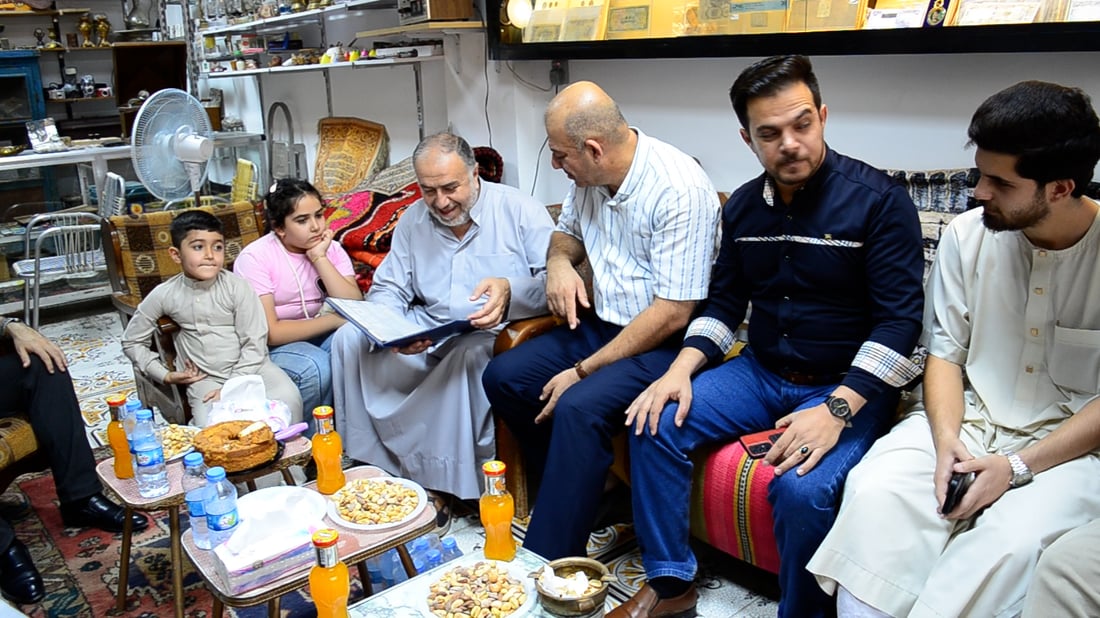
Heritage collectors gather in a private museum-like space in Tikrit to share and display antiques, vintage items, and collectibles. The group meets regularly to preserve and promote local cultural history across generations. Photo by 964media.
Tikrit collectors create private museum to preserve Iraq’s heritage
TIKRIT — A group of heritage collectors in Tikrit have turned their decades-long passion into a private gathering space resembling a museum, where they showcase antiques, rare coins, stamps, and cultural artifacts from Iraq’s past.
The initiative traces back to 1990, when Osama Al-Shadi, a university professor in Tikrit, began collecting Iraqi currency alongside his brother and a friend, Haj Khalid. “My hobby began with collecting Iraqi currency, then grew into antiques out of a love for our heritage,” Al-Shadi told 964media.
The project was paused for several years due to economic hardship but resumed around 2015, expanding into a network of 15 to 16 dedicated collectors. Their collection includes rare coins and stamps, vintage telephones and recorders, traditional household tools like millstones and spinning wheels, and everyday items such as 1960s detergent packaging. Many artifacts were inherited from family homes or purchased through the group’s network.
“Buying is our main source for new pieces,” Al-Shadi said, noting the difficulty of acquiring rare items like royal-era currency or unique stamps. Among the standout items is a telephone from 1895, along with coins issued by Iraq’s central bank and early 20th-century paintings.
“The place we created is like a museum and a meeting point for us,” he said. “We usually gather after Asr or Maghrib prayers, once work hours are over.” The group occasionally participates in exhibitions, although they typically limit displays to coins to avoid damage to larger artifacts. “The museum is open to visitors who want to learn about their ancestors’ history,” Al-Shadi added.
The oldest item in the collection is a traditional millstone passed down through generations, followed by Ottoman-era coins such as the lira and five qirsh, dated 1332 Hijri (around 1914), and a 1931 Iraqi riyal issued only once. “We can’t own anything older than 200 years because the law prohibits it,” Al-Shadi said.
Stamp collector Osama Mohammed, another member of the group, began collecting in 1989 at age 10, inspired by his father. “I was drawn to the small size, images, colors, and themes of stamps,” he said. “They’re usually designed to reflect specific events or ideas, some scientific, some related to animals or plants.”
His collection, now spanning over 30 albums, is divided into Iraqi, Arab, and international stamps, with a focus on Iraqi issues from the British occupation and the occupation of Mosul. Mohammed stores his stamps chronologically, beginning with Ottoman issues during the British occupation in 1917, followed by the first stamps marked “Iraq” in 1923 and those from the era of King Faisal. “Not all my collections are complete,” he said, citing the rarity of certain stamps now found mostly abroad.
Sadiq Al-Tikriti, another collector, emphasized the group’s diverse holdings. “We have old telephones, recorders, stamps, coins, and even vintage detergent packaging from the ’60s and ’70s,” he said. “One of our oldest pieces is a telephone from 1895 that was once used in Iraq. The collection shows the evolution of everyday devices over time.”