
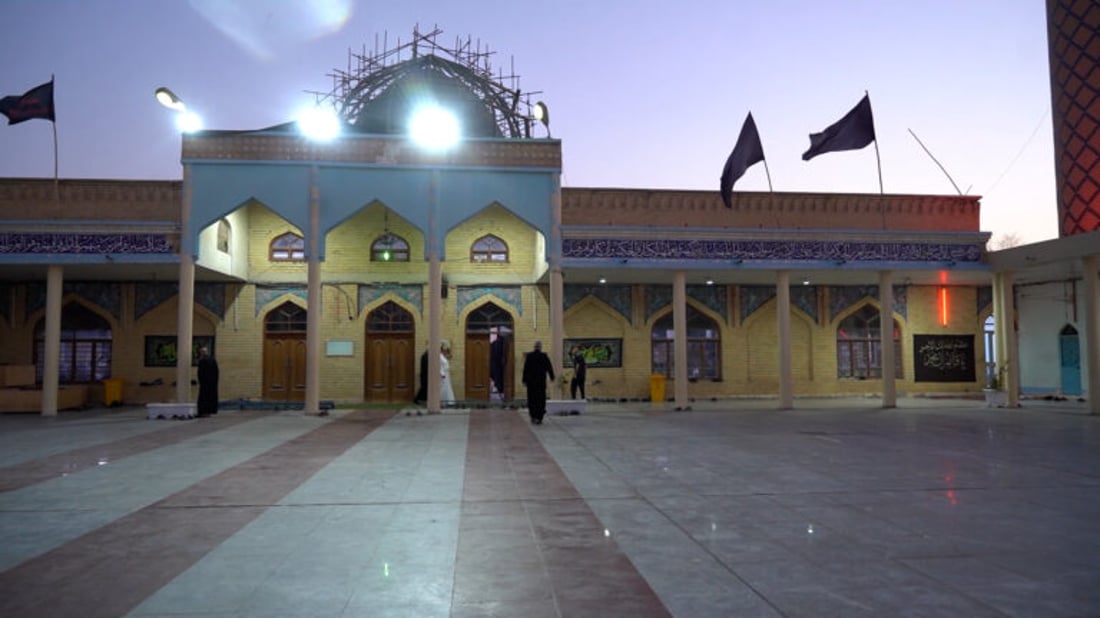
The Abla Mosque in Maqal, Basra
Basra
Abla Mosque stands as spiritual and political landmark rooted in worker contributions
BASRA — In the Maqal area of Basra, the Abla Mosque—known locally as the Sayyid Ali Al-Safi Mosque—stands not only as a house of worship but as a testament to grassroots resilience, civic leadership, and community memory stretching back to the 1970s.
Built through small monthly donations from Basra port workers, the mosque’s foundation reflects working-class solidarity during a time of limited resources. “The mosque was built through personal efforts. The state and merchants had no role in its construction,” said Mahmoud Abdul-Munim, a member of the Al-Safi family. “Each port worker donated a quarter dinar monthly, and with these modest contributions we built this place.”
Beyond its religious function, the mosque played a central role in political resistance. In 1979, chants of Shia religious slogans during Muharram from its grounds triggered a crackdown by the Baath regime. Dozens were arrested, some later executed, and the mosque’s library—home to rare manuscripts—was burned.
Following the regime’s fall in 2003, the mosque emerged as a center for civic and political organization. “From the office of Sayyid Ali Al-Safi, major decisions were made to manage the city, including the formation of Basra’s first provincial council,” Abdul-Munim said. He added that Sayyid Ali also guided efforts to recover looted government property, including vehicles.
Today, the mosque continues to function as a vital religious and social institution. “The mosque is one of Basra’s landmarks and among the largest in the city. Its social and religious role continues to this day,” said Qasim Karim, a resident of Abla. “Its influence is not limited to the Abla area, but extends across the entire Maqal and all northern parts of Basra.”
For others, its history is deeply personal. “As school students, we helped carry bricks,” said Kareem Juhi. “This place was more than a mosque; it was a school where we were raised. Each of us left a mark on its foundation.”
Now led by Dr. Hassanein Al-Safi, son of Sayyid Ali, the mosque remains a living part of Basra’s civic and spiritual identity, continuing the legacy of a family and a community that built it from the ground up.