
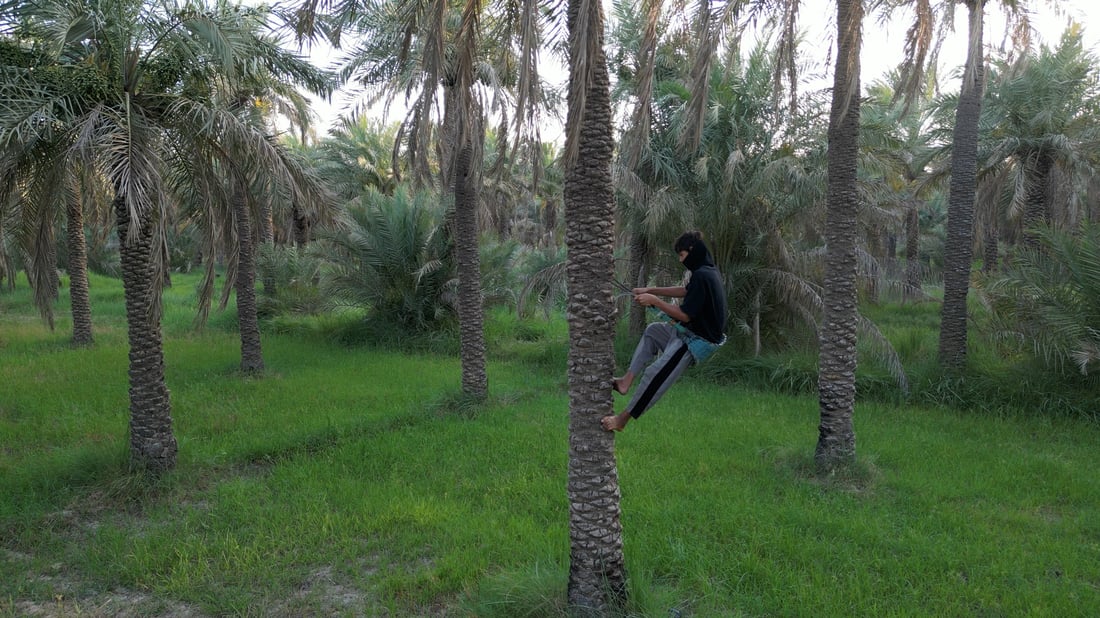
A worker climbs a date palm tree in Qalat Salih, Maysan, to begin the seasonal task of supporting fruit clusters—a traditional practice that protects the harvest during the critical mid-summer growth phase. Photo by 964media
Maysan
Farmers in southern Iraq enter date palm ‘khalal’ stage with traditional fruit bunch propping
MAYSAN — As summer reaches its peak in southern Iraq, farmers in the district of Qalat Salih, southeast of Maysan governorate, have entered the “khalal” phase of date palm development—the fourth stage of the growing cycle—marked by a seasonal farming tradition known as fruit bunch propping.
The process involves tying and distributing the heavy clusters of date palm fruit across the tree’s fronds to prevent breakage and protect the fruit from damage before harvest. “Each variety of date palm requires its own method and timing,” said orchard owner Haidar Hussein. “For example, the Asat Imran variety needs full propping, while others like Bream, Jabjab, Deiri, and Huweyzawi require only partial support due to the weight of the clusters, which can reach up to 40 kilograms.”
He added that climate change has shifted the timing of the work in recent years. “Fruit bunch propping used to start in early June, but now it often begins in mid or even late June due to changes in weather patterns.”
In addition to supporting the fruit, farmers also apply sulfur dust to protect the dates from insects and environmental dust and to enhance fruit size.
Muntadhar Ali, a date palm climber, said the process starts early in the morning. “We begin at 5 a.m. by trimming the fronds, lowering the clusters, and propping them. We manage about 15 palms in the morning and another 15 after 3 p.m.,” he said.
“In orchards, we’re paid 1,000 dinars [$0.71 USD] per palm, but at private homes the rate is 5,000 dinars [$3.55 USD] because it’s more strenuous work alone.”
Another climber, Hussein Mohammed, explained the benefits of applying sulfur after propping the fruit. “It prevents dust and insects and helps the fruit grow larger,” he said. “We start when the air is still cool, cutting dead fronds, organizing the clusters, and applying treatment.”