
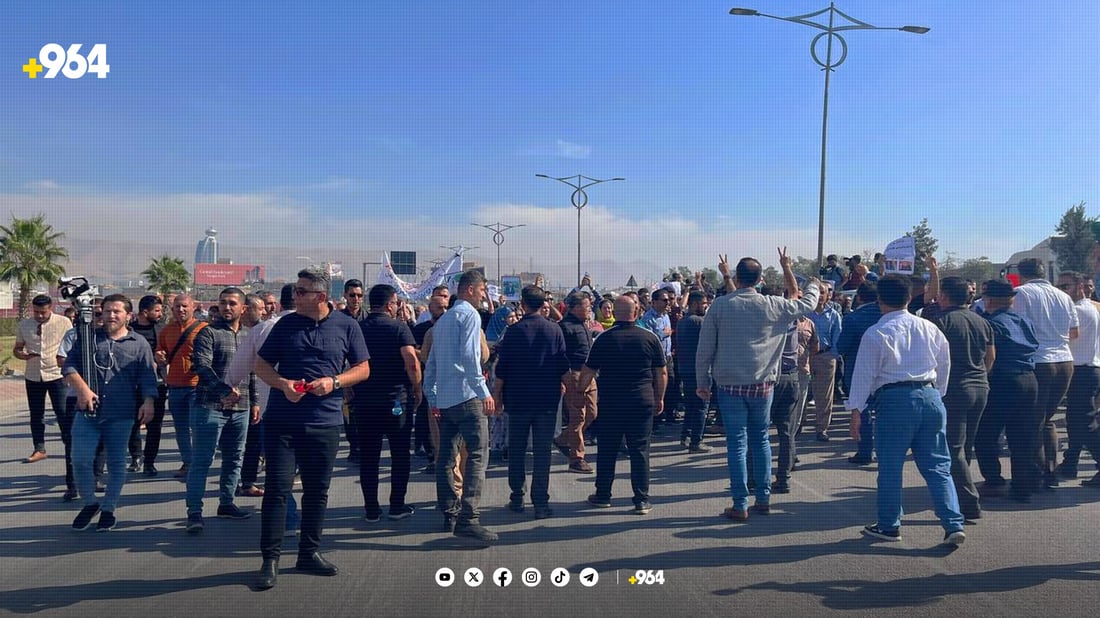
Teachers gather in Sulaymaniyah during a previous protest over delayed salary payments
Two teachers arrested in Sulaymaniyah ahead of planned protest over delayed salaries
SULAYMANIYAH — Security forces in Sulaymaniyah arrested two protesting teachers late Tuesday, according to a colleague, amid rising tensions over delayed salary payments in the Kurdistan Region.
“Last night, our colleagues Osman Gulpi and Dilshad Mirani were arrested by security forces and have not been released yet,” fellow teacher Srosh Hawari told 964media.
Hawari said the arrests took place in separate incidents. “At around 11 p.m., Dilshad Mirani was arrested in front of his house while standing with his brother. Then at 12:15 a.m., Osman Gulpi was arrested from inside his home,” he said.
He added that the arresting individuals identified themselves as members of the Asayish, the region’s internal security force. “They told the teachers’ families that they were from the Asayish and that the teachers would be taken for questioning and then returned,” Hawari said. “The families later visited the Asayish office and saw them there.”
The arrests came after a group of protesting teachers announced plans to hold a demonstration Friday in Sulaymaniyah over unpaid wages.
On June 24, the Sulaymaniyah governorate’s security committee issued a statement urging teachers to delay the protest.
“We in the Sulaymaniyah Security Committee fully support the rights and demands of teachers, employees, and all salary recipients,” the committee said. “We recognize the hardship caused by salary delays and affirm that their voices have reached all authorities in the Kurdistan Region and Federal Iraq. However, holding protests in this tense environment is not appropriate.”
The statement added, “Just as we previously cooperated to ensure a safe and organized space for demonstrations, this time we kindly request the protest be postponed to a more suitable time so that we can coordinate in delivering their message in a civil and safe manner.”
The call to delay the protest came during heightened regional tensions following a flare-up between Iran and Israel, which raised fears of a broader conflict. Authorities cited concerns that the unrest could spill over into neighboring areas, including the Kurdistan Region, especially Sulaymaniyah which borders iran, making public gatherings more sensitive and potentially risky.