
EU Delegations Commend Iraqi PM’s Neutrality Amid Regional Tensions, Emphasise Investment Opportunities
MERI Forum 2024
European ambassadors commend Iraqi government stance on regional tensions
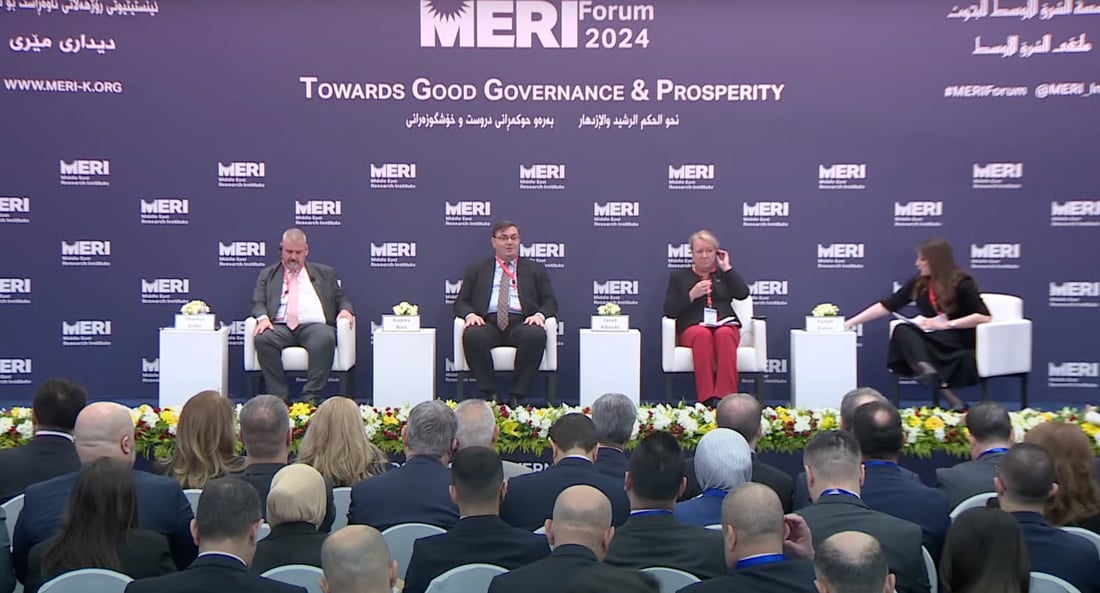
ERBIL — Ambassadors from the Netherlands and Austria joined the EU representative to Iraq for the first panel of this year’s MERI Forum hosted by the Middle East Research Institute.
Iraqi Prime Minister Mohammed Shia Al-Sudani’s efforts to keep Iraq out of regional conflicts were praised, affirming that security concerns are no longer a barrier for foreign investment in Iraq.
During the forum’s first panel, titled “Iraq and its International Partners: Converging Priorities & Enhancing Partnership,” Thomas Seiler, Head of the EU Delegation in Iraq; Janet Alberda, Dutch Ambassador to Iraq; and Andrea Nasi, Austrian Ambassador to Iraq, discussed Iraq’s policy of de-escalation and its impact on foreign engagement.
“We value the current policy by the Iraqi government when it comes to regional war; the entire Iraqi government, especially Mr. Al-Sudani, has contributed in the last two weeks to de-escalation in the region and also de-escalation within the country. We value this attitude,” Seiler stated, emphasizing Iraq’s neutral stance. He added, “Everybody in Iraq has understood that if this conflict spreads over to Iraq, they can only be losers. That is what all want to avoid.”
Alberda underscored the importance of stability, saying, “The path that has been chosen for Iraq to remain out of the conflict and to pursue a stable path— Iraq cannot afford to be in that conflict again after so many years of misery and conflict.” She noted that in meetings with Iraqi citizens in Baghdad, there was a consistent focus on economic development and stability, which the EU and its member states support.
Austrian Ambassador Andrea Nasi echoed this sentiment, saying, “The path charted by Al-Sudani is supported by the overwhelming majority of the Iraqi people.”
On Oct. 24, 2024, Iraqi Prime Minister Mohammed Shia Al-Sudani emphasized that only the state and its constitutional institutions hold the authority to make decisions on matters of war and peace, cautioning that any actions outside this framework would lead to legal repercussions.
Seiler also discussed the economic outlook, noting that “our bilateral relationship — I mean EU countries with Iraq — is very good, despite the fact that the EU is losing ground in Arab countries.” He emphasized that European investors recognize the improvements Iraq has made over the last two years and that security is no longer the primary concern for businesses considering Iraq. “For investors, it’s not so much the security situation… The questions investors are asking us are practical: How can I invest? What are the tax conditions? How do I bring in equipment from Europe?” Seiler said, stressing efforts to enhance communication and clarify these practical details to facilitate investments.
Alberda responded to questions about EU investment levels, acknowledging that it remains limited: “I don’t know the figures, but in my personal view and from my government’s perspective, it’s too little.” She expressed hope for a stronger economic partnership with Iraq, particularly in trade and economic cooperation.
Seiler noted that EU investment in Iraq currently stands at only 10% of China’s level, describing this as “a bad result” and highlighting the need for improvement through stronger cooperation and government support.
The two-day MERI Forum, hosted by the Middle East Research Institute, brings together local, national, and international policymakers, academics, civil society leaders, journalists, and diplomats to discuss Iraq’s pressing challenges and present solutions for sustainable governance and economic growth.