
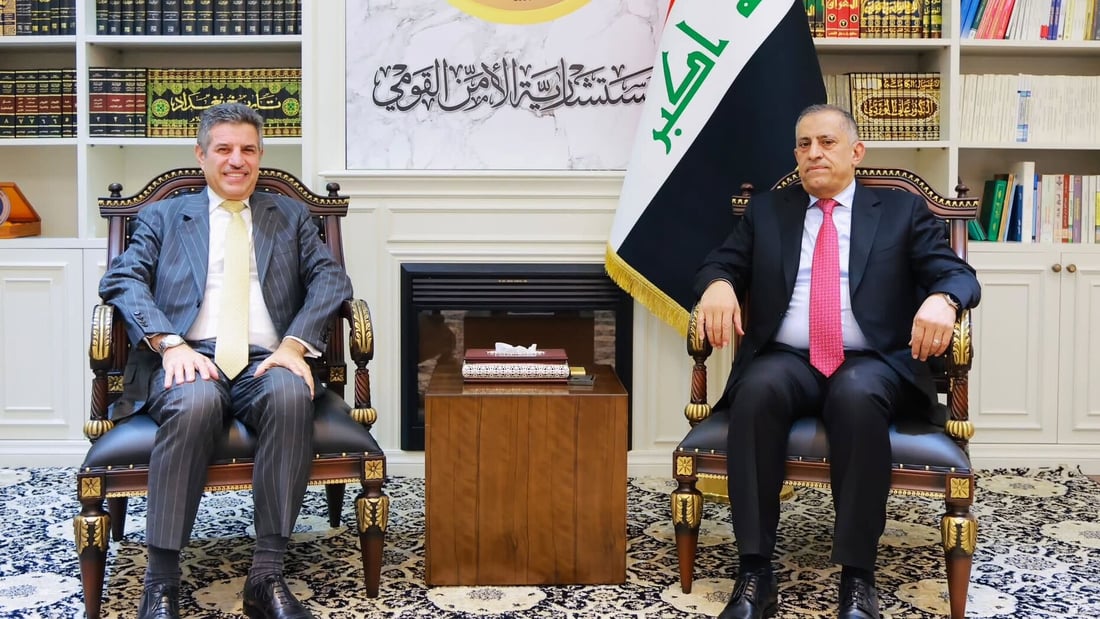
U.S. Chargé d’Affaires Steven Fagin meets Iraq’s National Security Adviser Qasim Al-Aboudi in Baghdad on Sept. 22, 2026.
US envoy says Washington and Baghdad agreed June 2027 deadline on weapons
BAGHDAD — Washington and Baghdad have agreed that by the end of June next year “only the state is the keeper of the military force,” U.S. envoy Tom Barrack said, making the prime minister’s new timetable for armed factions’ weapons a stated U.S.-Iraqi understanding rather than an Iraqi plan alone.
Barrack spoke to Al-Monitor after Secretary of State Marco Rubio met Prime Minister Ali al-Zaidi in New York on Monday. Zaidi told The New York Times the same day that armed groups would observe a 90-day halt in attacks from Sept. 30, when the coalition mission ends, before beginning to hand over weapons, with the process to conclude by June 30, 2027. The original date was Sept. 30 itself, which Zaidi gave President Donald Trump at the White House in July.
National Security Adviser Qasim al-Aboudi told the U.S. chargé d’affaires, Steven Fagin, on Tuesday that the government remained committed to its programme, particularly restricting weapons to the state, fighting corruption, attracting investment and economic reform, according to the National Security Advisory. He also called for support for reconstruction in Sinjar. Fagin expressed support for the government’s programme and for expanding trade and economic ties, the statement said.
Iraqi officials have given different accounts in recent days. Security adviser Qasim al-Araji said on Friday that there was “no specified period” for the process and that talks were continuing through a committee under the prime minister’s supervision, having earlier said Sept. 30 applied to the coalition withdrawal and marked the start of negotiations. Ammar al-Hakim, head of the National State Forces Alliance, told Fagin on Sunday that the issue should be handled on Iraqi mechanisms and Iraqi timelines.
It is at least Fagin’s sixth meeting with a senior Iraqi figure since he returned this month, after Foreign Minister Fuad Hussein, Zaidi, Supreme Judicial Council president Faiq Zaidan, KDP leader Masoud Barzani and Hakim. He told Barzani that the United States supports an Iraq in which militia forces are not armed outside the formal authority of the government.
Several armed groups have refused to hand over weapons while U.S. forces remain, and none of the refusing factions has said it accepts the 90-day halt.