
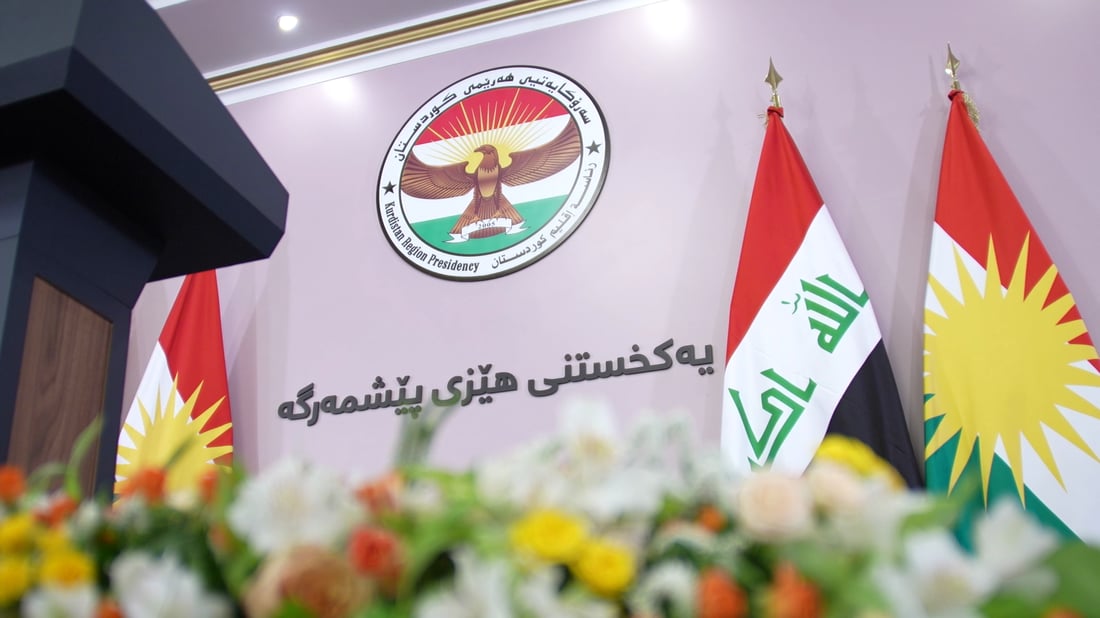
The Kurdistan Region Presidency emblem and the Iraqi and Kurdistan flags are displayed at a ceremony marking the formal unification of the Peshmerga forces.
Kurdistan formally declares Peshmerga unified with two commands under ministry orders
ERBIL — Kurdistan Region leaders formally declared the unification of the Peshmerga complete on Monday, bringing forces historically split between the Kurdistan Democratic Party and the Patriotic Union of Kurdistan under a single Ministry of Peshmerga Affairs command.
They are organised into two area commands that cover the same territory the two party forces did.
“Peshmerga is not a party force, but a Kurdistan force and belongs to no party,” said Kurdistan Region President Nechirvan Barzani, the Peshmerga’s commander-in-chief. “With this step, no force will remain outside the administration of the Ministry of Peshmerga Affairs.” The ceremony was attended by Prime Minister Masrour Barzani, Deputy Prime Minister Qubad Talabani, Peshmerga Minister Shoresh Ismail and Lt. Gen. Abdul Amir al-Shammari, who directs the office of Iraq’s federal commander-in-chief.
The unified force comprises 11 divisions, two support forces, a commando command and two area commands, replacing Unit 80, associated with the KDP, and Unit 70, associated with the PUK. Area Command One covers Erbil and Duhok with six divisions, 18 brigades and 54 regiments. Area Command Two covers Sulaymaniyah and Halabja with five divisions, 15 brigades and 45 regiments. The division follows the same line as before — Erbil and Duhok were the KDP force’s territory, Sulaymaniyah and Halabja the PUK’s. Though both commands now answer to the ministry.
“We announce to the whole world that the process of unifying the Peshmerga forces has come to an end and that we have recorded a historic achievement,” Ismail said, saying the forces would operate under “one military decision and one command.” The ministry had said earlier this month that the transfer of the two forces was complete; Monday’s ceremony was the formal announcement.
Nechirvan Barzani said transferring the units did not finish the reform and that the next stage could be harder. “Kurdistan needs one force, one ministry and one command,” he said, calling for unity to show in command, orders, training, organisation, promotions, doctrine and discipline, and for the force to stay out of party competition. Addressing the Peshmerga directly: “From today onward, when you wear the Peshmerga uniform, you are the Peshmerga of Kurdistan.”
Masrour Barzani called it “a historic day,” fulfilling a central commitment of his cabinet’s programme, and said the next phase should focus on equipping the force and coordinating with the Iraqi army. Both leaders described the Peshmerga as part of Iraq’s federal defence system. Nechirvan Barzani called on Baghdad to meet its constitutional and legal obligations on financial entitlements and military requirements, and Masrour Barzani said Peshmerga salaries and rights should be treated on the same basis as the Iraqi army’s. Nechirvan Barzani said the force should protect all communities in the Region, including Kurds, Turkmen, Christians, Yazidis and Arabs.
The effort has run for more than a decade. About 42,000 personnel from the two blocs were moved into 14 joint brigades between 2010 and 2013, before political disputes, the Islamic State offensive of 2014 and the upheaval of October 2017 slowed it. The KRG dates the wider reform to 2016, and a 35-point programme was developed with the U.S.-led coalition in 2018. Nechirvan Barzani said in June that the process was not progressing as required.
Coalition partners including the United States, Britain, Germany, the Netherlands, Italy and France have backed the reform with training and advice. The United States and the KRG renewed their memorandum on Peshmerga reform on Sept. 21, 2022, four years to the day before Monday’s ceremony, tying support to professionalising the force and bringing partisan units under ministry control. The ministry said in May that the financial and logistical support attached to it would run through September 2026, with a new arrangement to be negotiated, and the coalition mission in Iraq ends on Sept. 30.