
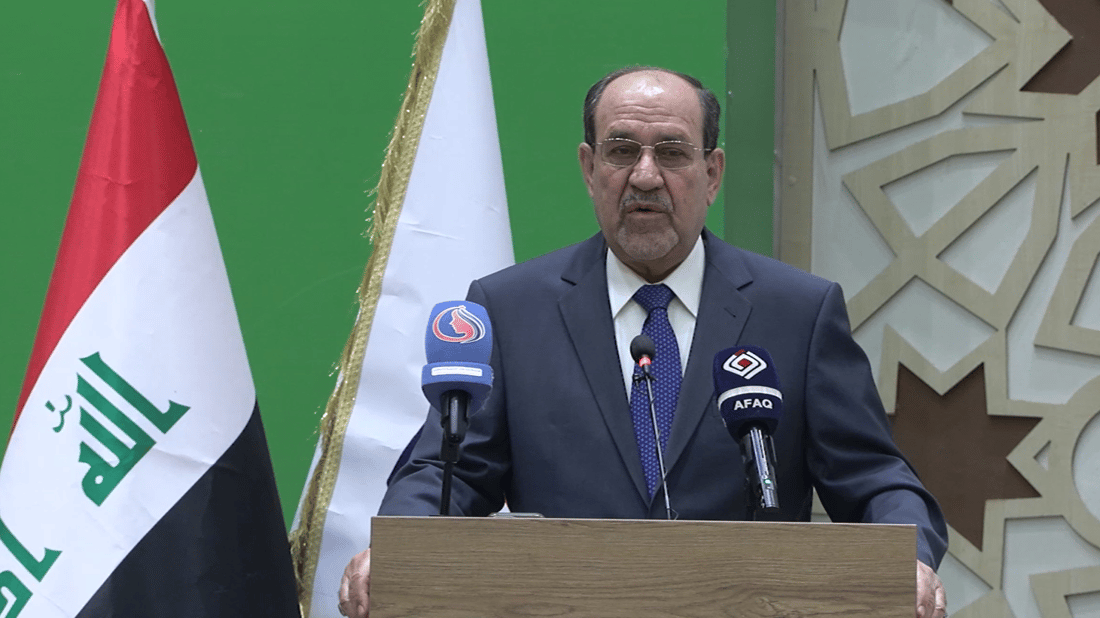
Former PM Nouri Al-Maliki, head of the State of Law Coalition
Iraqi Shia parties reject Trump ‘interference’ over Maliki return as premier
BAGHDAD – Several Iraqi Shia political parties and figures issued statements on Wednesday rejecting U.S. ‘interference’ in Iraq’s internal affairs following comments by U.S. President Donald Trump warning against the potential return of Nouri al-Maliki as prime minister.
Trump wrote Tuesday on Truth Social, “I’m hearing that the Great Country of Iraq might make a very bad choice by reinstalling Nouri al-Maliki as Prime Minister. Last time Maliki was in power, the Country descended into poverty and total chaos. That should not be allowed to happen again. Because of his insane policies and ideologies, if elected, the United States of America will no longer help Iraq and, if we are not there to help, Iraq has ZERO chance of Success, Prosperity, or Freedom. MAKE IRAQ GREAT AGAIN!”
In response, Asaib Ahl al-Haq, led by Qais al-Khazali, issued a statement declaring, “In defense of the sovereignty of our beloved Iraq and to preserve constitutional entitlements that express the will of the Iraqi people, we announce our rejection of attempts to interfere in our internal affairs and influence the peaceful transfer of power.”
“We do not accept external dictates and affirm that Iraqis are capable of identifying their interests, choosing their options, and nominating whomever they see as capable of managing the Iraqi state and protecting the rights of all Iraqis,” the group added.
Asaib reiterated its support for the Coordination Framework, which has officially nominated Maliki for the position, saying the choice “guarantees the unity of the country, safeguards sovereignty, and ensures security and prosperity for Iraq and its people,” and called on all political forces to “unify the national decision and prioritize the national interest.”
Abu Turab al-Tamimi, a leader in the Popular Mobilization Forces and the Badr Organization, said, “No honorable politician or Iraqi can accept American interference, especially from Trump, who is responsible for killing the ‘leaders of victory.’”
He added that anyone who yields to Trump is “complicit in their deaths” and said the United States bears responsibility for Iraq’s and the region’s current state, adding that “Iraq needs a strong prime minister like Maliki. Anyone who wants a weak one does so for partisan and personal interests.”
Earlier in the day, Nouri al-Maliki rejected what he described as U.S. interference in Iraq’s internal affairs. “We categorically reject blatant American interference in Iraq’s internal affairs, and consider it a violation of its sovereignty and contrary to the democratic system in Iraq after 2003,” Maliki said in a statement. He added that it was also “an infringement on the decision of the Coordination Framework to choose its nominee for the post of prime minister.”
In a separate statement, the Al-Nasr Coalition, led by former Prime Minister Haider al-Abadi, called on national forces to “prioritize public interest, strengthen stability, and address the crisis with rationality and responsibility, in line with the magnitude of challenges facing the country and people.”
“We affirm our commitment to the Iraqi national decision that ensures the country’s and citizens’ interests,” the coalition said.
Maliki served two terms as prime minister from 2006 to 2014. His second term was marked by political tensions and protests in several Sunni-majority governorates over arrests, de-Baathification measures and the application of anti-terrorism laws, followed by security crackdowns. He stepped down in 2014 after Iraqi army positions collapsed and the Islamic State group seized Mosul.
Meanwhile, the Huqooq Movement, the political wing of Kataib Hezbollah armed group, reaffirmed its support for nominating Maliki.
In a statement, the movement said, “What was issued by U.S. President Donald Trump — in terms of comments and indications that affect the Iraqi people’s right to choose their prime minister away from dictates and pressures — not only reveals the true face of American policy when it clashes with the will of nations but also confirms that slogans of democracy and people’s rights are used selectively, not as fixed principles.”