
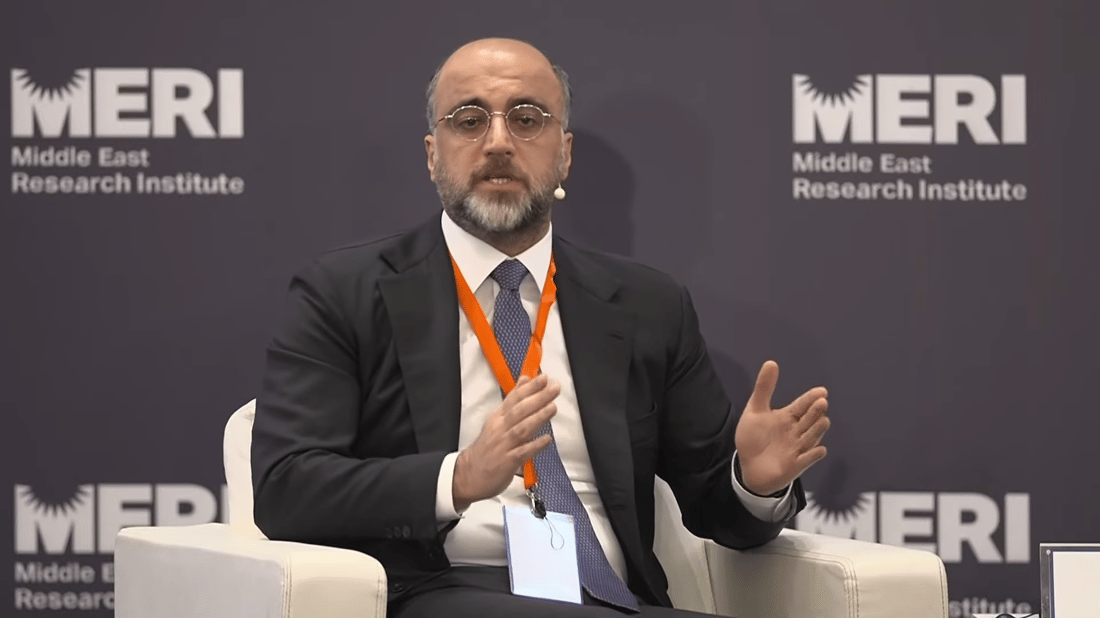
Aziz Ahmad, deputy chief of staff to Kurdistan Region Prime Minister Masrour Barzani, speaks about electricity management and the Runaki project during the MERI Forum in Erbil.
MERI 2026
KRG’s Aziz Ahmad on Runaki and Iraq’s power crisis
Aziz Ahmad, deputy chief of staff to Kurdistan Region Prime Minister Masrour Barzani, told the Middle East Research Institute Forum in Erbil that Iraq’s chronic electricity shortages stem mainly from poor management rather than a lack of generating capacity, and that Baghdad could learn from the Kurdistan Region’s Runaki program, which he said has cut consumption by more than half while delivering round-the-clock power.
Launched in October 2024 to provide continuous grid power and gradually replace private neighborhood generators, Runaki had connected about 4 million residents and more than 115,000 businesses by February 2026, according to the KRG Electricity Ministry.
Iraq’s Electricity Ministry put actual generation at 24,700 megawatts in September, against estimated peak summer demand of 55,000 to 60,000.
The following are excerpts from his remarks:
Running the Kurdistan Region’s electricity sector costs about $2.5 billion a year, more than $200 million a month. Most of that goes on four items, led by fuel and power generation.
Before we launched Runaki, electricity revenue was no more than $20 million a month, just 10% of operating costs. Today it has risen to nearly $80 million a month, but 20% of that goes straight to the treasury to cover salaries, which leaves us a net $60 million to meet costs of more than $200 million a month.
In the past, 60% of homes and businesses in the Region never received an electricity bill, and of the 40% that did, we managed to collect only 30% of what they owed. Our goal with Runaki now is to become self-sufficient and match revenue to spending within a year or two.
We have hundreds of factories and industrial projects, large and small, that have been waiting four or five years to be connected to the public grid, while demand for electricity in the Region is growing by 5% a year. Our priority is to get power to those projects so they become new customers who pay their bills regularly.
Installed generating capacity in the Region is more than 8,000 megawatts, while peak demand is no more than 4,500. We never needed those extra 4,000 megawatts at all, and the investment in them has saddled the regional government with billions of dollars in debts and obligations that more careful planning could have avoided.
When we announced Runaki, we were told our analysis was unrealistic and that we would never manage 24-hour power because demand was too high. But actual consumption in the Region has now fallen by more than half, and electricity is available around the clock without interruption.
Iraq’s actual output today is more than 35,000 megawatts. That is enough for every governorate, and more than enough when you compare it with the Kurdistan Region’s model. Instead of learning from our experience, Baghdad has announced it wants to double generation to 70,000 megawatts, enough for two countries the size of Iraq. That shows the crisis there is one of mindset and approach, not generating capacity.
What made the project possible in the Region was that there were only 7,000 neighborhood generators, owned by fewer than 1,000 people, so negotiating with them was straightforward. The rest of Iraq has more than 30,000 generators, most of them tied to political parties and factions. Even so, the model can work there if the federal government starts gradually, with a single district or subdistrict.
Private generator owners are currently working as standby under contracts of six to 18 months. Once Runaki covers all of Kurdistan, the real way to put their capacity and know-how to use is to move them into solar energy projects.
We have to be completely frank with people. In the past, we covered the cost of electricity and its deficit from oil export revenue and domestic sales. Now that we have lost that revenue, we can no longer keep up the kind of unrealistic subsidies the federal government in Baghdad applies.
The roughly 1,000 megawatts we export to central and southern Iraq does not bring a single dinar into the Region’s treasury. The money goes entirely and directly to the three generating companies to cover part of their plants’ costs, which come to $120 million a month and which the government cannot pay in cash.
The regional government owes the power generation companies more than $10 billion in arrears built up over past years, and last year we could pay only 70% of what we owed them. We need to sit down with them and agree a new, realistic financial model.