
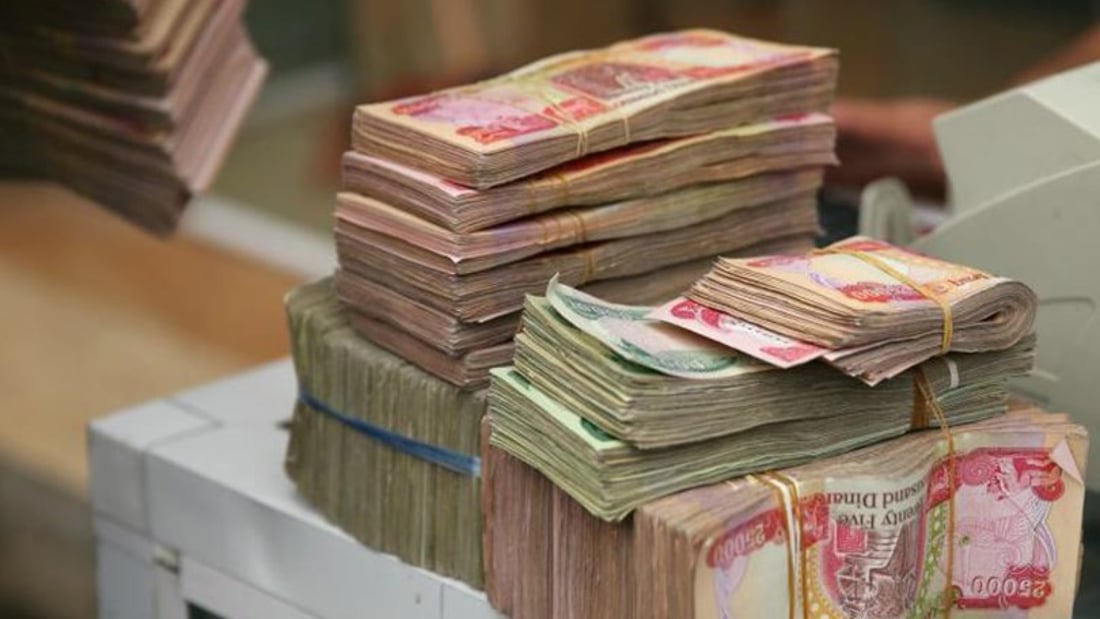
Stacks of Iraqi dinars are seen at a money exchange office
Treasury holds 1 trillion dinars against a monthly salary bill of 8 trillion, MP says
BAGHDAD — Iraq may be unable to finance public-sector salaries beyond the next two months, with the treasury holding only 1 trillion dinars against a monthly bill of 8 trillion to 10 trillion, a member of parliament’s Security and Defense Committee said the finance minister told lawmakers.
Mahmoud Faleh al-Sayed told Dijlah TV that Finance Minister Faleh Sari gave those figures. The Finance Ministry has not confirmed the remarks. On the figures as reported, the treasury holds roughly a tenth of a single month’s salaries, and covering two more months would require 16 trillion to 20 trillion dinars from revenue or borrowing.
Sayed said Iraq’s situation was worse than during the sectarian violence of 2005 and 2007 or the Islamic State group’s 2014 offensive, describing simultaneous political, financial, security and border crises.
Sari formally asked parliament on Monday to hear him at its earliest session on the financial situation and the measures being taken to meet the state’s obligations, saying the request reflected “the ministry’s commitment to providing the people’s representatives with an accurate picture.”
July salaries were paid late. The ministry began funding them on July 28 and released payments in stages, first to security personnel and Popular Mobilization Forces members and later to civilian institutions. Some permanent Education Ministry employees in Basra did not receive theirs until early August.
A government source close to the discussions told 964media that officials are weighing several difficult options after federal Iraq’s first significantly delayed salary payments since the fall of Saddam Hussein’s regime. They include paying salaries every 40 days rather than monthly, and paying lower-paid workers before senior officials, special-grade employees, lawmakers, presidential palace staff and university professors. Political discussions have also touched on selling about 1,000 palaces and properties formerly associated with Saddam, the source said.
The property sale has already drawn objections. Jamal Kocher, a member of parliament’s Finance Committee, said state real estate would raise no more than 7 trillion dinars, less than a single month of salaries at the rates Sari is reported to have given, and called selling assets during a crisis “very dangerous” because property could go below its real value. He argued the government should pursue corruption cases and recover stolen public funds instead. Mudher Mohammed Saleh, the prime minister’s financial adviser, has separately warned against relying on any single option to manage the deficit.
The government confirmed last week that Iraq is in a financial crisis and that salaries would no longer follow their previous schedule, spokesperson Haider al-Aboudi said. Oil Ministry figures show Iraq earned about $2.34 billion from 32.1 million barrels of crude and condensates in May and June, roughly $1.17 billion a month, after shipping through the Strait of Hormuz was disrupted. Oil normally provides more than 90% of federal revenue.
Estimates of the monthly salary bill differ widely. Health Minister Abdul Hussein al-Mousawi has put it at 10.8 trillion dinars, Jamal Kocher of parliament’s Finance Committee at 7.8 trillion and analyst Mustafa Hantoush at 7.5 trillion to 8 trillion, while Finance Ministry accounts for the first four months of the year show civil servant wages running at about 5 trillion dinars a month. Kocher has called for the Central Bank to create more money, Hantoush for a 10 trillion dinar borrowing law, and the prime minister’s adviser Mudher Mohammed Saleh for spending controls and stronger non-oil revenue collection.