
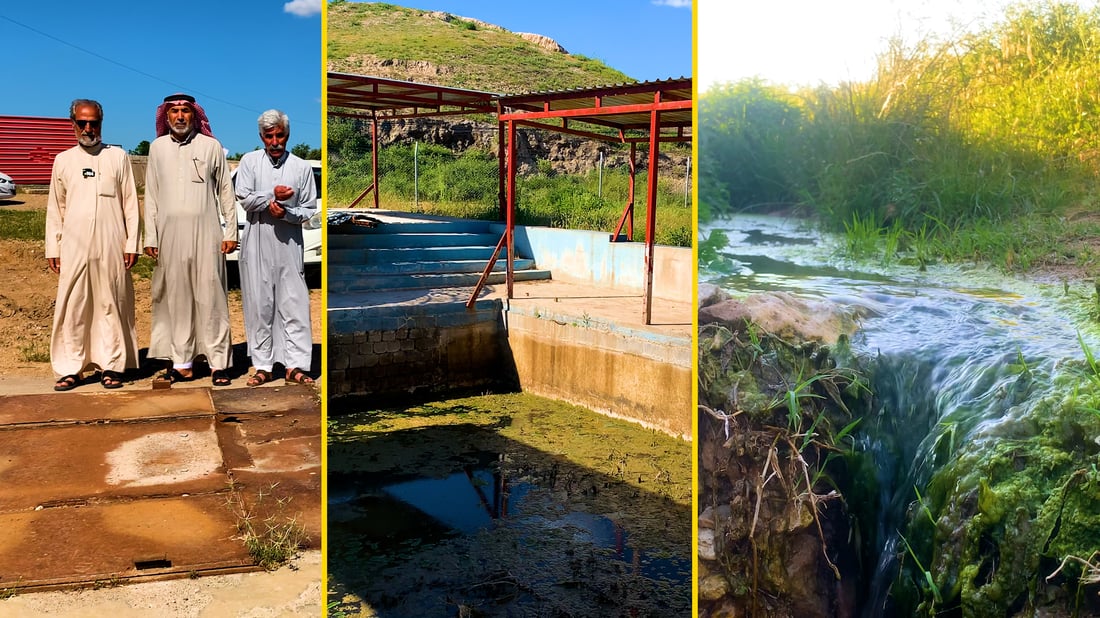
Residents stand beside a historic spring in Zummar, where locals say only four of the area’s eight traditional water sources remain active. Photo by 964media.
Nineveh
Half of Zummar’s historic springs dry up as residents warn of lost heritage
NINEVEH — Residents of Zummar, west of Mosul on the desert road toward the Syrian border, say years of neglect have left only four of the area’s eight historic natural springs still functioning, raising fears that the decline will erase part of the region’s history.
Locals describe the springs as landmarks tied to centuries of social life in the area, used for drinking water, irrigation and livestock. Despite a wetter-than-usual season across Iraq and the Kurdistan Region that helped replenish water resources after years of drought, residents say Zummar’s springs continue to face declining flows and neglect.
Retired engineer Hajj Othman Ahmed told 964media that of the original springs, Ain Al-Jahishiya dried up years ago, Ain Qasrij stopped flowing nearly 100 years ago, and Ain Hakna’s water declined sharply in 2010 and remains weak. Only Ain Tal Mous, Ain Mifri, Ain Hakna and Ain Halwa remain active, though Ain Halwa has been reduced to a well.
Ahmed said Ain Tal Mous, originally called Al-Hartha, predates the village itself and dates back more than 350 years. Its water flows from Tal Mous village through Mifri village until it reaches Asky Mosul and empties into the Tigris River. In 2006 he requested geologists from the University of Mosul to examine the spring’s source. “They brought a 25-meter sonar device and could not find the end of its depth,” he said.
A 100 million dinar project to pave and excavate the site was allocated but never implemented due to security conditions.
“We demand that the relevant authorities pay attention to these springs because many residents depend on them for orchards. We have grown fig, pomegranate and grape trees since the 1950s thanks to them,” he said.
Abdul Aziz al-Asaad, an engineer from Ain Halwa village, said the spring that gave the village its name was once strong enough to supply nine surrounding villages. “Its history goes back more than 150 years, and its water was used for drinking and cooking because of its sweetness,” he said. Its flow declined more than a century ago and it went out of service after a water supply project was implemented in 1984.
Fathi Hassan, a resident of Mifri village, said that spring is more than 250 years old and has nearly dried up over the past two years. “The village benefited from its water for irrigating orchards and watering livestock,” he said. Maintenance work was carried out five years ago, but the decline has continued.
Khaled Hamed, a resident of Ain Habash village, said its spring, located 14 kilometers northeast of Zummar, continues to flow despite falling water levels. “It was neglected after the village was abandoned,” he said, noting the spring is more than 150 years old and flows toward Domiz village before reaching the Tigris. Fahd Ghazi, another Zummar resident, said Ain Al-Tin spring near Ain Zalah village, about 15 kilometers northeast of Zummar, is between 150 and 200 years old and flows into Wadi al-Shour.