
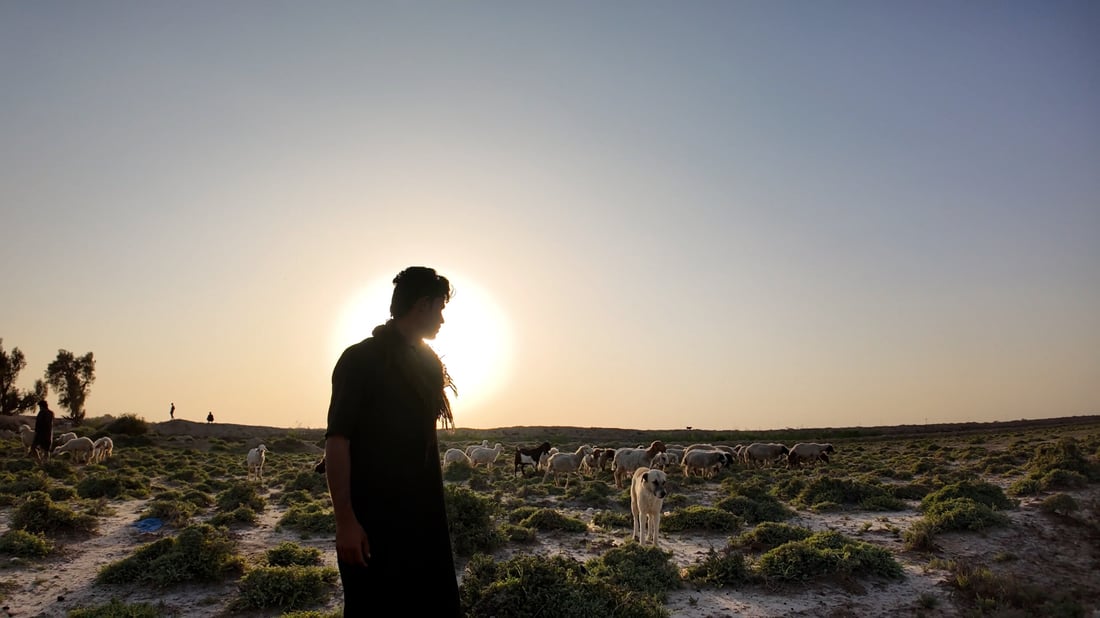
A shepherd stands beside his flock at sunset in the Al-Harraqa area near Qalat Saleh in Maysan governorate, where herders face drought, livestock disease and declining milk production linked to harsh climate conditions. Photo by 964media.
In Maysan, a shepherd watches a way of life shrink under drought
MAYSAN — In the Al-Harraqa area south of Qalat Saleh, shepherd Khudair Badai calls his sheep by name — Barsha, Ashma, Daraa, Asmaa, Gharraa — most chosen according to their colors and markings.
His flock numbers only about 40 animals.
The names reflect a closeness to the animals that defines pastoral life in rural southern Iraq, where livestock breeding remains a primary source of income and daily rhythms are shaped entirely by the needs of the flock. But Badai says years of harsh conditions and drought have changed that life in ways that are difficult to reverse.
“The daily life of a shepherd begins from the early morning hours,” he told 964media. “He eats breakfast and then takes the sheep out to pasture.” Local shepherds use the term “tasreeh” to describe driving sheep out to graze — a practice that follows the seasons. “Sheep depend during winter on agricultural crops, while in summer they depend on dry grass and harvest leftovers,” he said.
The daily routine involves feeding the flock, taking the animals to water and spreading them across open land before returning them home at sunset. Shepherds with nearby grazing land usually return their animals by afternoon. Those with distant pastures leave their flocks overnight under the care of a worker in a practice locally known as “azba.” “That means a person settles in distant land to care for livestock and lives in a simple hut built from reeds,” Badai said.
Diseases have increased this year. Feed now relies heavily on barley and harvest remains.
The most visible sign of changed conditions is milk. Although sheep give birth twice a year, families now leave the milk entirely for newborn lambs. “Milk production is no longer enough for human consumption,” Badai said.