
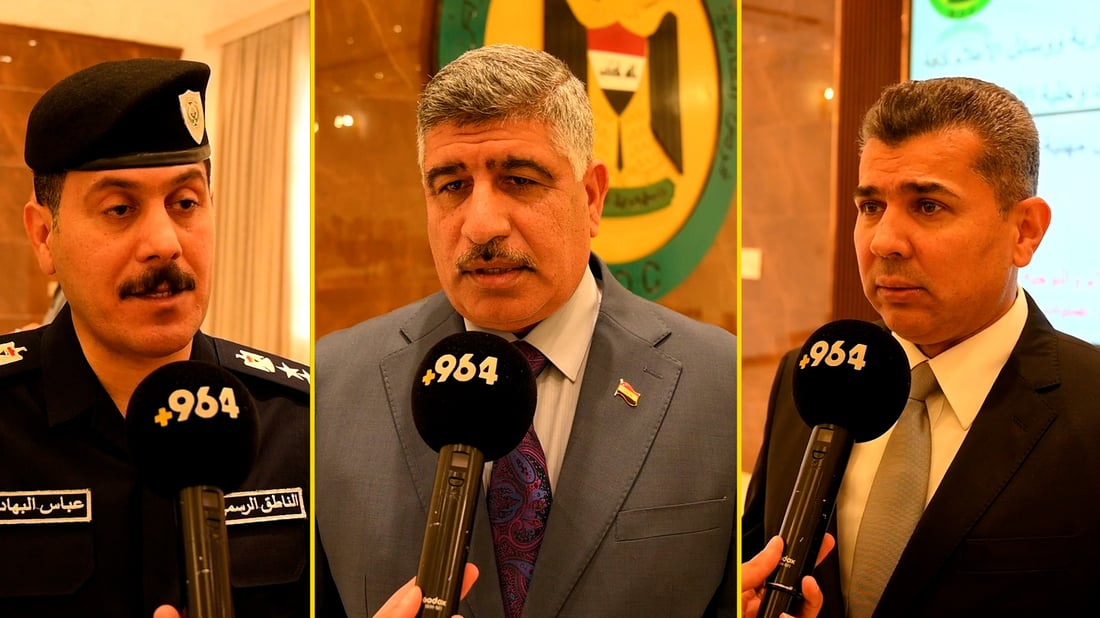
From left: Interior Ministry spokesperson Abbas al-Bahadli, armed forces spokesperson Sabah al-Numan, and Security Media Cell chief Saad Maan speak to 964media in Baghdad.
Iraqi officials stress diplomacy, vows accountability after wave of attacks
BAGHDAD — Iraqi officials said Wednesday the government is prioritizing diplomatic solutions to end the regional war while pursuing those responsible for a wave of attacks on security forces, infrastructure and diplomatic sites that has shown no sign of abating.
“We rely on diplomatic solutions to end this conflict because its impact is very large, not only on the parties to the conflict but on Iraq, the region, the Gulf, and the entire world,” military spokesman Sabah al-Numan told 964media. He said the government rejects attacks on Iraqi forces and facilities and retains its “legal right to pursue those responsible for targeting our security forces.” Prime Minister Sudani has ordered security agencies to pursue those behind recent strikes on oil fields and hotels, al-Numan said, describing them as “terrorist acts” that “embarrass the Iraqi government.”
The remarks come after one of the most intense stretches of the conflict on Iraqi soil. Drone and rocket attacks have repeatedly struck the U.S. Embassy compound in Baghdad’s Green Zone, with fresh strikes Tuesday evening also hitting the Victory Base Complex near Baghdad International Airport and setting off explosions heard across the capital. The Al-Rasheed Hotel — housing the Saudi embassy and the EU Advisory Mission — was struck by a drone Monday night. The UAE Consulate General in Erbil has been hit twice in a week.
Airstrikes widely attributed to the United States and Israel have hit PMF positions across at least seven governorates, killing dozens of fighters.
In the Kurdistan Region, Iran’s IRGC and allied militias have carried out 307 attacks since the war began Feb. 28, killing eight people and wounding 51, according to Community Peacemaker Teams – Iraqi Kurdistan.
Security Media Cell chief Saad Maan sought to counter what he described as misinformation circulating about conditions in the capital, rejecting reports that hotels were refusing foreign guests. “All Iraqi hotels are open to all guests… these hotels are secured,” he said, adding that temporary road closures may occur “to protect citizens from falling foreign objects.”
Interior Ministry spokesperson Col. Abbas al-Bahadli said prison security has been reinforced through engineering, logistical and personnel measures. “There is nothing to cause concern… security is stable and the situation inside correctional facilities is good,” he said. The assurances follow days of heightened concern over facilities near recent strike zones — the Justice Ministry warned earlier this week that six strikes in a single day had landed close to Karkh Central Prison near Baghdad airport, cautioning that the facility holds inmates described as “highly dangerous terrorists.”
The Supreme Judicial Council also convened a high-level meeting of judicial and security officials Tuesday to review protection measures for prisons holding Islamic State detainees transferred from Syria, with Iraq currently holding more than 5,700 such detainees representing more than 60 nationalities.
Iraq’s government has issued repeated condemnations and pledges to pursue attackers since the conflict began. The strikes on diplomatic missions, military sites and energy infrastructure have continued regardless.