
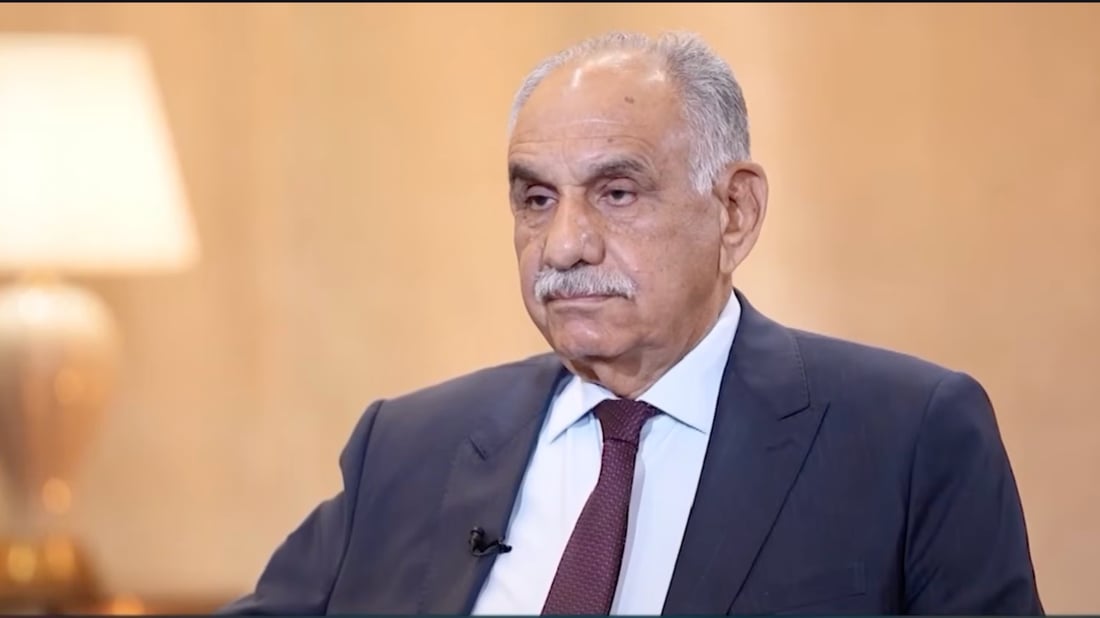
Saleh al-Mutlaq, former deputy prime minister, appears during a televised interview discussing political developments and government formation efforts.
Media Monitor
Mutlaq: Coordination Framework in ‘greatest predicament’ after Trump tweet
BAGHDAD — Former Deputy Prime Minister Saleh al-Mutlaq said the Shiite Coordination Framework became politically entangled after President Donald Trump’s post opposing Nouri al-Maliki’s potential return to office, describing the situation as a “greatest predicament.”
Speaking in an interview on Al-Sharqiya TV, Mutlaq said the Coordination Framework had initially wanted the next prime minister to function as a ‘director general’ — an administrator rather than a political leader.
When it sought consensus between Mohammed Shia al-Sudani and Maliki, “they expected neither would concede to the other, but they were surprised when Sudani stepped aside.”
He said their calculations became complicated and they resorted to conditioning the choice on the opinion of the religious authority and international acceptance.
“As for Trump’s tweet, it was the most difficult,” Mutlaq said. “Mr. Maliki cannot withdraw now in order to preserve his political standing, and the Framework cannot withdraw his nomination under pressure from the tweet. That is the greatest predicament.”
He added that while Maliki “may be more capable than others of limiting the weapons of armed factions,” the core challenge lies in the U.S. position, which now rejects “any figure with ties or alignment with Iran.” He noted that “this principle applies to everyone and is not limited to Maliki alone.”
Mutlaq said “true democracy requires that presidencies and positions go to qualified individuals, not according to prevailing political customs,” but added that “democracy suffered a complete setback in 2010” when the Iraqiya list was prevented from forming a government despite winning the most seats.
He said the rejection was “distinctly Iranian,” claiming Tehran told the Iraqiya delegation at the time that their cross-sectarian project was a “red line” and that Iraq must remain divided into Shiites, Sunnis and Kurds.
On armed groups, Mutlaq said “no country can succeed in the presence of influential militias,” adding: “The time has come for the decision to dismantle militias to be Iraqi before it is imposed from abroad.”
The Coordination Framework nominated Maliki following the 2025 elections. Trump has warned that Washington could halt support for Iraq if Maliki returns to office.
Excerpts from Saleh al-Mutlaq’s interview on Al-Sharqiya TV:
The Coordination Framework wanted the next prime minister to function as a “director general.” When they pushed toward consensus between Sudani and Maliki, they expected neither would concede to the other, but they were surprised when Sudani stepped aside. Their calculations became complicated, and they then resorted to conditioning the choice on the opinion of the religious authority and international acceptance, as though they had become entangled in that step.
As for Trump’s tweet, it was the most difficult. Mr. Maliki cannot withdraw now in order to preserve his political standing, and the Framework cannot withdraw his nomination under pressure from the tweet. That is the greatest predicament. Although Maliki may be more capable than others of limiting the weapons of armed factions, the real obstacle lies in the U.S. position, which has come to reject any figure with ties or alignment with Iran. This principle applies to everyone and is not limited to Maliki alone.
True democracy requires that presidencies and positions go to qualified individuals, not according to prevailing political customs. But democracy suffered a complete setback in 2010, when the principle of the “largest winner” was violated and the Iraqiya list was prevented from forming the government despite being a national, cross-sectarian project. The rejection was distinctly Iranian; Tehran informed the Iraqiya delegation at the time that their project was a “red line” and that Iraq must remain divided into Shiites, Sunnis and Kurds. A legal justification was later found through the Federal Supreme Court. Even the United States at the time sided with Iran because its interests required it, as negotiations were underway regarding nuclear weapons.
The current political entrenchments and the formation of “frameworks” will ultimately lead to the country’s division. Shiite politicians bear responsibility for this approach, which feeds on sectarian mobilization to ensure they remain in power.
These blocs seek to build authority, not a state, and they use political money and the electoral system to sideline civilians. Regarding weapons, no country can succeed in the presence of influential militias. I support a single army; whoever wishes to defend the nation should join the regular armed forces, and whoever wants otherwise should seek civilian employment away from weapons. The time has come for the decision to dismantle militias to be Iraqi before it is imposed from abroad.