
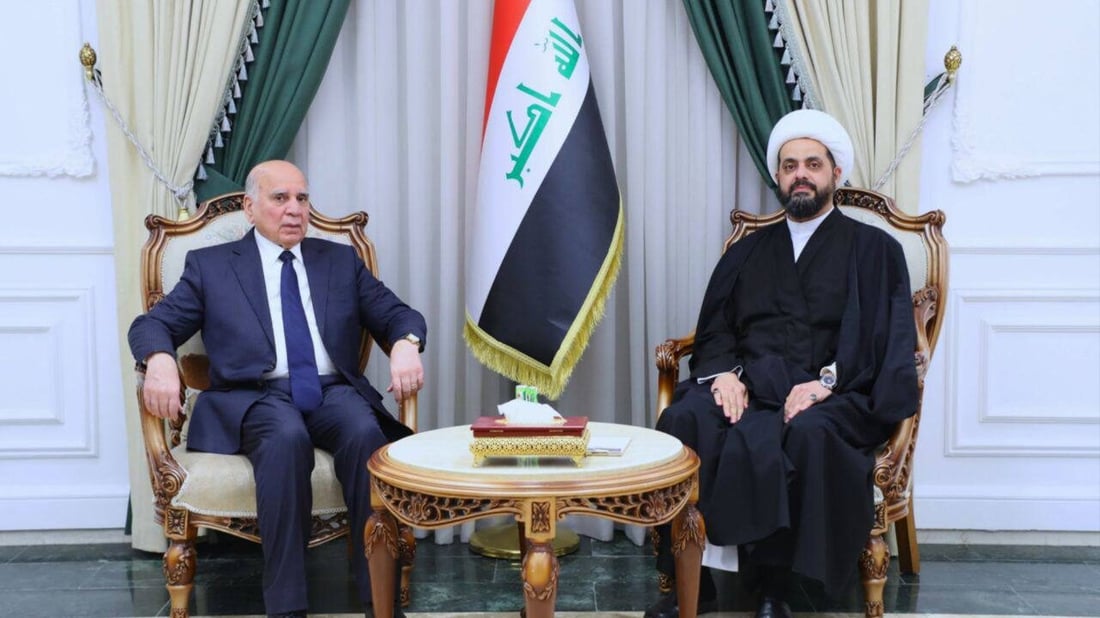
(Photo: Al-Khazali’s media office)
Khazali: ‘Coordination Framework supports any consensus’ on presidential post
BAGHDAD — Asaib Ahl al-Haq Secretary-General Qais al-Khazali said Wednesday that the Coordination Framework supports any agreement reached between Kurdish parties on the presidency.
According to a statement from al-Khazali’s media office, al-Khazali received Foreign Minister and presidential candidate Fuad Hussein at his office in Baghdad.
They addressed the file of the presidency, emphasizing “the necessity of achieving consensus among the Kurdish political forces regarding the selection of the president of the republic, in a manner that contributes to supporting political stability and moving forward with completing constitutional entitlements.”
Al-Khazali said, “The Coordination Framework supports any consensus reached between the Kurdish brothers regarding this entitlement,” and affirmed the bloc’s commitment to “consolidating the principle of national partnership and ensuring the participation of all components in managing the state in accordance with constitutional frameworks.”
Iraq’s government formation has stalled since the Nov. 11 elections. Parliament must first elect a president, who then tasks a nominee with forming a cabinet. A scheduled session to elect the president was postponed without a new date, extending the impasse.
Under Iraq’s post-2003 power-sharing framework, the presidency is customarily held by a Kurdish politician, the prime ministership by a Shiite Arab and the speakership by a Sunni Arab.
The Kurdistan Democratic Party and the Patriotic Union of Kurdistan have not reached consensus on a candidate. The presidency has been held since 2003 by figures linked to the PUK, including Jalal Talabani, Fuad Masum, Barham Salih and current President Abdul Latif Rashid. The PUK has named Nizar Amedi as its candidate, while KDP has named Fuad Hussein.
The Shiite Coordination Framework has nominated former Prime Minister Nouri al-Maliki, who served from 2006 to 2014, drawing criticism domestically and from President Donald Trump, who said the United States would not continue support for Iraq if al-Maliki returned to office.